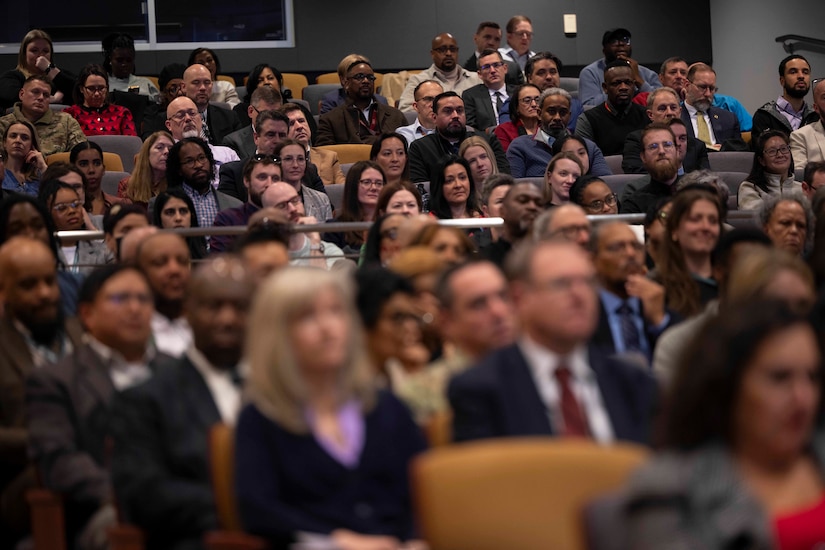
The Pentagon's newest chief information officer, Kirsten Davies, gathered her department's senior leaders and staff together at the War Department's Mark Center in Alexandria, Virginia, Feb. 10, where she laid out a vision for her office that focuses strongly on supporting America's warfighters.
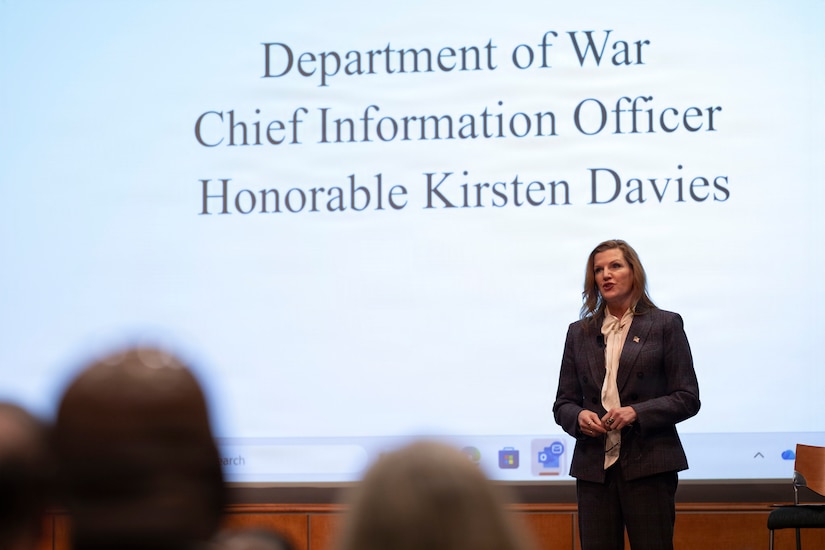
"Our mission is to support the National Defense Strategy … and the warfighters," Davies told those assembled in the Mark Center's auditorium. "Everything we do should be supporting the warfighter community and their mission."
Just six weeks into the job, Davies is responsible for serving as the principal staff assistant and senior advisor to the secretary of war and deputy secretary of war for information technology — including national security systems and defense business systems — information resources management and efficiencies.
This means that Davies is responsible for all matters related to the War Department's information enterprise, including cybersecurity, communications, information systems and more.
With all those responsibilities under her purview, Davies expanded on the Office of the Chief Information Officer's vision statement, "[building] an information enterprise that is resilient, modern, secure and agile; one that is worthy of the warfighter."
"We need ruthless prioritization of all of our initiatives. There are some things we're just simply not going to do because [they don't] serve the warfighter mission," Davies said, adding that she will be seeking her team's help in identifying those initiatives and prioritizing items to pursue immediately, versus what can be pushed further downstream.
Next, she spoke about OCIO visibility and the need to share it across the entire War Department, including the department's military and civilian-manned field activities.
"We can't defend what we can't see, [and] we can't optimize something if we don't know what's there," Davies said. "So, [visibility] becomes a real priority."
Visibility can help OCIO determine if the office's money is being spent appropriately throughout the department and serving the warfighter most effectively, especially as it relates to tactical agility, she added.
Davies also spoke about additional topics not listed in OCIO's vision statement, including accountability.
"If you want to own something, own it. There's accountability that's attached to that," she told the group of leaders.
"We will measure outcomes, not activity," Davies added.
Additionally, she spoke about transforming OCIO's technology landscape in a rapidly evolving information environment.
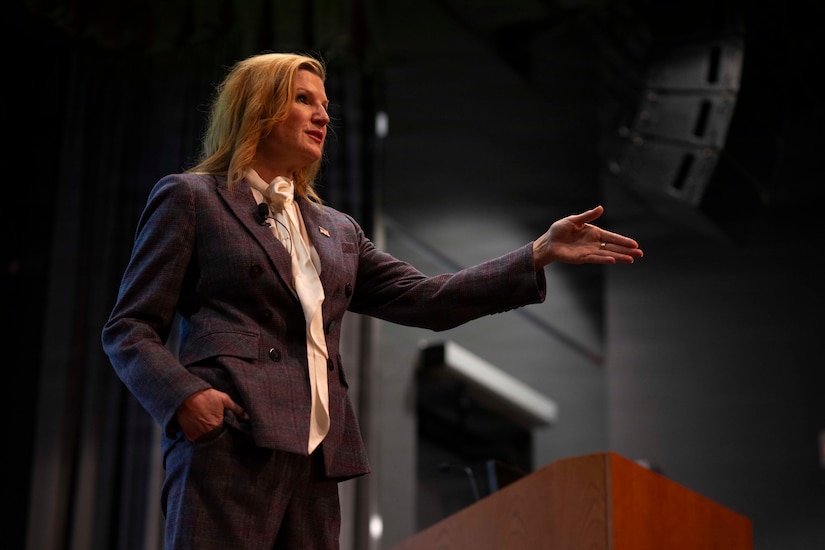
"We need to execute on data analytics and AI. … We need to secure our advantage in the spectrum … This is a long-term play for us, for national security and for our partners and allies," Davies said.
Two topics she would like to prioritize for all OCIO leaders immediately are getting up to speed on the recently published National Defense Strategy and becoming familiar with Secretary of War Pete Hegseth's ongoing Arsenal of Freedom tour.
The tour represents Hegseth's initiative to transform the department's acquisition system and processes to accelerate delivery of capabilities to the warfighter and revitalize America's manufacturing might.
"Our mission is to support the warfighter," Davies reiterated.
"You've heard [the secretary] talk about us being on a war footing [and] again, we are not a technology company — we are part and parcel of the warfighter's mission," Davies said, adding that it is essential OCIO align with the warfighter in the realm of cybersecurity and cyber defense.
As her remarks wound down, Davies encouraged those in attendance to be bold while participating in OCIO's journey from that point forward.
"Change requires boldness; it requires courage," she said. "We have a window of opportunity to do some really interesting, exciting, transformative work. I want you to embrace the opportunity and also know that I've got your back."


 Posts
Posts


No comments:
Post a Comment