Thursday, September 14, 2017

Florida Air Guardsmen Assist Elderly at Florida Shelters


By Air Force Master Sgt. William Buchanan, Florida Air National Guard

PALM COAST, Fla., Sept. 14, 2017 — When disaster strikes, first responders jump into action at a moment's notice. When Hurricane Irma sent hundreds of civilians into special-needs shelters here, moments weren't long enough.

"We had 15 [team members] and we needed 30," said Air Force Tech. Sgt. Shawnna Landeros, a respiratory therapist with the Florida Air National Guard’s 125th Medical Group.

"I started looking for other people that were medical and grabbing them to find 15 more," Landeros added.

Elderly civilians with heart transplants, feeding tubes and strokes continued to pour into the shelter. Every second counted.

"Within five minutes of me reporting in, Tech. Sgt. Landeros grabs me and says: ‘This is what we are doing, and they tell us that we are going out to Flagler to a special-needs shelter,’" said Air Force Senior Airman Brooke Summy, a medical technician with the 125th Medical Detachment 1.

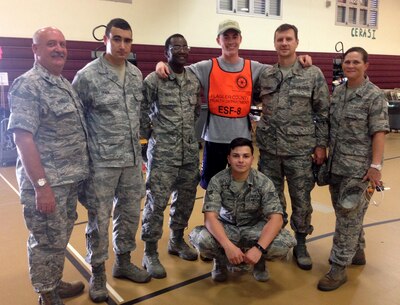
The team that headed to special-needs shelter at Rymfire Elementary School here in Flagler County, with luck, had seven airmen from the medical field, Summy said. The team assisted first responders, caring for the 502 Floridians sheltered there.

‘The National Guard is Here!’

"When we arrived, one woman yelled, 'The National Guard is here! The National Guard is here!'" Summy recalled.

Several shelter occupants were dependent on oxygen, Landeros said. Even though Rymfire Elementary School had backup generators, Landeros knew that she needed a plan if the power went out.

"We identified where our oxygen tanks were and we realized that we had to get others that were at another location," she said.

Guests of the shelter not only had critical medical needs, some required assistance just for the basics.

"Every 15 minutes, we were lifting patients out and taking them to the restroom,” Air Force Senior Airman Nelson Rolle said. “We were doing that all night, from 10 p.m. to 6 a.m."

Little Rest

While most of the airmen found at least a few hours to sleep, one medical officer, Air Force Maj. Andrew Kurklinsky, a medical provider with the 125th Medical Detachment 1, sacrificed rest in favor of solidifying a sustainable special-needs shelter. He took it upon himself to evaluate the needs of the shelter and come up with a solution to providing proper care of the Floridians as they rode out Hurricane Irma. The solution: run the shelter like a hospital.

"The key to the group was Major Kurklinsky," said Air Force Lt. Col. Matthew Sands, chief of dental service, 125th Group Medical Unit. "He was able to go in and make the assessments, such as, what was the need? What was the layout, and what type of patients?"

The first step for these guardsmen was to setup a process the volunteers could maintain if or when they were needed elsewhere.

"Major Kurklinsky came in and basically produced the infrastructure and we implemented it," Rolle said. "He was the director and we were the actors. We went in with a mindset of a mission, even though we were volunteers."

Helping People in Need

Although airmen train for these kinds of emergencies, the wind and rain pounding on the shelter walls provided real-world experience that only strengthened their skills.The Florida guardsmen worked long days in response to the destruction Hurricane Irma left behind. The airmen working in this special-needs shelter were no different.Medical expertise wasn’t the only skill Kurklinsky brought to the special-needs shelter that night.

"There was Russian mother from New York with a 6-month-old baby that had come on vacation and got caught in the storm," Sands said. "She had a hard time communicating because she spoke Russian. Major Kurklinsky speaks Russian, and he was able to communicate with her and get her some help."

"We asked for this mission, because I knew that this was going to be a need," Kurklinsky said. "My priority was to set up a system that was functional, successful and enduring. You have to run it like a hospital."

With the team giving Kurklinsky a lot of credit, he gives the credit back to all the volunteers involved.

"Everyone went beyond and everyone went out of their comforts of their particular jobs," Kurklinsky said. "I appreciate the reflections of my team for my leadership, but I couldn't have been successful without my team, their enthusiasm or dedication."

Dedicated Air Defense Soldiers Keep Watch on Korean Peninsula


By Army Staff Sgt. Monik Phan 35th Air Defense Artillery Brigade

OSAN AIR BASE, South Korea, Sept. 14, 2017 — More than four stories below the entrance of 35th Air Defense Artillery Brigade headquarters here, teams of soldiers provide around-the-clock, real-time surveillance of the tactical ballistic missile threat on the Korean Peninsula.

Despite their moniker that conjures thoughts of the fantasy role-playing game Dungeons and Dragons, these soldiers fully understand their real-world mission, and the vital role they play. The Dungeon Dragons of the Dragon Brigade are essential in monitoring, receiving and disseminating information to ensure U.S. ballistic missile defense is ready to fight tonight.

The Fire Direction Center, in concert with the soldiers that work in the Air Defense Artillery Fire Control Officer office, are not like other staff sections. There is a bond among the group that resembles a football team playing deep into the playoffs -- they are a close bunch. Their closeness is forged in long hours, lost weekends and a clear understanding of the impact they have on the millions of people that call South Korea home.

Fight Tonight

From the most southern point in South Korea to the 38th parallel, the 8th Army mantra of fight tonight reverberates throughout every unit.

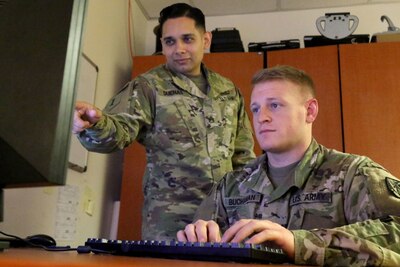
“The primary mission of the FDC and the ADAFCO is to provide situational awareness to our brigade commander on the Korean Peninsula,” said Army Staff Sgt. Raul Duenas, an air defense battle management system operator with Headquarters and Headquarters Battery, 35th ADA Brigade.

As an air defense battle management system operator, Duenas works in the FDC and monitors multiple systems that provide a common operating picture of tactical ballistic missiles and air breathing threats. The images are depicted with detailed information to enable his team to submit time-sensitive reports situational awareness if a missile is launched.

“If something were to happen, we would be the first people to know about it,” Duenas said. “We will be the first ones to see it. We will have to quickly react to make the necessary phone calls and disseminate information about the event.”

The FDC and ADAFCO personnel work around the clock to ensure every potential threat is observed. Their systems are always collecting and saving data so they can quickly analyze the information to prepare and consolidate situational reports for the brigade command team.

“Our job is to monitor the [radar] screens to see the first signs of any threat,” said Army Spc. Ryan Buchanan, an Air Defense Enhanced Early Warning Operator from Headquarters and Headquarters Battery, 35th ADA Brigade. Buchanan is among the soldiers who are under Duenas’ supervision.

The brigade’s monitoring systems are capable of identifying the type of missile launched  through the use of advanced radar technology, said Army Spc. Christopher Lee, an air defense battle management system operator from HHB, 35th ADA Brigade.

Due to the North Korean threat, the brigade is always conducting training to keep their units prepared, said Army Pfc. Dorold Nguyen, a Patriot Fire Control Enhanced Operator/Maintainer with HHB, 35th ADA Brigade. The units are always training to ensure everything is fully missioned capable and batteries are at the directed posture of readiness.

One of the most essential components within the ADA community is the data-link architecture that allows units to communicate with each other while they are geographically dispersed, Nguyen said. Although there are measures in place for units to fight autonomously if needed, the brigade is most effective when communication links are networked.

“We are always testing our communication links between batteries and battalions to make sure they stay running,” Nguyen said. “When everyone passes the information among each other, it helps us fight together.”

Training

The brigade recently completed an internal exercise with their South Korean counterparts here to prepare for the annual peninsula-wide exercise Ulchi Freedom Guardian. The purpose of the training was to ensure the brigade’s operation centers, along with the crews that fight the air battles during UFG, are familiar with their systems and processes.

One of the biggest benefits of the combined exercise was the ability to conduct training and implement battle drills through digitized simulations, said Army Staff Sgt. Jordan R. Hobbs, an air defense battle management system operator with HHB, 35th ADA Brigade.

The brigade’s combined exercise reinforced the leadership’s emphasis of enhancing interoperability. And, the more that units work together in a training capacity, the better prepared they will be for real-world events.

Christopher Tarpley, event lead from Missile Defense Agency based out of Colorado Springs, Colorado, explains the ADA exercises in South Korea are simulated scenarios that provide a baseline of understanding of how the South Korean military and its allied forces could defend themselves during an attack, such as a tactical ballistic missile threat from North Korea.

During the exercises, ADA soldiers with the 35th ADA Brigade coordinate with the South Korean air force and army to deconflict airspace amongst each other. They are able to utilize each other’s systems to identify different types of aircrafts and other objects that are visible in the airspace they monitor.

The 35th ADA Brigade continues to implement combined and joint training whenever possible to enhance readiness and leverage capabilities, officials said. At each echelon throughout the brigade, combined and joint operations are planned to improve interoperability. The next large-scale peninsula-wide training exercise is Key Resolve that will occur in the winter of 2018.

Face of Defense: Volunteer Devotes Time to Keep Fellow Airmen Safe


By Air Force Senior Airman Robert Volio 30th Space Wing

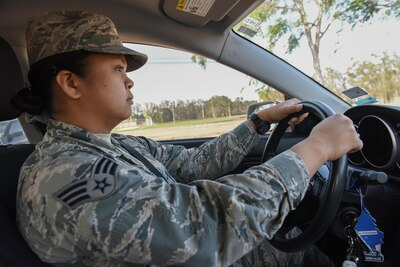
VANDENBERG AIR FORCE BASE, Calif., Sept. 14, 2017 — Air Force Senior Airman Lanimarie Baclian, an Airmen Against Drunk Driving volunteer, is always happy to answer her phone.
AADD

“I've been a volunteer driver since February,” said Baclian, an intelligence, surveillance and reconnaissance target development analyst with the 614th Air Operations Center here. “I recently became an AADD squadron representative in June. I'm the point of contact for my squadron when it comes to AADD events. I recruit volunteers from my squadron, and coordinate my hours with the driving coordinator. I enjoy being part of an organization whose sole function is to look out for and help other people.”

Since she became an AADD volunteer, Baclian has worked 27 shifts for a total of 162 hours. During that time, she has picked up airmen all over the Central Coast and sometimes on base during official functions.

What started as a favor to a friend became a much more important cause.

“I initially started volunteering as a driver because my friend was recruiting volunteers and not a lot of people were volunteering, so I decided to step up,” Baclian said. “However, the more active I was, the more important it became to me. While there are other options airmen can utilize, AADD gives people a safe, reliable, and anonymous option if someone were to find themselves stranded.”

Consequences

Driving while intoxicated can have extreme repercussions, not only on those driving, but for passengers and other drivers on the road.

“Driving under the influence can have a significant impact on other people,” Baclian said. “A person is putting other peoples’ lives at risk when they decide to drink and drive. My mom instilled in me at a young age that when you make that choice and you end up crippling or killing someone, that feeling stays with you forever. No amount of goodwill bring that person back to life. You may think you're fine, but it's not worth your life and someone else's as a result of poor decision-making.”

Getting caught driving under the influence can also end a career.

“Driving under the influence can have severe implications on your career,” Baclian said. “It can cost you your career: a demotion, referral performance report, an Article 15 that will make it difficult for re-enlistment, and a potential criminal conviction.”

Volunteers Needed

AADD is always looking for volunteers, and not just drivers, Air Force Staff Sgt. Isis Land, AADD president said..

“We solicit for five people a night on weekends, holidays and events to be a dispatcher, primary or alternative female driver, and primary or alternative male driver,” said Land, the 30th Medical Group Periodic Health Assessments noncommissioned officer in charge. “To get involved, members can reach out to their squadron reps, our driver coordinators or any of the council members and let us know when they would like to help.”

Through her contributions and involvement with AADD, Baclian has been a consistent wingman for her fellow airmen.

“It's a great feeling,” Baclian said. “I'd drive any one of my friends if they needed it, and this allows me to expand and be a wingman to other people.”

With the potential to save a career or a life, AADD is always just a phone call away. Volunteers like Baclian are always happy to answer that call.

“It has been drilled into our heads at every safety brief to have a plan,” Baclian said. “You should not be ashamed to ask for help. There are people who work every week to drive out and make sure you get home safe.”