Friday, April 10, 2020

First 'Tele-Graduation' Marks Last Iteration of CIO Leader Course


April 10, 2020 | BY C. Todd Lopez , DOD News

As the coronavirus pandemic disrupts everything from church services to basic training, the latest cohort of students in the Chief Information Officer Leadership Development Program at the National Defense University still held its graduation ceremony — online.

It's both a first and a last for the course, as the program is being discontinued after a 30-year run.

"The NDU is a second-to-none institution when it comes to those of us who are interested in the national security of our great nation," Dana Deasy, the Defense Department's chief information officer, said in his remarks to the graduates today. "Each and every one of you should be proud that you have completed the CIO Leadership Development Program at NDU."

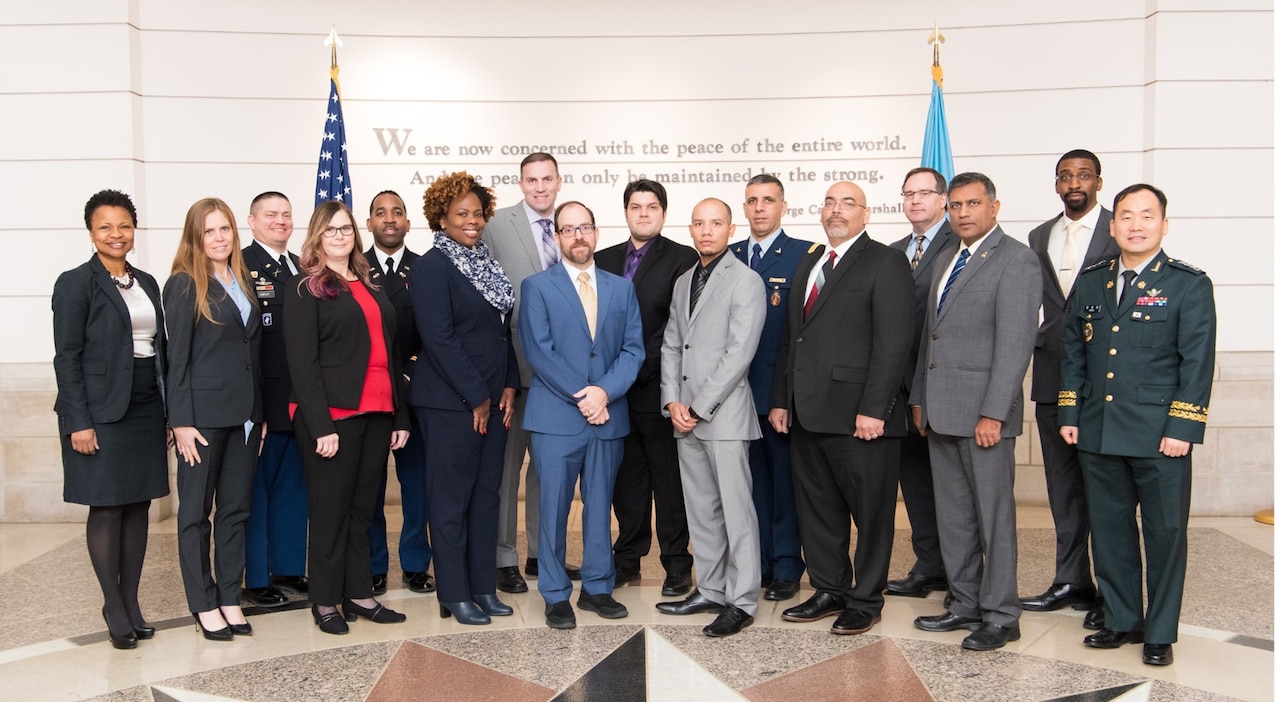
This year, 15 students, including civilians from across the federal government as well as military personnel from two partner nations graduated from the course. The graduation ceremony and the last weeks of their course were conducted online as a result of social-distancing requirements related to stemming the spread of COVID-19.

Deasy said it's fitting that information technology prevented COVID-19 from being able to disrupt the advancement of students through the remainder of the CIO leadership course or to their graduation. The same is being seen elsewhere in the nation, he added, as technology has enabled a resilience that would not have been possible just 40 years ago.

"I cannot help but wonder what a pandemic of this scale would look like if the year was 1980," Deasy said. "Nearly everything would have been grounded to a halt if everyone were at home. [Yet] tens of millions of jobs across all major industry sectors are still being performed today because we have the tech-enabled connectivity to continue to work and create value."

That same kind of technology advancement has also increased capability in support of the nation's defense, Deasy said.

"Information technology has also risen to the occasion to enable the nation to perform critical missions in many areas, including national security," he said. "Despite COVID-19, the department remains ready and able to execute critical missions. Every day I see how access to information and our technological capabilities is an enduring source of U.S. military strength and critical to survival on the future battlefield."

The students graduating today will be at the forefront of leading continued advancement in information technology in the coming years, Deasy said.

"Everyone here today is serving their country in some capacity," he added, "and I want to take this opportunity to thank you for your past and future service, where you will continue to provide your dedication to the mission."

Dr. Cassandra C. Lewis, the acting chancellor of the College of Information and Cyberspace, which hosts the CIO Leadership Development Program at NDU, said the program has had great effect on the Defense Department and the federal workforce.

A circular logo shows a spearhead over the top of a purple shield. Atop the shield is an oil lamp and a wreath. Words around the shield say “College of Information and Cyberspace -- National Defense University.”

"For three decades, the CIO LDP has been our nation's flagship program for rising senior leaders and managers working to achieve national and international security goals through the use of information and information technology," Lewis said. "This prestigious program has served countless standout leaders, both within the federal government as well as our partners and allies."

More than 1,500 students have graduated from the 14-week program since it began in 1990. The program is targeted at senior-level managers and leaders responsible for promoting and attaining national and international security goals through the strategic use of information and information technology. The program provides participants with the chief information officer certificate, a diploma, and course work applicable toward a master of science degree in government information leadership.

"Over 14 short weeks, [students] have completed six courses, they met with ... leaders inside the Beltway, [and] participated in a pretty rigorous and engaging domestic field study experience all to gain first-hand knowledge about how public and private senior leaders are advancing CIO competencies and leading in this complex environment," Lewis said.

This graduation was the last scheduled iteration of the CIO LDP, and the College of Information and Cyberspace is also slated for elimination within the next two years as part of a transformation effort at the NDU.

The College of Information and Cyberspace, or CIC, was established in 1964 as the Department of Defense Computer Institute, or DODCI. In 1988 the school transitioned to the Information Resources Management College, also called the "iCollege." In 2016, it became CIC. Early on, Navy Adm. Grace Hopper was an instructor at the school.

"One thing that has remained consistent throughout all of those evolutions [is the] steadfast, fierce determination of our faculty and staff, and their commitment to bring innovation into the classroom [and] to advance through their thought leadership, information, cybersecurity, emerging technology and cyberspace," Lewis said. "They've also been steadfast in their commitment to prepare senior military and government leaders to lead and meet the challenges that we know they are bound to face in this ever-evolving world."

Georgia Man Arrested for Attempting to Defraud the Department of Veterans Affairs in a Multimillion-Dollar COVID-19 Scam


Christopher Parris, a 39-year-old Atlanta, Georgia resident, was arrested today and charged in federal court in the District of Columbia with fraud for attempting to sell millions of nonexistent respirator masks to the Department of Veterans Affairs in exchange for large upfront payments, the Justice Department announced.

The criminal complaint charges Parris with wire fraud.  It alleges that he made and caused to be made a series of fraudulent misrepresentations in an attempt to secure orders from the Department of Veterans Affairs for 125 million face masks and other personal protective equipment (PPE) that would have totaled over $750 million.  For example, the complaint alleges that Parris promised that he could obtain millions of genuine 3M masks from domestic factories when he knew that fulfilling the orders would not be possible.  Parris also allegedly made similar false representations to other entities in an effort to enter into other fraudulent agreements to sell PPE to state governments.

“We will vigorously pursue fraudsters who exploit the COVID-19 pandemic to make money,” said Attorney General William Barr.  “As this case demonstrates, even beyond the typical costs associated with unlawful behavior, COVID-19 scams divert government time and resources and risk preventing front-line responders and consumers from obtaining the equipment they need to combat this pandemic.  The Department of Justice will not tolerate this conduct, especially when it involves this kind of egregious attempt to target and defraud our nation’s treasures – our veterans.”

After arrest, Parris appeared before Chief United States Magistrate Judge Alan J. Baverman in the United States District Court for the Northern District of Georgia, where he was ordered detained.  Parris will be extradited to the District of Columbia.

“During this time of crisis, fraud or attempted fraud impacting services for veterans, who have selflessly served this country, is unconscionable,” said U.S. Attorney Timothy Shea for the District of Columbia.  “My office will devote whatever resources are necessary to stop scams aimed at exploiting Americans during this unprecedented pandemic.”

“We are committed to protecting the integrity of taxpayer funds and ensuring the delivery of medical supplies necessary to provide quality healthcare to our nation’s veterans, and any attempt to exploit the current global COVID-19 pandemic for personal gain will be dealt with swiftly,” said Inspector General Michael J. Missal for the Department of Veterans Affairs.  “Today’s charges are the direct result of the expeditious and tireless efforts of special agents of the Department of Veterans Affairs, Office of Inspector General, working in tandem with our lawenforcement partners at the Department of Justice and Homeland Security Investigations.”

“Homeland Security Investigations special agents have sworn an oath to protect the American public, particularly during this health crisis, from opportunistic individuals who seek to deliberately harm and deceive others for their own profit," said Special Agent in Charge Jere T. Miles, Homeland Security Investigations – New Orleans.  “Today, our special agents have shown their commitment to that promise.”

A criminal complaint is an accusation by a federal law enforcement agent, and defendants are entitled to the presumption of innocence unless proven guilty.  Upon conviction for the wire fraud charge, the maximum statutory penalty is 20 years’ imprisonment and a $250,000 fine.

The Department of Veterans Affairs, Office of the Inspector General and Homeland Security Investigations investigated the case.  Trial Attorney Patrick Runkle of the Department of Justice’s Consumer Protection Branch and Assistant U.S. Attorneys Peter Lallas and Zia Faruqui of the U.S. Attorney’s Office for the District of Columbia are prosecuting the case.  Assistant U.S. Attorneys Alison Prout and Theodore S. Hertzberg of the U.S. Attorney’s Office for the Northern District of Georgia provided substantial assistance.

Information about the Consumer Protection Branch and its enforcement efforts may be found at http://www.justice.gov/civil/consumer-protection-branch.  For more information about the U.S. Attorney’s Office for the District of Columbia, visit its website at https://www.justice.gov/usao-dc. 

The public is urged to report suspected fraud schemes related to COVID-19 (the Coronavirus) by calling the National Center for Disaster Fraud (NCDF) hotline (1-866-720-5721) or by e-mailing the NCDF at disaster@leo.gov.

SEAC Calls on NCOs, Petty Officers to be 'the Calm in the Eye of the Storm'


April 10, 2020 | BY Jim Garamone , DOD News

Noncommissioned officers and petty officers must be "the calm in the eye of the storm" as the armed services confront the coronavirus pandemic, Senior Enlisted Advisor to the Chairman Ramón "CZ" Colón-López said.

The SEAC spoke during a town hall meeting on Facebook this afternoon.

NCOs must be the conduits of truthful, correct and timely information to troops and their families, the SEAC said. This is critical to ensure that people's minds are at ease.

Colón-López said many of the questions were grouped around money, moving and separations from families. He said he is in daily conversations with Army Gen. Mark A. Milley, the chairman of the Joint Chiefs of Staff, and Defense Secretary Dr. Mark T. Esper, and that both men are intensely interested in feedback from the field.

The financial cost of the stop-movement order is a concern to many families, Colón-López said. Many families received orders and began the process of moving — including committing to a new house — only to have the move frozen. Those families may now be paying for two homes. The SEAC recommended that service members in that predicament contact their local finance office to get the specifics, because no particular regulation is going to cover all cases. But the bottom line is that finance offices are working for continuation of basic allowance of housing for those people who are affected.

He said they are also working on housing allowances for members moving from within the continental United States who are paying for two households. "We're working on ways to be able to go ahead and compensate our members due to any COVID-related issues," he said.

Service members are looking ahead to when the stop-movement order ends and the provisions for moving can proceed. Colón-López said there will be a priority list once the order is lifted.

We're going to continue to fight for you, and it is simply just the right thing to do."
"Clearly, there's going to be an order of priority on how we're doing, because there's only going to be so much capacity to be able to move everybody that is on hold right now," he said. "Given that [the stop-movement order] can potentially go through the main [moving] season is going to create a backlog, every single service right now is developing plans of actions [to] make sure that we properly prioritize and move people."

He said financial hardship and separation will be factors that commanders consider when assigning priorities. Moving commanders, essential personnel, schools and more will be part of the equation. "But we want you to make sure to continue the dialogue with your chain of command to make sure we know exactly who's been a subject of this hardship and what action we need to take to best take care of you," he said.

The stop-movement order also affected leaves. "We're currently and aggressively working on a course of action to treat this the same way that we do deployments to where you're able to carry over leave," the SEAC said. "Now, it is not finalized yet, but I will promise you one thing — that I have been your strongest advocate, along with the chairman of the Joint Chiefs of Staff, to make sure that this happens for you."

"We're going to continue to fight for you, and it is simply just the right thing to do," he continued. "A lot of weddings, a lot of planned leave, spring breaks for a lot of families have been canceled because of this stop movement. And we want to make sure that you get that time back to be able to enjoy your family."

The stop-movement order will last until at least May 11 for moves in the continental United States and May 23 for overseas locations. "Right now, there's a discussion of what's going to happen next: Will this be extended, [or] will the stop movement be rescinded?" he said. "COVID gets a vote. Until we get to see the spread of the disease peak and start coming down, … we need to maintain the [Centers for Disease Control and Prevention] guidelines in place."

One airman asked the SEAC when the pandemic is expected to end.

The pandemic is unprecedented and there is no vaccine for it, he replied. "This pandemic is going to go ahead and put restrictions on a lot of us for quite some time," he said.

Performing the military mission under threat of the virus may be the new normal, Colón-López said. "There's going to be a lot of changes to norms in society, there's going to be a lot of changes to procedures and the way that we used to do things — from grocery shopping, to the way that we interact with people, to the way that we conduct meetings, and the ways that we conduct training."

The safety of the force is paramount, the SEAC stressed.

"The bottom line is that we cannot afford to keep people getting sick," he said, adding that military medical professionals are a crucial asset right now.

"The more safe we are, the less strain on them, and the more they can handle the people that are already infected by this virus," he said. "So, again, I ask you and urge you to please continue to be patient. Think of ways that we can go ahead and get through this. And, at the end of the day, we'll have a hell of an after-action report to go ahead and discuss how we beat this thing."