More than 200 airmen training with the Air Force's
368th Training Squadron spent Feb. 27 at Fort Leonard Wood, Missouri,
learning about unmanned aerial systems during an exercise designed to
cultivate Air Force airmindedness and the warrior ethos.
The training squadron, based at Fort Leonard Wood, provides initial
skills and advanced level training in the areas of ground
transportation, engineering, emergency management and pavements and
construction equipment.
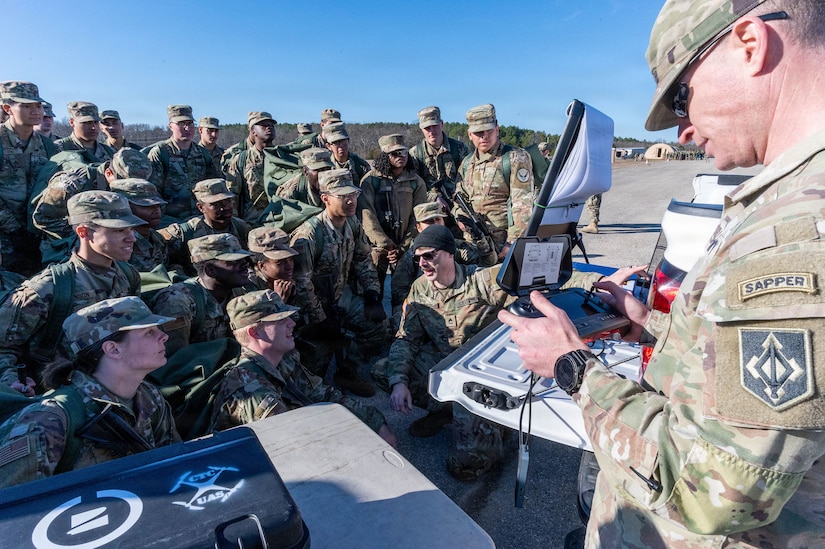
According to Air Force Tech. Sgt. Christopher Moss, a specialty code instructor assigned to the training squadron, airmen at various specialty schools on base usually train separately, but this day was unique because it brought them all together.
"It allows them to integrate with our other schoolhouses, bringing them together as one force instead of each person learning just their craft," Moss said. "Producing more well-rounded airmen for the force."
Air Force Capt. Nathan Elking, 368th Training Squadron director of operations, said the unique training event is called Bracer Forge and is an operational readiness exercise.
"It is a continuation of the training airmen receive at basic training," Elking said. "Both exercise initiatives are designed to instill airmindedness and warrior ethos in our airmen."
The squadron's exercise topics vary, but the current unmanned aerial system focus was driven by the unit's specialty codes, which according to Elking play a key role in airfield damage assessment and rapid airfield damage recovery.
"Before each iteration of Bracer Forge, we provide the participating airmen with an operation order for the day and reporting instructions with a training scenario to recover a damaged airfield," he said.
Squadron instructors prepared four stations for the airmen to rotate through.

At the airfield damage assessment challenge, Elking said teams conducted an assessment on a simulated airfield and relayed the information to their teammates in an emergency operations center.
"The airmen in the EOC were tasked with creating a map of the airfield using the details their counterparts called in over the radio," he said.
While at the UAS reporting challenge, teams established defensive fighting positions and reported UAS activity to their teammates in the EOC by consolidating the information into a report to send up.
The other two stations were a high intensity physical fitness event
and a UAS capabilities overview. Soldiers assigned to the Maneuver
Support Center of Excellence Combat Training Company gave the UAS
portion of the training.
"We are not subject matter experts on counter-UAS and UAS employment.
Being able to leverage our Army partners at [center of excellence]
played a significant role in the exercise's success," Elking said.
According to Army Sgt. 1st Class Austin Priebe, Combat Training Company
UAS chief, his mission was to introduce small UAS threats, and teach the
basics of identifying, reacting to and reporting small UAS threats.
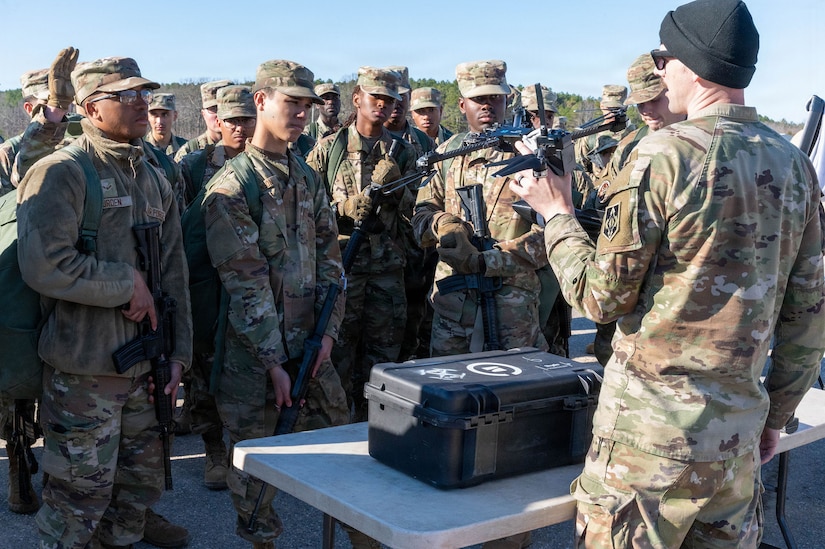
Priebe said most trainees he instructs have watched or controlled a simulated UAS in video games, but being able to experience a UAS in person, see and hear a drone up close, is "essential to prepare service members for what they will see in current and future conflicts."
"We conducted practical exercises on scanning for [small] UAS, completing a report and showed the airmen what they look like from an elevated viewpoint," Priebe said.
This was the training company's first time facilitating interservice UAS training.
"I've largely been focused on enabling training and instruction to the Army units here on Fort Leonard Wood since the inception of our UAS program this past fall," Priebe said.
As the battlefield changes rapidly, so does our training requirements. If our organization can provide more realistic and in-depth training to our brothers and sisters in other branches, we only stand to benefit as a military."
Priebe said his team is looking forward to conducting more interservice training events in the future.
At the end of the day, the exercise was a catalyst for innovation, Elking said.
"By exposing airmen to the dual nature of UASs — both as a threat to
counter and a tool to master — we challenge them to rethink their
mission sets and pioneer new solutions for the modern battlefield," he
said.


 Posts
Posts


No comments:
Post a Comment