Tuesday, July 07, 2020

Sports Heroes Who Served: WWI Soldier Helped Desegregate Baseball

July 7, 2020 | BY David Vergun , DOD News

Almost every sporting event in the United States has been postponed due to the COVID-19 pandemic. To help fill the void, this series looks at sports heroes who also served in the military.

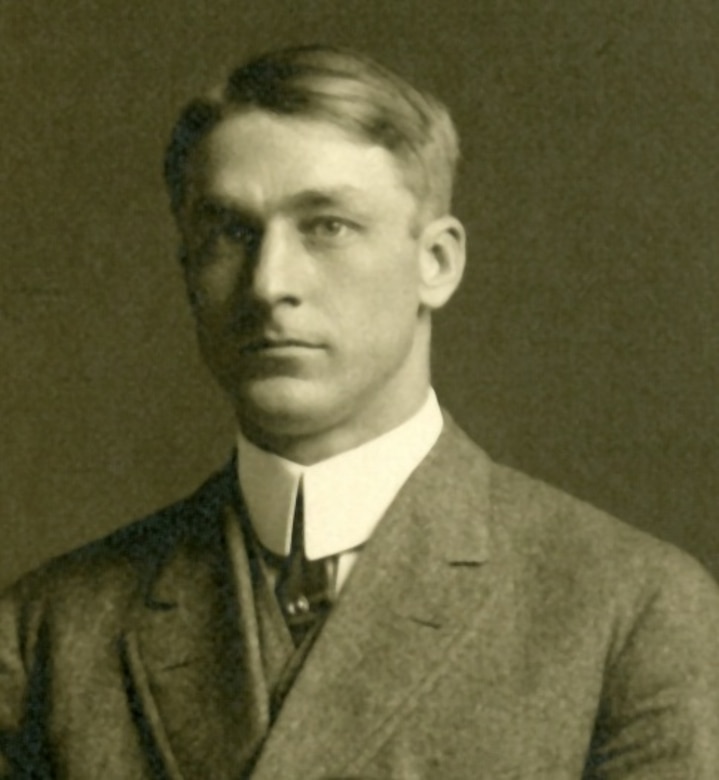
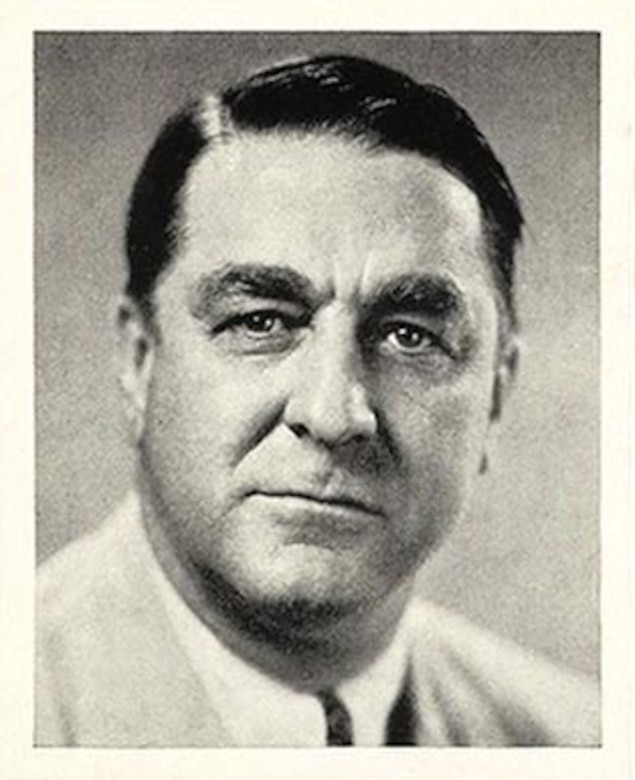
Branch Rickey was an Army officer in the Chemical Warfare Service during World War I. In his unit, coincidentally, were future baseball greats Ty Cobb and Christy Mathewson. Rickey would also take a place in baseball history, thanks to his decision to do the right thing.

Man poses for a photo.

In October 1945, as general manager of the Brooklyn Dodgers, Rickey signed infielder Jackie Robinson, an African American, for the Dodgers' minor league organization. Robinson's later success with the Dodgers from 1947 to 1956 led other owners to seek Black talent.

This was before the U.S. military integrated, which happened July 26, 1948, after President Harry S. Truman signed an executive order establishing the President's Committee on Equality of Treatment and Opportunity in the Armed Services, committing the government to integrating the then-segregated military.

Man ready to hit baseball

At the time, no statute barred Blacks from playing professional baseball. However, it was an unwritten rule among club owners that they were not welcome.

Rickey was said to have appreciated the service and sacrifices African Americans made during World War I and II, and he was eager to enlist their services in baseball.

Man poses for photo

He also remembered a Black player from the baseball team he coached at Ohio Wesleyan University in 1903 and 1904 who was denied hotel accommodations. The incident was said to have made him furious, and he personally intervened to let the player spend the night there.

Rickey later said: ''I may not be able to do something about racism in every field, but I can sure do something about it in baseball.'' Then there was the business-practical element. The Negro leagues had a lot of talent, and this didn't go unnoticed by Rickey.

Baseball great Jackie Robinson poses for a photo.

Incidentally, Rickey and Robinson were brothers — that is, brothers in arms. Robinson served in the Army during World War II.

Among Rickey's many accomplishments and milestones:

  •  In 1902, he played professional football for the Shelby Blues of the Ohio League, which later became known as the National Football League.
  •  In 1904 and 1905, he stayed busy at Allegheny College in Pennsylvania, coaching baseball, basketball and football, as well as teaching English literature and history.
  •  He played in the major leagues in 1905 and 1906 with the St. Louis Browns.
  •  He was manager and general manager of the St. Louis Browns from 1913 to 1915 and in 1919.
  •  He helped to devise the farm system of training ballplayers in 1919.
  •  He was manager and general manager of the St. Louis Cardinals from 1919 to 1942 and helped to create the team’s logo, which is still in use today.
  •  He was general manager of the Brooklyn Dodgers 1943 to 1950 and of the Pittsburgh Pirates from 1950 to 1955.
  •  His teams won World Series championships in 1926, 1931, 1934 and 1942 and National League pennants in 1928, 1930, 1947 and 1949


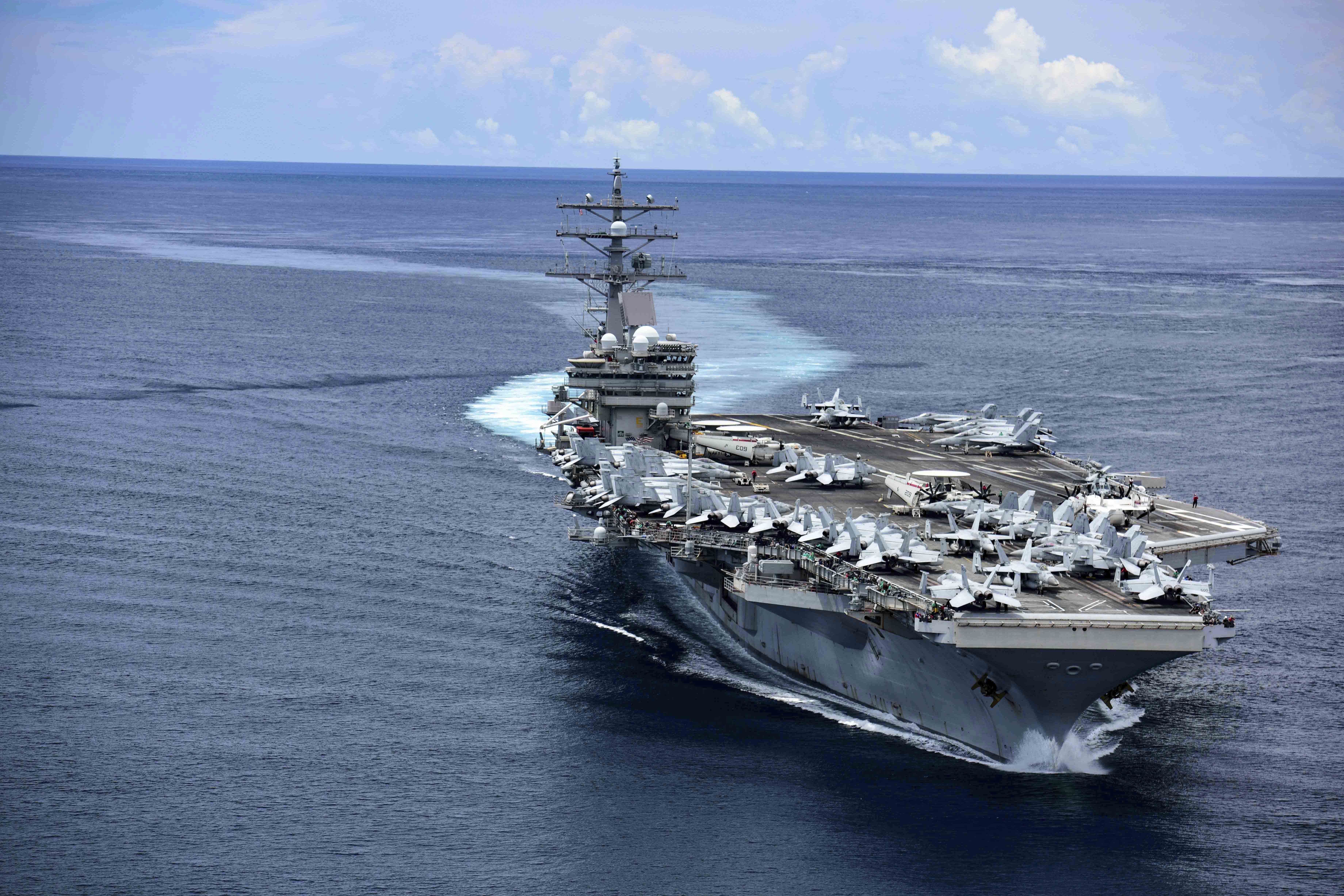
Sea Crossing

The USS Ronald Reagan steams through the San Bernardino Strait, July 3, 2020, crossing from the Philippine Sea into the South China Sea.

Secretary Mark T. Esper Message to the Force on Accomplishments in Implementation of the National Defense Strategy

July 7, 2020

Today, Secretary of Defense Mark T. Esper released a video address to thank the members of the Department for their hard work and contributions as a team to achieve the goals of the National Defense Strategy over the past year. The Secretary addressed the progress made through three main lines of efforts: lethality and readiness of the force; strengthening allies and build partners; reforming the Department for greater efficiency and accountability. He also addresses his personal priority line of effort: service members and their families.

In addition, the Secretary outlined ten targeted goals to support implementation of these lines of efforts.

“Soon after I came into office, civilian and uniformed leaders across the Department and I met to develop detailed plans to implement these lines of effort.  We created a list of ten targeted goals, each with sub tasks, and we set out to accomplish most of these by the end of 2020. They are as follows:

  1. Review, update, and approve all China and Russia plans;
  2. Implement the Immediate Response Force, Contingency Response Force, and Dynamic Force Employment enhanced readiness concepts;
  3. Reallocate, reassign, and redeploy forces in accordance with the NDS;
  4. Achieve a higher level of sustainable readiness;
  5. Develop a coordinated plan to strengthen allies and build partners;
  6. Reform and manage the 4th Estate and DoD;
  7. Focus the Department on China;
  8. Modernize the force—invest in game changing technologies;
  9. Establish realistic joint war games, exercises, and training plans; and,
  10. Develop a modern joint warfighting concept, and ultimately, doctrine.

I am proud to report that we’ve made real progress on these goals, with most on track to be accomplished on time. I will soon be posting an extended list of what we’ve achieved over the past year on the DoD website, but today I want to highlight several standouts, and celebrate what we have accomplished together.”

Secretary Esper’s full video message can be found here. The transcript can be found here.

Australia-Japan-United States Defense Ministers’ Meeting Joint Statement

July 7, 2020

Australian Minister for Defence Linda Reynolds, Japanese Minister of Defense KONO Taro, and U.S. Secretary of Defense Mark Esper convened a virtual trilateral defense ministerial meeting on July 7 (Washington).  The ministers reaffirmed their joint commitment to enhance security, stability, and prosperity in the Indo-Pacific region in keeping with their shared values and longstanding alliances and close partnerships.  This was the ninth meeting among the three nations’ defense leaders.

The ministers concurred that the COVID-19 pandemic underscored the importance of a rules-based international order in setting the conditions for our nations to address this shared threat in a way that is transparent, accountable, and resilient.  As a measure of the strength and adaptability of the trilateral partnership, the ministers discussed collaborative efforts to mitigate the impacts of COVID-19.  They committed to:

(1) Continue to share information, best practices, and lessons learned about measures taken by defense authorities toward mitigating the impacts of COVID-19, including as part of whole-of-government efforts;

(2) Further develop a mutual understanding of the threat environment in the Indo-Pacific region, including the potential effects of the spread of COVID-19 on their respective defense policies and preparedness; and

(3) Promote vigorous trilateral defense cooperation and exchanges that make tangible contributions in support of a free, open, inclusive, and prosperous Indo-Pacific region.

The ministers reinforced their strong opposition to any destabilizing or coercive unilateral actions that could alter the status quo and increase tensions in the East China Sea.  They expressed their intention to continue to coordinate closely on the security environment in this region, with a view to deterring such actions.

With regard to the South China Sea, the ministers reinforced strong opposition to the use of force or coercion to alter the status quo, and reaffirmed the importance of upholding freedom of navigation and overflight.  They expressed serious concern about recent incidents, including the continued militarization of disputed features, dangerous or coercive use of coast guard vessels and “maritime militia,” and efforts to disrupt other countries’ resource exploitation activities.  They emphasized the importance of peaceful resolution of disputes in accordance with international law, in particular as reflected in the United Nations Convention on the Law of the Sea (UNCLOS), and called for all countries in the region to take meaningful steps to ease tension and build trust.  The ministers also called for any Code of Conduct in the South China Sea to be consistent with existing international law, in particular as reflected in UNCLOS; not to prejudice the interests of third parties or the rights of any State under international law; and to reinforce existing inclusive regional architecture.

The ministers also expressed their deep concern over Beijing’s imposition of a national security law upon Hong Kong.

The ministers shared their strong concern that North Korea’s series of ballistic missile launches pose a serious threat to international security and condemned the repeated violations of multiple United Nations Security Council Resolutions (UNSCRs).  They expressed concern about North Korea’s announcement that it no longer considered itself bound by its moratorium on nuclear tests and launches of intercontinental ballistic missiles.  The ministers again called upon North Korea to cease actions that increase tensions and undermine regional stability, to comply with its international obligations, and to take clear steps to achieve the complete, verifiable, and irreversible dismantlement of its weapons of mass destruction and ballistic missiles programs of all ranges in accordance with UNSCRs.  To this end, they commended ongoing diplomatic efforts to engage North Korea, and called on North Korea to return to the negotiating table and make a sustained commitment to dialogue.  In the meantime, they reaffirmed their commitment to implement and enforce sanctions against North Korea, including through ongoing cooperation to monitor and deter illegal ship-to-ship transfers of refined petroleum, coal, and other sanctioned goods.

The ministers underlined the instrumental role of ASEAN in facilitating regional dialogue and establishing norms of behavior that support stability, security, and prosperity in the Indo-Pacific region, and recognized the importance of supporting partners in South and South East Asia.  The ministers emphasized their ongoing support for ASEAN centrality as a key contributor to regional security and prosperity.  The ministers undertook to continue to coordinate closely on their support to the region, in order to maximize the benefits of their national and combined engagement activities in a transparent, efficient, and effective manner under their shared strategic vision.

The ministers underscored their unwavering commitment to work closely with their Pacific partners to support a Pacific region that is prosperous, secure, and respectful of sovereignty.  They decided to continue their trilateral capacity-building efforts in the Pacific through joint defense initiatives with regional partners.  The ministers welcomed and acknowledged the significance of each country’s military-to-military activities, particularly when those activities contributed to whole-of-government engagement with Pacific nations.

In reference to the 2019 Australia-Japan-United States Trilateral Strategic Action Agenda, the ministers directed their respective officials to continue to pursue avenues for practical engagement, cooperation, and interoperability in a time of geostrategic change.  

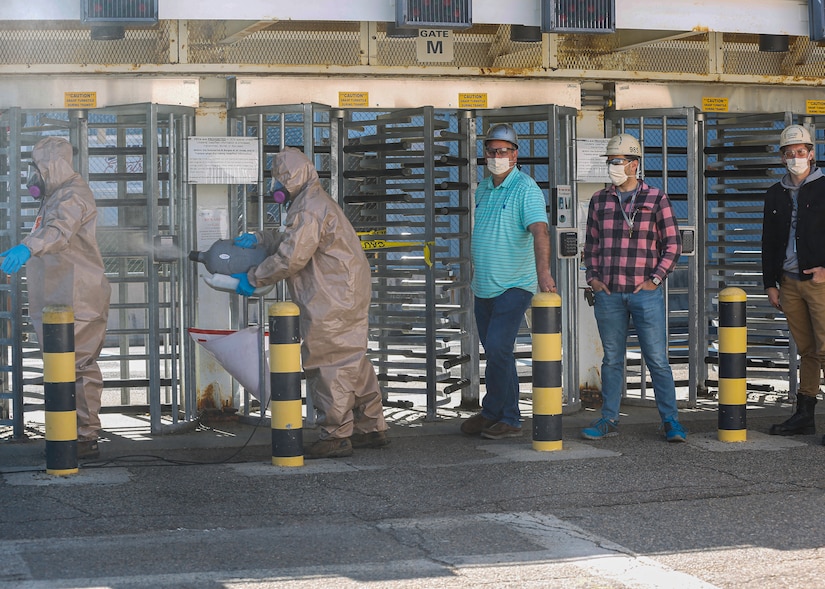
Norfolk Naval Shipyard Uses Misting Disinfectant to Protect Employees

July 7, 2020 | BY KRISTI R. BRITT

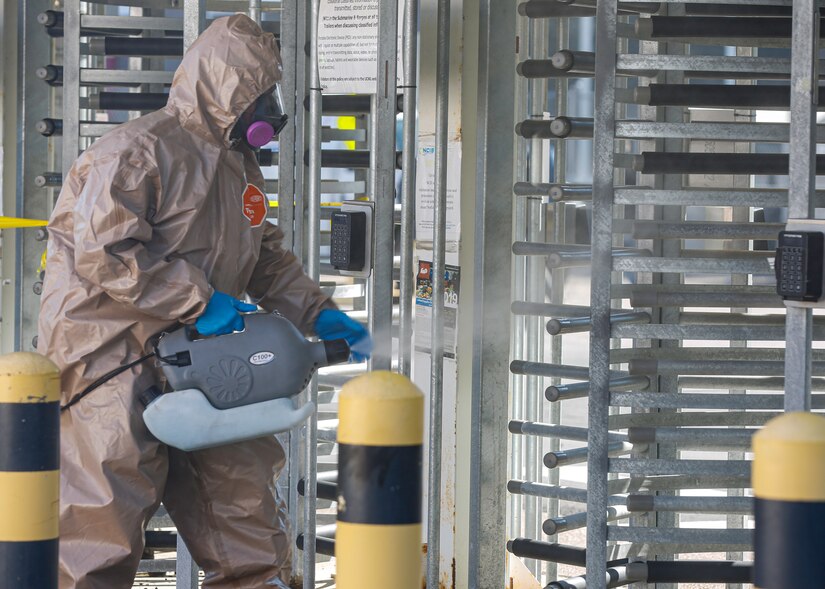
During the early stages of combating the spread of COVID-19 at Norfolk Naval Shipyard, Virginia, many people stepped up to provide innovative, safe solutions that would help ensure the safety of employees. One such group was the Facilities Support Branch (Code 985), which was enlisted to help address high-traffic and high-touch areas in need of regular disinfecting.

A man dressed in full protective gear sprays a turnstile entrance with disinfectant.

''We have areas like drydock handrails, turnstiles and break rooms that are constantly in use,'' said Caleb Steckmann, a facilities support engineer. ''The safety of our employees is our No. 1 priority, and we wanted to establish something that could directly help those who were continuing to serve our mission and utilizing these high-traffic areas.''

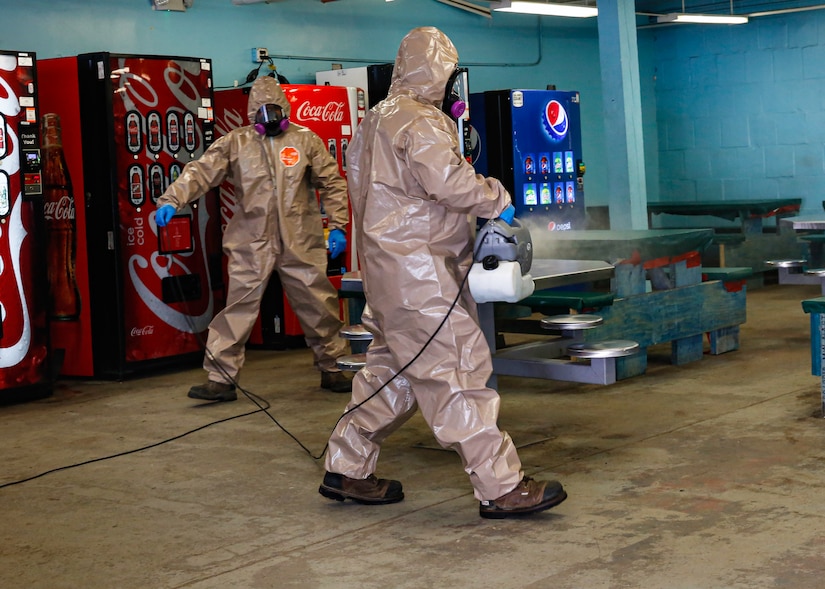
In an emergent response to minimize the potential spread of COVID-19, Code 985 employees worked with a local contractor that specializes in environmental cleaning to begin applying preventive misting and disinfectants to high-traffic areas. For four weeks, Code 985 worked diligently with contractor personnel, escorting, scheduling and collecting pertinent data to work on providing the safest environment possible for shipyard employees.

Men dressed in full protective gear spray a room with disinfectant.

''The initial response team included those from the contracting company; as well as Code 985 employees — facilities support engineers Joseph Marousas, Caleb Steckmann and myself,'' said Bobby Truitt, the TF-1 program manager. ''We worked as a unit, making sure these areas were continuously addressed and handled so 'America's Shipyard' could keep moving forward while remaining as safe as possible.''

Because of their response and the data they collected, he added, Naval Facilities expanded the cleaning contracts to include preventive disinfecting.

Two men in full protective equipment sanitize turnstiles as three other men wearing face masks stand nearby.

''We exhibit our CORE values – Care, Ownership, Respect and Excellence – in everything we do here,'' Marousas said. ''We wanted to help flatten the curve of COVID-19 any way we could. We wanted to help minimize the spread while maximizing the mission.''

 Because the shipyard needs to continue to serve the fleet and the nation, he said, taking care of its people is paramount.

(Kristi R. Britt is assigned to Norfolk Naval Shipyard.)

Urgent Acquisition Effort Provides Safe COVID-19 Patient Transport in 95 Days

July 7, 2020 | BY C. Todd Lopez , DOD News

The Air Force, Air Mobility Command and U.S. Transportation Command have a new capability to bring large numbers of COVID-19 patients home via airlift without putting associated flight crews at risk — and the solution arrived quicker than expected.

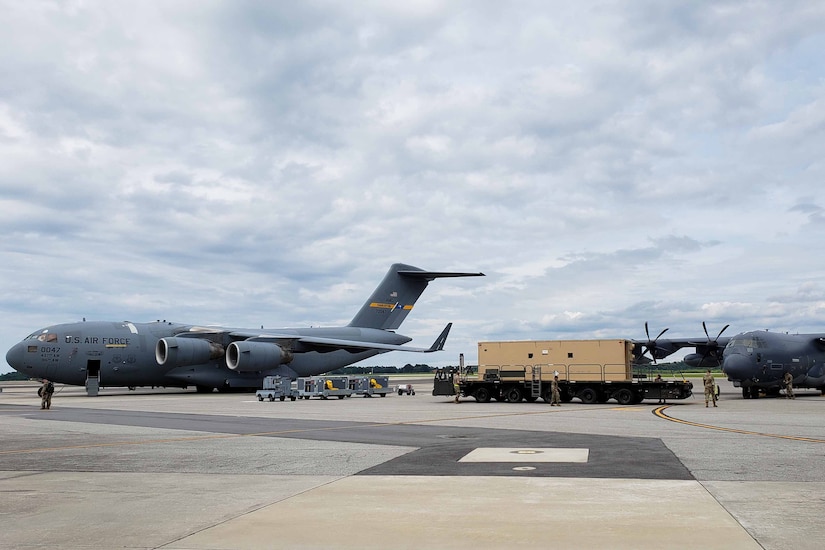
The "Negatively Pressurized CONEX," or NPC, flew its first operational mission June 30 out of Ramstein Air Base, Germany, just 95 days after Transcom published a joint urgent operational need statement that spelled out a requirement to transport as many as 4,000 individuals a month who might be infected with COVID-19.

Two transport aircraft on a ramp with a large, multiwheeled flatbed vehicle between them.

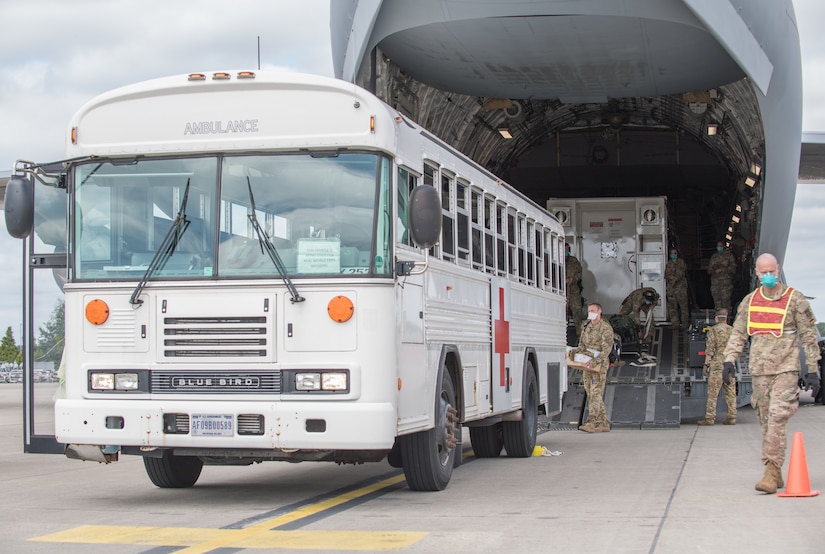
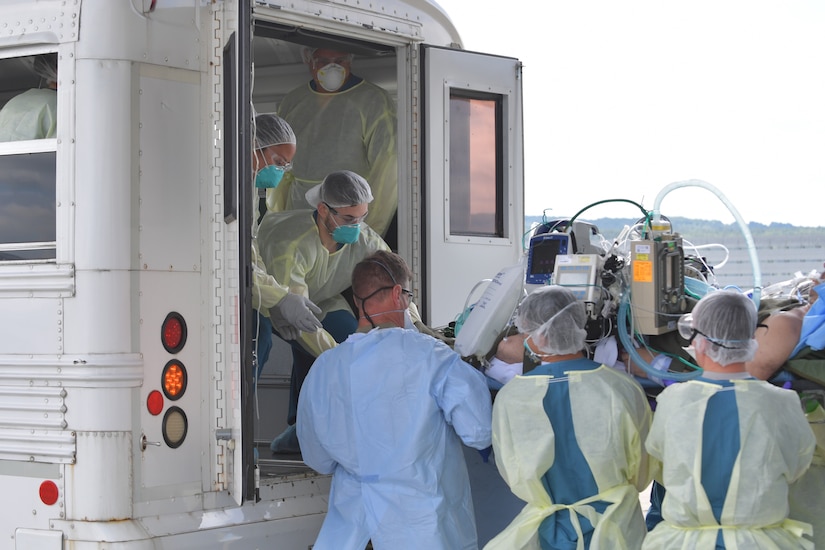
The NPC is a 40-foot metal container outfitted with air-handling and other equipment that can be carried aboard a C-17 transport jet. The NPC can be used to move 23 COVID-19 patents who need the attention of medical personnel. The system's onboard equipment ensures negative air pressure on the inside so that the aircrew responsible for transporting it and its patients won't be put at risk for infection.

The system also can be configured to hold as many as 30 ambulatory personnel who might potentially be infected with COVID-19 and need to be kept quarantined during an airlift operation, but who don't need the attention of medical personnel.

Navy Capt. Jeff Stebbins, deputy director of the Joint Rapid Acquisition Cell, commended the Joint Staff, Air Force, Air Mobility Command and Transcom for taking a requirement spelled out March 28 and turning it into a product that meets warfighter needs in just 95 days, when the process might normally take more than a year to complete.

"Our work with the Joint Staff and Transcom was done in parallel, not sequentially," Stebbins explained. "That allowed us to move faster."

A white bus with a red cross on its side backs up to a large military aircraft.

Stebbins said Transcom sent the joint urgent operational need statement to the Joint Staff for validation on the same day that the Joint Rapid Acquisition Cell assigned it for execution to the Air Force.   

"Everybody was working together, and there was a lot of crosstalk," he said. "Because we all worked effectively together and in parallel across departments, across agencies, we were able to move all of the authorities necessary to execute this mission quickly."

Within the Air Force, it was Air Force Lt. Col. Paul Hendrickson, the materiel leader for chemical, biological, radiological and nuclear defense, who first conceived of the NPC.

"When the COVID crisis kicked off, Transcom and Air Mobility Command began to see a need for the transport of COVID patients," Hendrickson said. "They took a look at their inventory. And the only system that they had readily available was the 'transportable isolation system,' or TIS. It was developed through a JUON for the Ebola crisis."

Medical personnel move a patient on a stretcher out of the back of a white bus.

The TIS, Hendrickson said, is basically a wire frame with plastic sheeting over the top. It's fragile, and it can accommodate only about six people.

Another option was the Portable Bio-Containment Module, a product of the State Department, Hendrickson said. At the time, the Joint Program Executive Office was working to get the PCBM its flight-worthiness certification for transport on the C-17 aircraft. The PCBM carries only three people, only four of the systems exist, and it would take a long time to get more of them purchased, he said.

Neither solution was ideal to meet the needs to move so many COVID-19 patients.

Hendrickson said his office was working on a solution for "collective protection" to provide CBRN protection to groups of people. For example, he said, airmen who perform aircraft maintenance while required to wear the full array of individual chemical protection equipment might eventually suffer exhaustion due to the heat burden. They would need a place to go between tasks where they could be safe from a chemical attack, but at the same time be able to remove their individual chemical protection suits so they could recover.

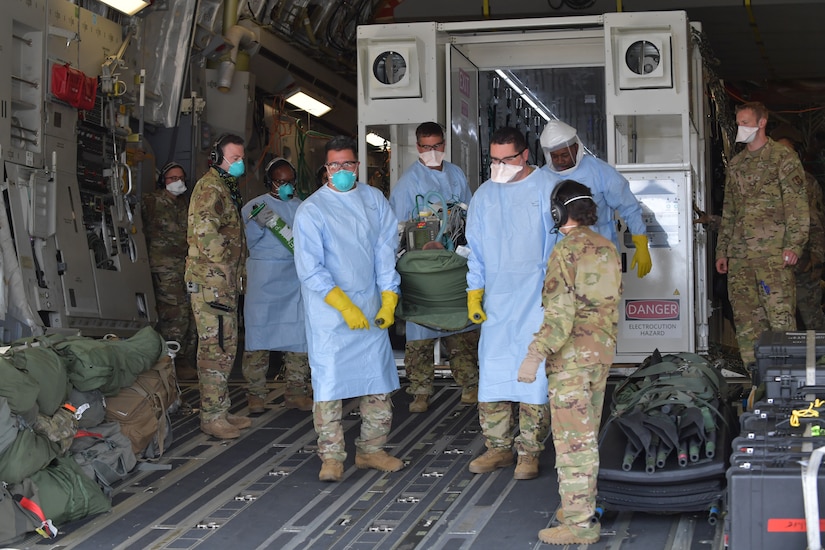
Medical personnel, some in military uniforms, gather outside a large metal box that is situated inside a large military aircraft.

"We had been working with Osan Air Base and the 51st Aircraft Maintenance Squadron [in South Korea] to figure out how to get them more agile collective protection," he said. "We were working on a rapid technology demo of what we call the 'Collective Protection CONEX,' which is taking a 40-foot ISO container and retrofitting it to be a collective protection facility."

The "Collective Protection CONEX" or CoPro CONEX, was conceived to keep people inside it safe from dangers that might be outside.

The concept of the CoPro CONEX might be flipped on its head, Hendrickson thought, to keep people on the outside safe from people on the inside who might be contagious. He asked one of the officers within his own agency if such a thing could be done — and within just a few hours, he said, there was a mock-up of what would eventually be the NPC.

Air Mobility Command liked the idea, he said, and briefed it to the Joint Rapid Acquisition Cell. They approved the plan and by April 7 Air Mobility Command awarded a contract using the "other transaction authority" process.

Hendrickson cited the contractors involved in building the NPC, along with the C-17 program office; the Air Force Lifecycle Management Center's engineering directorate; personnel at Joint Base Charleston, South Carolina; members of Detachment 2, Air Force Operational Test and Evaluation Center; the 28th Test and Evaluation Squadron out of Eglin Air Force Base; the Air Mobility Command surgeon general and aeromedical standards evaluation shop; three bio-containment pathologists and others as being instrumental in getting the NPC developed, and then proven airworthy and safe to fly.

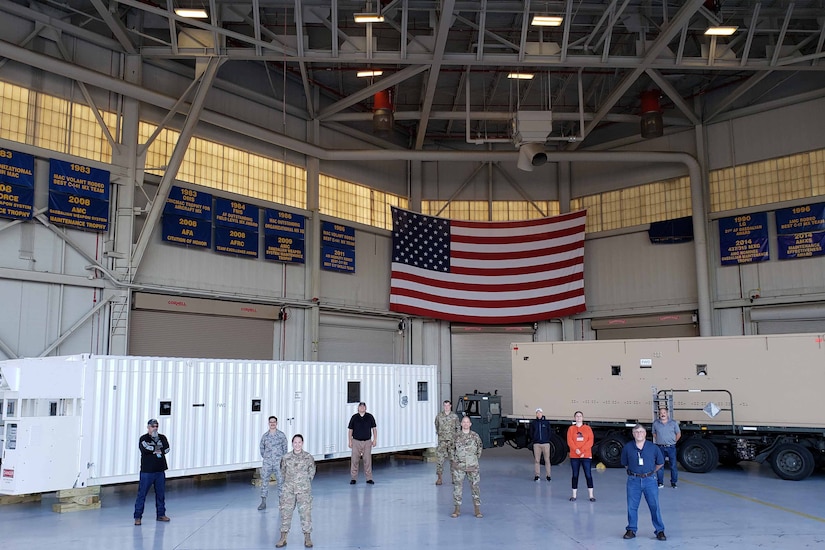
Airmen and civilians stand in a hangar beneath a large U.S. flag.

The NPC was delivered to Joint Base Charleston, South Carolina, on June 7, where it was subjected to a rigorous series of tests, Hendrickson said. It had its test flight June 15, and flew its first operational mission June 30.

Only one NPC exists, but officials expect that the Air Force will get 30 of the systems and that the first of those will roll off the assembly line in mid-July. Hendrickson said he thinks the manufacturer could produce at a rate of one NPC every eight days.

In addition to the NPC, there will also be 30 "NPC-Light" models, which will be about 12 feet shorter than the NPC, carry fewer passengers, and will fit on the smaller C-130 aircraft. The NPCL, he said, is expected to move patients inside a theater of operations, while the NPC will be used to move patients out of theater.

"The Air Force and what Lieutenant Colonel Hendricks' team has done is a phenomenal job at developing an initial capability," Stebbins said. "We believe this serves as an excellent case study for urgent capability acquisition — that when a combatant command has an urgent need, we use every tool available to rapidly develop and field a capability."
Ocean Ops

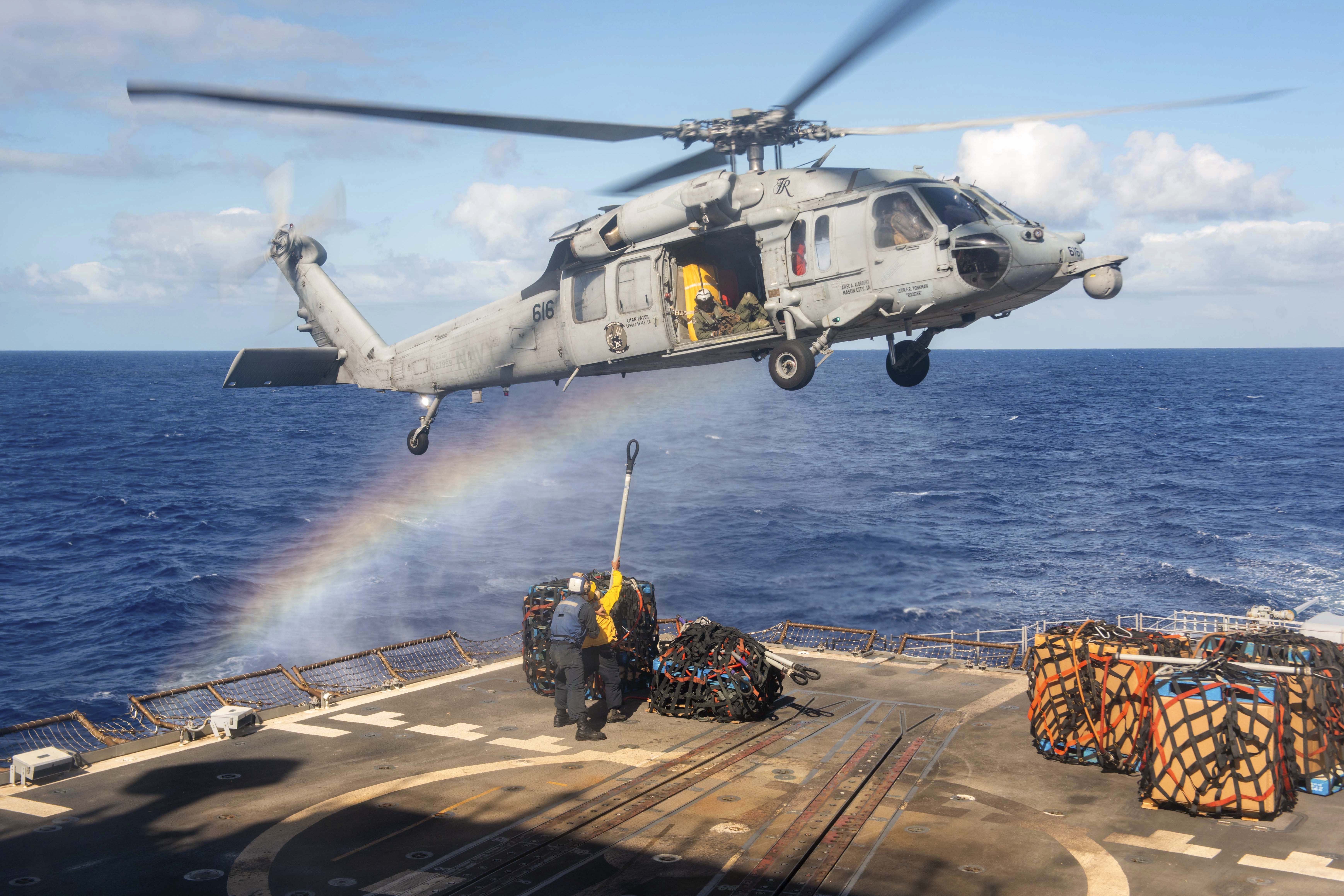
Navy Seaman Elijah Butsko and Petty Officer 2nd Class Joel Lazo attach a cargo leg to an MH-60S Seahawk on the flight deck of the USS Bunker Hill in the Pacific Ocean, July 1, 2020.

Former Air Force Employee Facing Federal Indictment for Stealing More Than $774,000 in Government Funds

Coordinated Congressional Travel in the Office of the Secretary of the Air Force, Office of Legislative Liaison

Greenbelt, Maryland – A federal grand jury has indicted Eddie Ray Johnson, Jr., age 59, of Brandywine, Maryland, on federal charges of theft of government property and money laundering.  The indictment was returned on July 6, 2020.

The indictment was announced by United States Attorney for the District of Maryland Robert K. Hur; Brigadier General Terry Bullard of the Air Force Office of Special Investigations (OSI); Special Agent in Charge Robert E. Craig, Jr. of the Defense Criminal Investigative Service (DCIS), Mid-Atlantic Field Office; and Special Agent in Charge Kelly R. Jackson of the Internal Revenue Service - Criminal Investigation (IRS-CI), Washington, D.C. Field Office.

According to the indictment, from January 2003 to February 2018, Johnson was a civilian Air Force employee, most recently as a travel coordinator in the Secretary of the Air Force, Office of Legislative Liaison, where he planned congressional travel and reviewed and approved accounting packages submitted by trip escorts, among other duties.  The indictment alleges that from March 2014 through September 2017, Johnson used his government-issued travel credit card to obtain more than $1.1 million in cash advances, at least $774,000 of which he diverted to his own personal use.

According to the indictment, Johnson frequently deposited the stolen funds into a non-interest bearing account opened in his name at a bank branch in the Pentagon.  Employees in the Office of Legislative Liaison were instructed to open such accounts so that they could more easily deposit and withdraw government funds for official use without accruing interest.  After depositing the stolen funds, Johnson allegedly wrote checks to himself, which he deposited into his personal bank accounts, as well as expended the money for his personal use.

If convicted, Johnson faces a maximum sentence of 10 years in federal prison for theft of government property and a maximum of 20 years in federal prison for money laundering.  Actual sentences for federal crimes are typically less than the maximum penalties. A federal district court judge will determine any sentence after taking into account the U.S. Sentencing Guidelines and other statutory factors.  An initial appearance in U.S. District Court in Greenbelt has not yet been scheduled.

An indictment is not a finding of guilt.  An individual charged by indictment is presumed innocent unless and until proven guilty at some later criminal proceedings. 

United States Attorney Robert K. Hur commended the Air Force OSI, the DCIS, and the IRS-CI for their work in the investigation.  Mr. Hur thanked Assistant U.S. Attorneys Dana J. Brusca and Elizabeth G. Wright, who are prosecuting the case.

Meal Prep

Arizona National Guardsmen help prepare meals for the homeless at Saint Vincent de Paul’s rescue mission in Phoenix, July 6, 2020, as part of the state’s COVID-19 response.

Monday, July 06, 2020

Fuel Refill


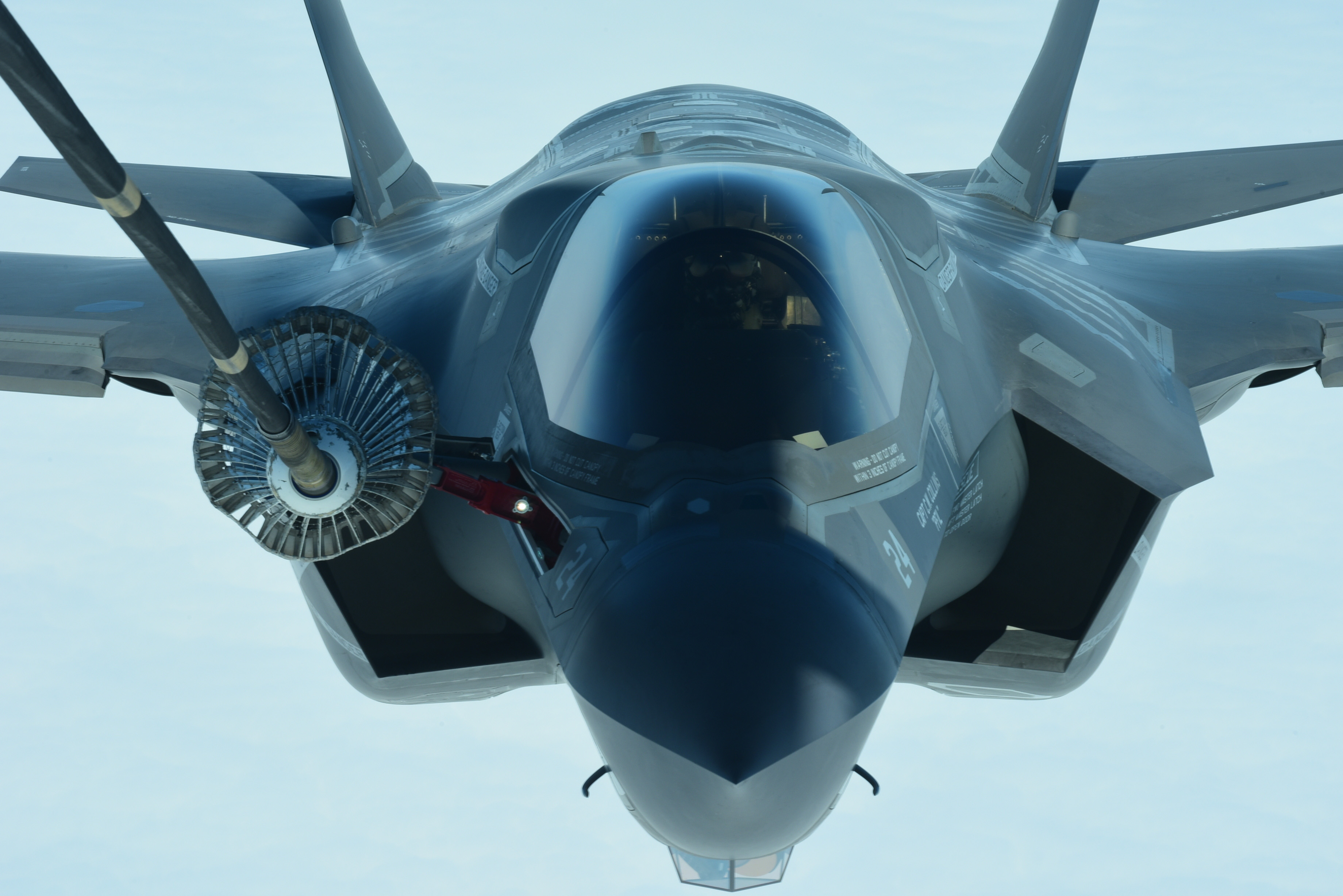
A Marine Corps pilot lines up an F-35B Lightning II to refuel from a KC-10 Extender assigned to the 305th Air Mobility Wing at Joint Base McGuire-Dix-Lakehurst, N.J., July 4, 2020. The F-35B is part of a formation of military aircraft that flew over Boston, New York City, Philadelphia, Baltimore and Washington D.C. during a Salute to America event.

Sea Ops

Aircraft fly in information while the USS Nimitz and the USS Ronald Reagan carrier strike groups conduct dual carrier operations in the Indo-Pacific region, July 6, 2020.

Brits School U.S. Troops in Tea-Making, But They Prefer Coffee

July 6, 2020 | BY Jim Garamone , DOD News

The Twitterverse is atwitter....as Brits teach Americans how to make a proper cup of tea.

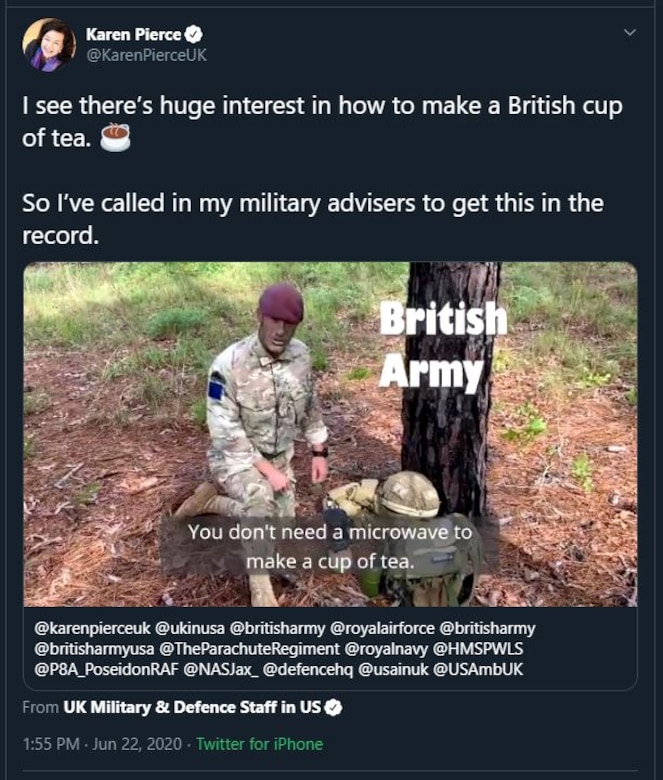
It's the fallout from a TikTok video that shows an American woman brewing a cup of tea in the microwave. 

Screenshot of a tweet dispelling the notion that a microwave is required for making tea.

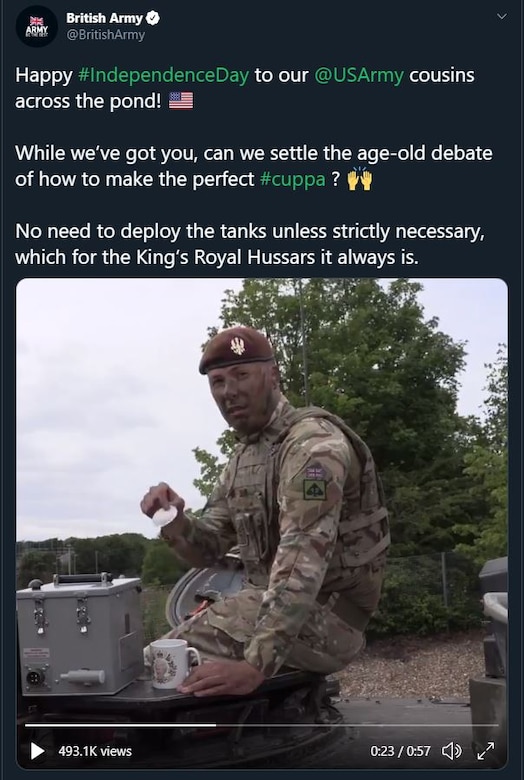
The British army, navy and air force jumped in to educate their military cousins across the pond, letting them know that brewing tea requires a kettle, tea bag, milk and sugar.

Microwaving is a faux pas, and even the order you put things in the hot water matters. 

Screenshot of a tweet by the British Army offering tea-making expertise.

While U.S. service members applaud the British for their willingness to impart their tea-making wisdom, it may be unnecessary. Military service members of the United States of America do not — as a rule — drink tea.

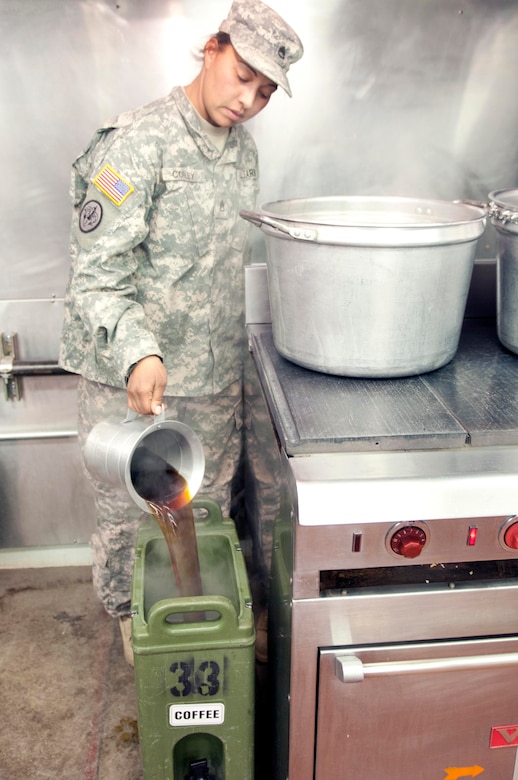
Service members do, however, drink coffee, and they will go to great lengths to ensure they have their morning cups of go-juice. Coffee and service members is a tradition as time-honored as the services themselves.

In garrison, forward operating bases, and even combat outposts, there's always coffee available somewhere. Service members can grab a foam or paper cup, pour in the coffee and fix it the way they like it. At larger bases, there's even a choice of liquid creamer and fake sugar available.

For service members in the field, rations — or meals ready to eat — even come with instant coffee, powdered nondairy "creamer" and sugar. There's also a flameless heater that gets the instant coffee hot enough to burn the mouth. But if they're desperate, soldiers just dump the coffee granules into cold water, shake it and slam it down.

A soldier pours coffee into a large container.

The U.S. military makes every effort to get coffee to the troops. During the Civil War, getting a hot cup of coffee was a real morale booster. Young William McKinley delivered hot coffee to his unit under fire at the battle of Antietam, Maryland — which he noted as he rose in politics, eventually being elected U.S. president in 1896.

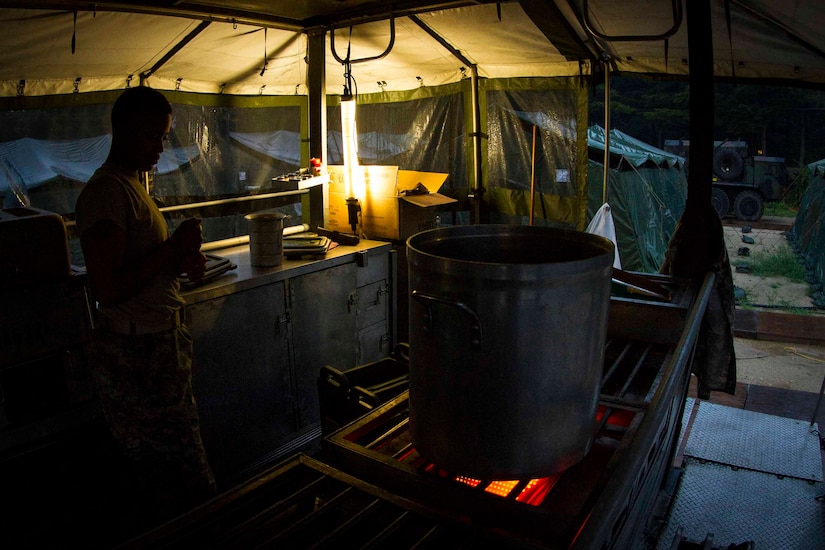
Civil War soldiers didn't have all the accoutrements that today's coffee snob has. At every break in a march, the troops would build a fire, heat water and use their musket butts to crush the beans. They would dump them in the water, and let it steep.

According to a Navy legend, the phrase "cup of Joe" was coined after Navy Secretary Josephus Daniels outlawed booze on board ships in 1914. Coffee was the strongest drink a sailor could have.

During World War I, cooks tried to deliver hot coffee to the troops manning the trenches. Behind the lines, Red Cross volunteers called "doughnut dollies" made sure there were coffee and doughnuts for troops coming off the line or going in.

A soldier watches a large, metal container heat over an outdoor stove.

During World War II, troops from Iwo Jima to the Battle of the Bulge dug through their rations for a caffeine fix.

At the dedication of the Korean War Memorial in Washington, one Korean War vet described "sock coffee" that his Marine platoon made up by the Chosin Reservoir. They took a sock, filled it with coffee grounds, and dunked it in a canteen cup with boiling water. "We tried to get a clean sock, but we didn't care," he said.

During the Vietnam War, troops used pinches of C-4 plastic explosives to heat the coffee in their ration packets.

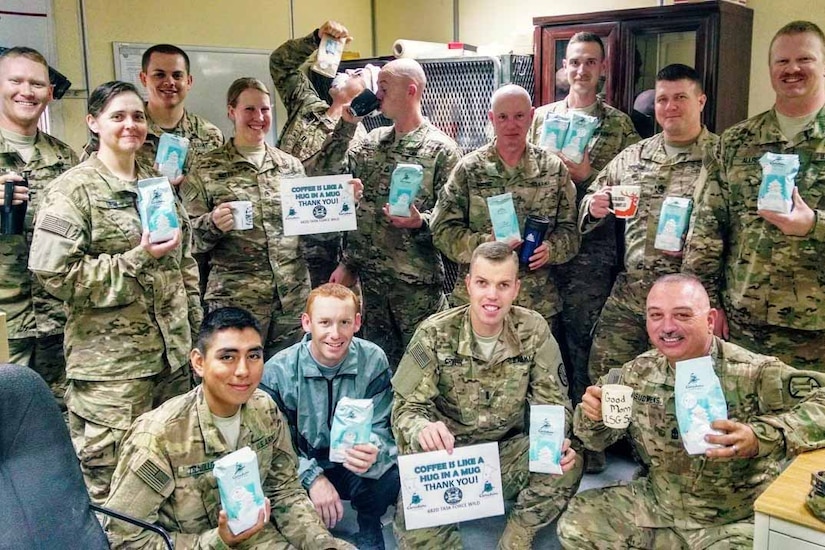
In 2003's Operation Iraqi Freedom, Americans sent lots and lots of coffee to the troops. In one instance, a platoon got 10 bags of Starbucks coffee, but it was whole-bean, rather than ground.

Smiling soldiers hold donated bags of coffee.

There actually was a young 3rd Infantry Division soldier who had a coffee grinder — but in all the moving, it had been broken. This same soldier took fishing poles to Baghdad, but he actually got to use those.

Someone mentioned how the troops during the Civil War had done it, and the tradition continued. The troops soon liberated a huge pot from the Baghdad International Airport, filled it with water and put it over a fire. They put the coffee beans in a plastic sandbag and used their weapons and bricks to crush them. Then they dumped the result into the boiling water.

The coffee was so strong, it would walk over to you if you whistled. 

It was just what they needed.

DOD Identifies Army Casualty

July 6, 2020

The Department of Defense announced today the death of a soldier who was supporting Operation Joint Guardian.

Pfc. Alexander Blake Klass, 20, from Willamina, Oregon, died as the result of a non-combat related incident, July 4, 2020, at Camp Novo Selo, Kosovo. The incident is under investigation.

Klass was assigned to 2nd Battalion, 162nd Infantry Regiment, 41st Infantry Brigade Combat Team, Oregon National Guard, Springfield, Oregon. 

For more information regarding Pfc. Alexander Blake Klass, media may contact Maj. Stephen S. Bomar, Oregon Military Department Public Affairs at stephen.s.bomar.mil@mail.mil; agpa@mil.state.or.us, or at (503) 584-3885.

Florida Guard Supports Relocation of Community-Based COVID-19 Testing Sites

July 6, 2020 | BY Army Maj. Jesse Manzano

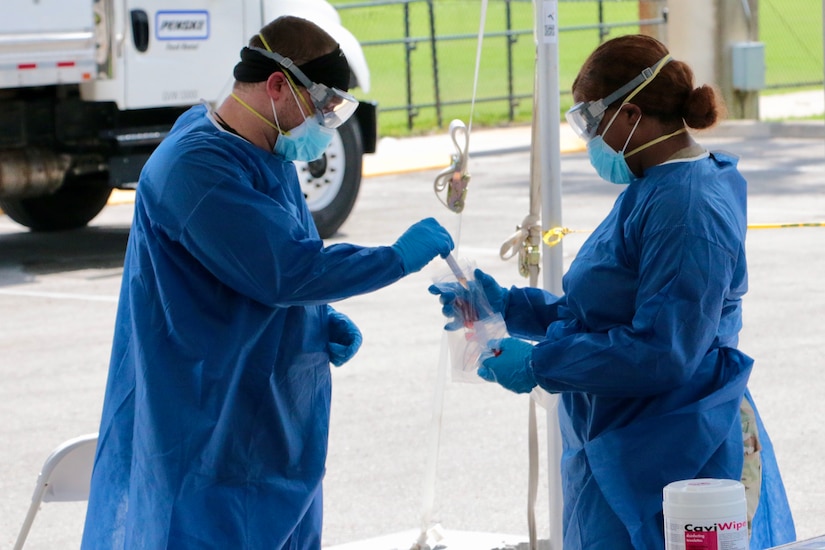
Soldiers with the Florida National Guard supported local and state authorities in the move, setup and resumption of operations for two community-based COVID-19 testing sites in Broward County.

A soldier holds a plastic bag open as a health care provider deposits a nasal swab into it.

"We have been working at testing sites in Broward County since we arrived in South Florida at the beginning of June," said Army Sgt. 1st Class Thomas Jones, a noncommissioned officer assigned to Charlie Battery, 1st Battalion of the 265th Air Defense Artillery out of Deland, Florida. "We were originally assigned to the Hampton Pines testing site, but when it was moved to Lauderdale Lakes, our mission continued in the new location."
The two new test sites at the Vincent Torres Memorial Park in Lauderdale Lakes and at Lincoln Park in Fort Lauderdale replaced the Hampton Pines and Urban League CBTS locations respectively, which are now closed.

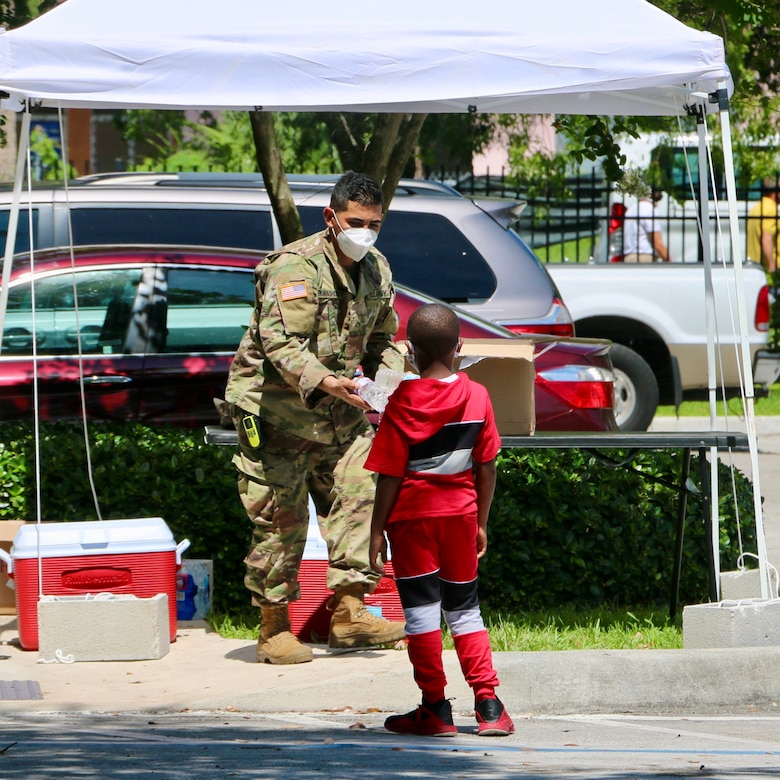
A soldier gives a bottle of water to a boy.

"We are here to help the community," said Army 2nd Lt. Pablo Iguaran, a platoon leader with Alpha Battery, 1-265 ADA and the officer in charge of the Lincoln Park site. "The Florida Guard can adapt very quickly, so when the move from the Urban League to Lincoln Park was announced, we were prepared to handle it without any issues."
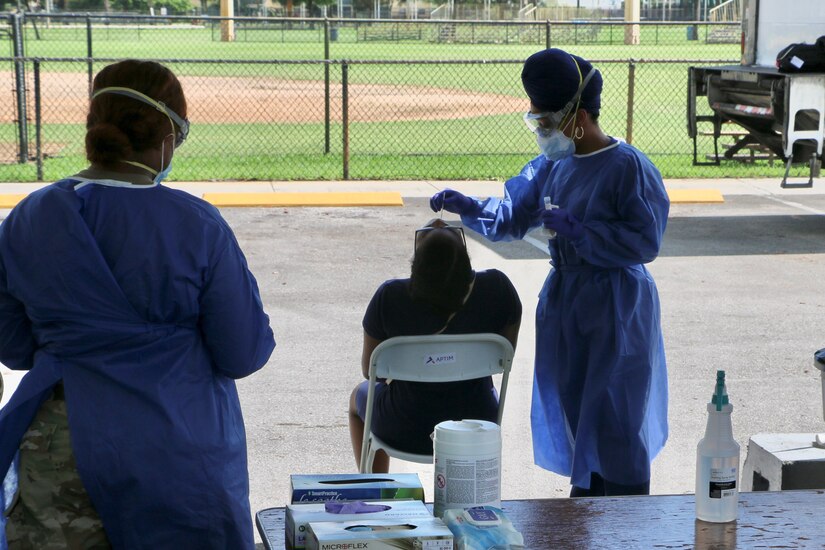
A soldier assists with  a nasal-swab specimen collection.

Since starting COVID-19 operations in mid-March, the 50th Regional Support Group has served as the Florida National Guard's main effort in supporting the state's COVID-19 response. Working together with federal, state and local authorities throughout Miami-Dade, Broward and Palm Beach counties, the 50th RSG and its subordinate units have provided direct and indirect support to more than a dozen CBTS locations, helping to administer more than 200,000 sample collections in their area of operations. The group’s soldiers also are supporting screening operations at three airports.

(Army Maj. Jesse Manzano is assigned to the 50th Regional Support Group.)

Army Adapts NCO Education in Response to COVID-19 Pandemic

July 6, 2020 | BY Army Sgt. 1st Class Gary Witte

More than 200 enlisted soldiers serving throughout the Middle East and Africa were slated to travel to Kuwait for the Army's Basic Leader Course in March. Then the military banned nonessential travel in response to the increasing threat of COVID-19.

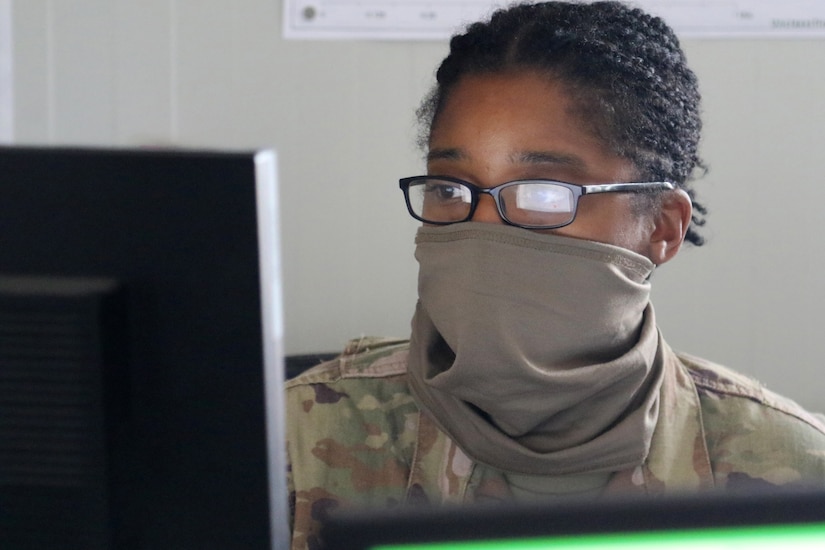
A soldier wearing a face mask and eyeglasses works at a computer.

"I found out I wasn't going to BLC the day I was leaving," said Army Sgt. Robert M. Raitano, the noncommissioned officer in charge of intelligence with the 207th Regional Support Group. "My bags were packed."

The three-week course is crucial for young soldiers. It is the first official step in learning how to be a noncommissioned officer, and the class is required before they can be promoted to sergeant. Even if personnel can get a waiver while on deployment, they still are required to attend the school when they return to the United States.

Some soldiers had waited for years for the opportunity to take the course. Army Sgt. Aquenda R. Roundtree, the operations noncommissioned officer in charge with the 248th Area Support Medical Company, said she had been trying to go to the school since 2017, but her transfers among various Georgia National Guard units derailed those efforts. The latest cancellation promised another long delay.

"I was, like, 'Wow – again?'" she said, "because they kept pushing it back."

In April, the NCO Leadership Center of Excellence delivered a solution: an online version of the class supplemented by instructors stationed at each base. Despite the course being primarily online, the students were still required to lead physical fitness training while maintaining social distancing requirements.

The students' units provided the assistant instructors. At Al Asad Air Base, Iraq, the 207th Regional Support Group and the 248th Area Support Medical Company combined efforts to create a class for five students. Army Staff Sgt. Heather Bojarski, a small group leader with the U.S. Central Command NCO Academy at Camp Buehring, said other participants were spread throughout more than a half-dozen countries – all reporting back to the school in Kuwait.

The assistant instructors at Al Asad attempted to recreate a school environment as much as possible. They reserved a meeting room and had internet connections installed so the students could train together. The NCOs scheduled physical training sessions in the morning prior to classes and had the students march to meals together to practice drill and ceremonies.

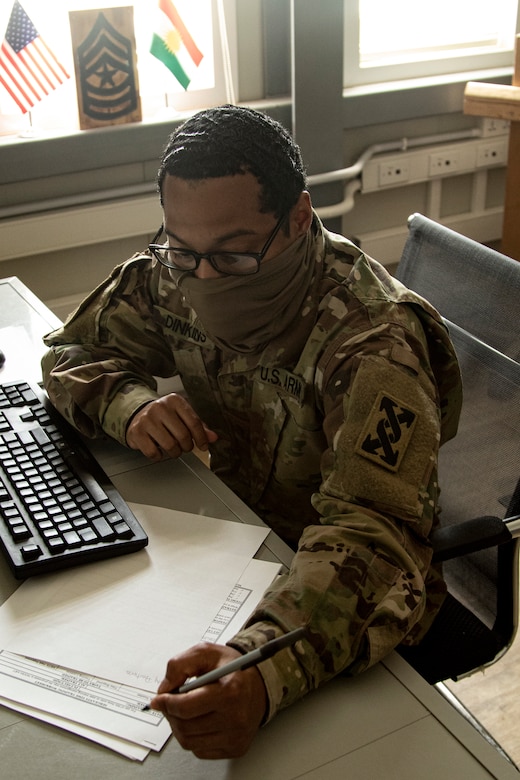
A soldier wearing a face mask and eyeglasses is seated at a table, taking notes as he works on an online assignment.

"I was thinking we'd just be sitting there online all the time," Roundtree said. "I didn't expect everything that happened."

During class hours, students regularly responded to questions and reacted to each other's discussion points using their laptops. Outside of class, they had to prepare written papers and a public speaking presentation. Roundtree, who was the first student to serve as class leader, helped ingrain the standards and common procedures their group followed throughout.

"We always tried to stay ahead of the game," she said. "Everyone was held accountable so nobody fell behind."

Raitano, who said he originally joined the military five years ago with no specific goals in mind, said the class helped him clarify his understanding of leadership, followership and what kind of person he wants to be. He zeroed in on servant leadership, particularly after helping classmates with the required school tasks.

"It took constant hours of practice and preparation," he said. "Being able to see results from that was very inspiring."

Teamwork became essential as the students aided each other in their studies and practices for the practical exams. Students gathered after class hours to work on drills.

"We never really had a moment where we feuded or didn't agree with each other," Raitano said. "We came together fairly well."

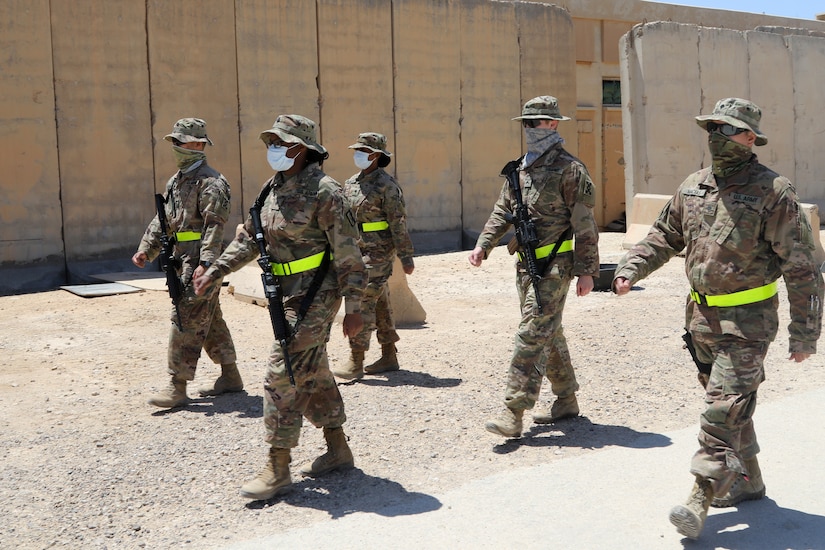
Socially distanced soldiers wearing face masks practice drill and ceremonies.

Both Raitano and Roundtree, similar to others in their class, received their promotion to sergeant shortly after graduating.

"There were a lot of things I didn't know," Raitano said of the lessons he learned from the classes. "There are things I will pick up and use in my day-to-day life."

From her office in Kuwait, Bojarski said the remote class program has continued to be successful. According to the school, out of 201 students in the first class, 193 graduated in May. The second class started in June.

"I liked the challenge," she said of the emergency BLC. "I liked that it tapped our resiliency….and it pushed me to think outside the box."

The unique situation has led to the innovative use of technology in some cases. When one of the students was having trouble passing their physical resilience training drills, the assistant instructor used a video call to contact Bojarski and let her watch for issues.

"I could actually see what the sergeant was doing," she said.

Likewise, in subsequent BLC classes the school increased its use of the online Defense Collaboration System, which has increased the small-group leaders' ability to communicate with remote students every day.

"It made me more accessible to them," she said, noting it allowed them to problem solve together. "That's what we're here for."

(Army Sgt. 1st Class Gary Witte is assigned to the 207th Regional Support Group.)

Fitness Center at Joint Base Charleston Opens With Restrictions

July 6, 2020 | BY Air Force Airman 1st Class Cory Davis , Joint Base Charleston

The 628th Force Support Squadron's operations have recently started back up, including the opening of the Air Base Fitness Center at Joint Base Charleston, South Carolina, with restrictions in place due to COVID-19.

"When the military members come in, they have to have on a mask," said Air Force Master Sgt. Sandra Coleman, the fitness and sports section chief with the 628th FSS. "We go over the COVID-19 questionnaire, and we also have our rules printed out. The newest thing is that customers do not have to wear a mask while they're working out. As they transition from equipment or machines, they do have to put their mask back on. They have to abide by the room capacity numbers and maintain a minimum of 6 feet of physical distance."

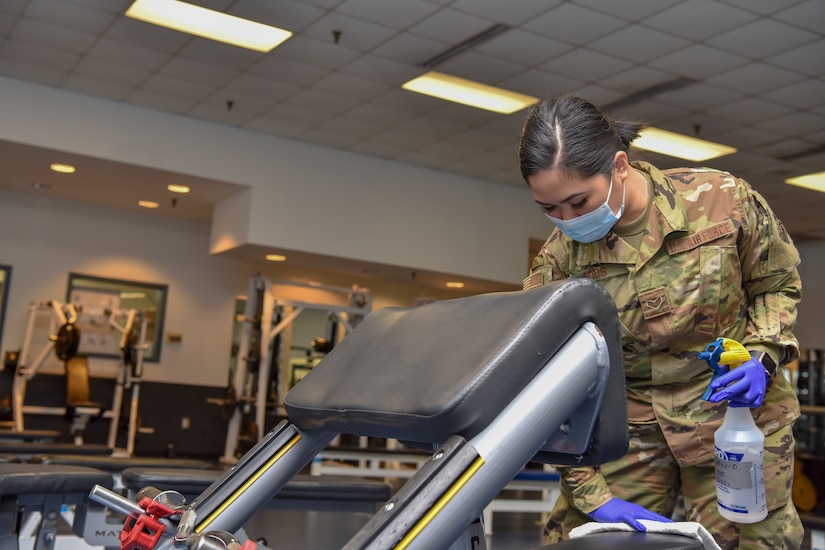
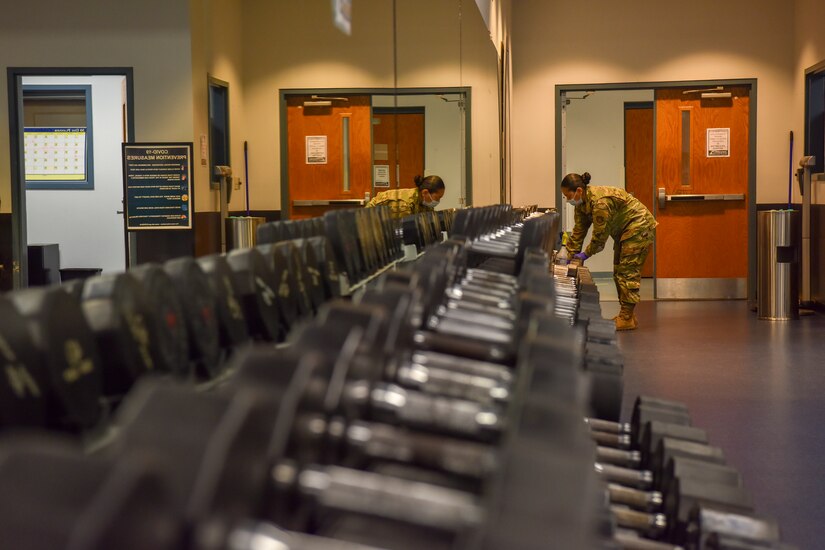
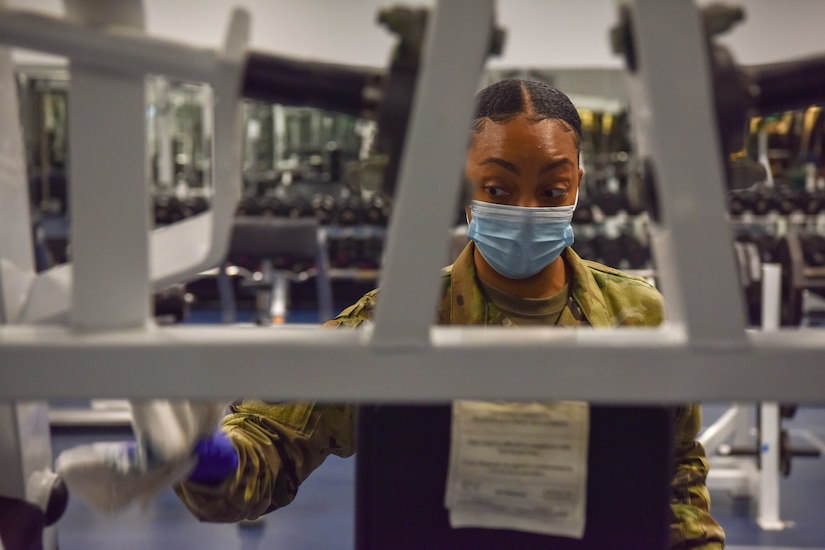
An airman sanitizes fitness equipment.

Coleman added that the fitness center team has spaced all the equipment out to ensure compliance with social distancing guidelines.

"Customers must wipe down all equipment bars, handles, seats, etc.," she said. "There is no equipment that will be handed out, and all members must exit through the hurricane port into the lobby, where they will check out with us. Also, personnel must come in proper fitness attire — changing is not permitted."

An airman sanitizing fitness equipment.

Air Force 1st Lt. Brian Boarman, the officer in charge of fitness and sports, outlined the gym facilities that remain closed.

"Our parent-child room is closed," he said. "The spin room, the racquetball courts, the Alpha Warrior rig and the aerobics room are all closed, as well as the locker rooms, the sauna and the showers."

Boarman also listed who is allowed in the Air Base Fitness Center and what times they are allowed to be there.

An airman sanitizing fitness equipment.

"Right now it is all active duty, guard and reserve members only," he said "We do not have 24-hour access right now, nor do we have weekend hours. The reason is we wouldn't have the staff to clean it. We're open Monday through Friday from 6 a.m. to 8 p.m."

Trail Tradition

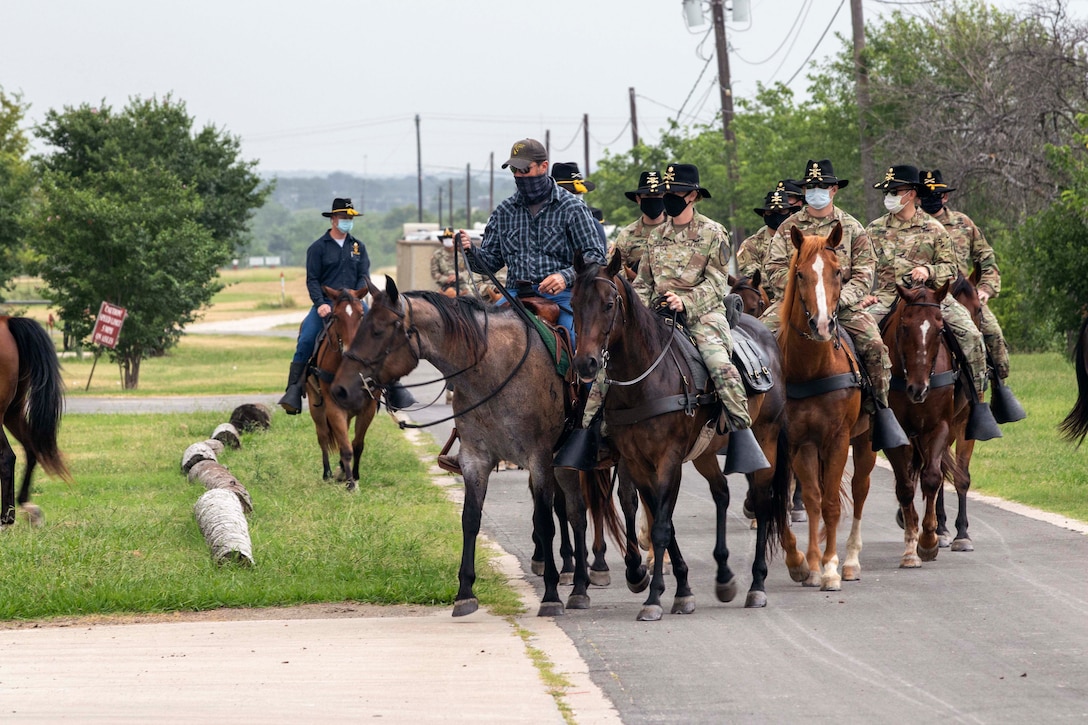
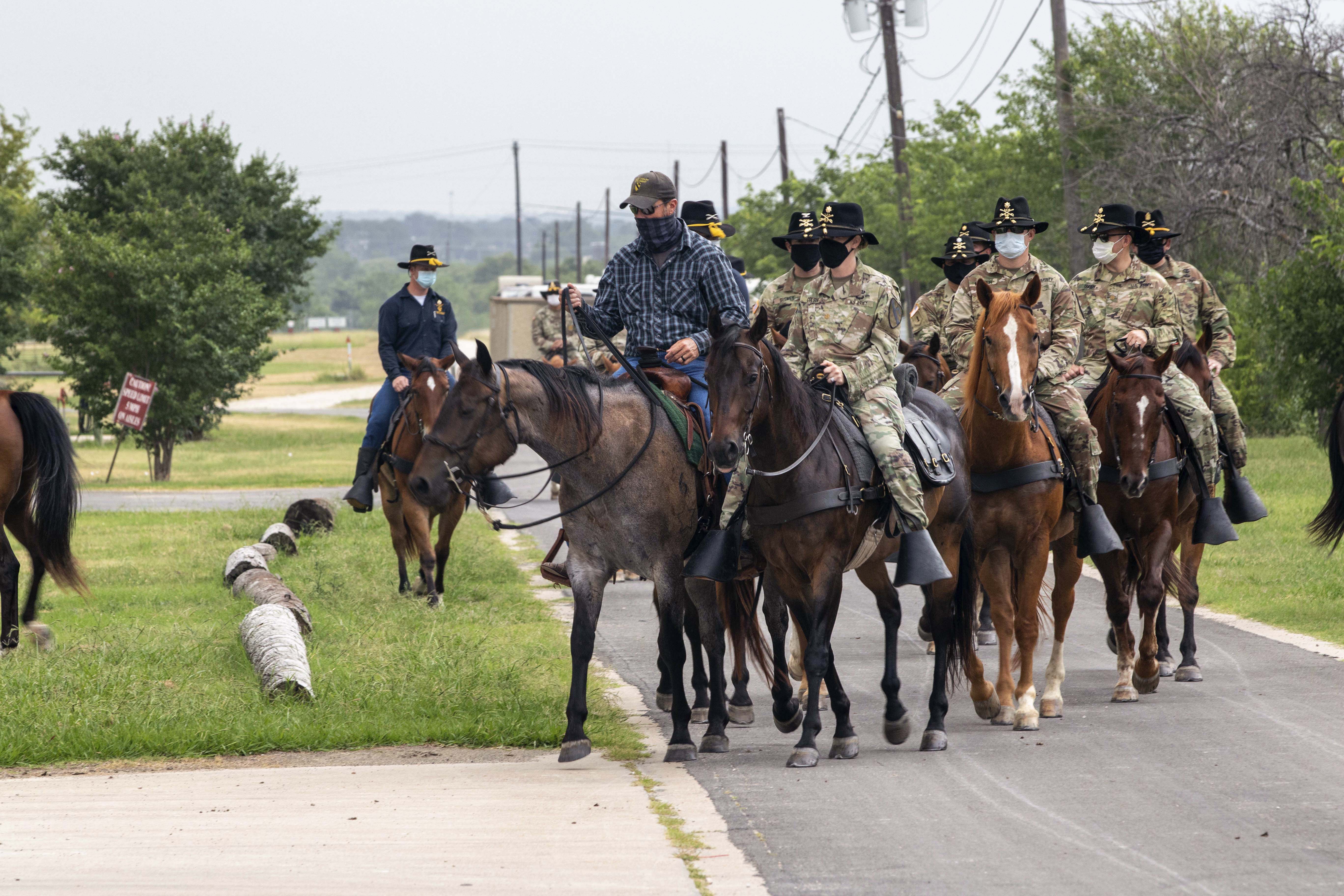
A group of soldiers ride horses.

Soldiers participate in a trail ride led by the 1st Cavalry Division Horse Detachment at Fort Hood, Texas, July 1, 2020.

Cargo Delivery

A Marine Corps CH-53E Super Stallion prepares to place cargo on the flight deck of the USS Bataan in the Atlantic Ocean, June 29, 2020.

Routine Ops

The USS Ronald Reagan steams through international waters while conducting routine flight operations in the South China Sea, July 4, 2020.

Flag Officer Announcement

July 6, 2020

Secretary of Defense Dr. Mark T. Esper announced today that the president has made the following nomination:

Navy Capt. Trent R. Demoss for appointment to the rank of rear admiral (lower half). Demoss is currently serving as vice commander, Fleet Readiness Center, Patuxent River, Maryland.

General Officer Announcement

July 6, 2020

Secretary of Defense Dr. Mark T. Esper announced today that the president has made the following nomination:

Marine Corps Col. David Nathanson for appointment to the rank of brigadier general. Nathanson is currently serving as the assistant chief of staff, G-4, I Marine Expeditionary Force, Camp Pendleton, California.

General Officer Announcements

July 6, 2020

Secretary of Defense Dr. Mark T. Esper announced today that the president has made the following nominations:

Air Force Lt. Gen. Glen D. VanHerck for appointment to the rank of general, with assignment as commander, U.S. Northern Command; and commander, North American Aerospace Defense Command, Peterson Air Force Base, Colorado.  VanHerck is currently serving as director, Joint Staff, Pentagon, Washington, D.C.

Air Force Lt. Gen. Richard M. Clark for appointment to the rank of lieutenant general, with assignment as superintendent, U.S. Air Force Academy, Colorado Springs, Colorado.  Clark is currently serving as deputy chief of staff, strategic deterrence and nuclear integration, Headquarters U.S. Air Force, Pentagon, Washington, D.C. 

Air Force Maj. Gen. Tony D. Bauernfeind for appointment to the rank of lieutenant general, with assignment as vice commander, U.S. Special Operations Command, Pentagon, Washington, D.C.  Bauernfeind is currently serving as chief of staff, Headquarters U.S. Special Operations Command, MacDill Air Force Base, Florida.

Air Force Maj. Gen. Jeffrey A. Kruse for appointment to the rank of lieutenant general, with assignment as the director’s advisor for military affairs, Office of the Director of National Intelligence, McLean, Virginia.  Kruse is currently serving as director for defense intelligence (warfighter support), Office of the Under Secretary of Defense (Intelligence), Pentagon, Washington, D.C.

Saturday, July 04, 2020


Rushmore Flyover

The Navy’s Blue Angels fly over Mount Rushmore, S.D., during a Salute to America celebration, July 3, 2020. The Blue Angels, based out of Naval Air Station Pensacola, Fla., were part of the Defense Department’s participation in the event.

Thursday, July 02, 2020

No Sign of Operations Tempo Slowing, National Guard Bureau Chief Says

July 2, 2020 | BY David Vergun , DOD News

Some 120,000 members of the National Guard have responded this year to natural disasters — floods in Michigan, wildfires in Kansas and tornadoes in Tennessee, just to name a few; — and have participated in global military operations and responded to civil disturbances and to COVID-19, the chief of the National Guard Bureau said.

"It has been a crazy year, and it's just early July," Air Force Gen. Joseph L. Lengyel said today during a Brookings Institution webcast today titled "The Force America Needs: Lessons of 2020 and the Future of the National Guard."

A soldier puts on protective gear.

With COVID-19 cases on the rise in some states and no reduction to worldwide operational commitments, Lengyel said, he sees no reduction in operations tempo.

About 45,000 members of the guard have been assisting with COVID-19 mitigation efforts in every state and territory since the pandemic started, the general said. Another 45,000 supported the law enforcement response to civil disturbances in 33 states.

"All across the country, the National Guard was aiding the American people, delivering personal protective equipment, and in some cases, they were manufacturing personal protective equipment, staffing food banks and test centers, protecting peaceful protesters' First Amendment rights, and sharing best practices as we learn how to do some of these things," Lengyel said.

A soldier loads medical supplies into a vehicle.

Infantry officers were running food banks and COVID-19 test sites, he noted, adding that the National Guard "can do any task that our nation needs them to do."

While serving Americans on the homefront, none of the National Guard's operational commitments to combatant commanders around the world were reduced, he added.

A service member directs a jet.

Lengyel said the National Guard has been involved in space operations for at least 25 years and that he hopes it will play a major role in the Space Force, the newest military service.

The National Guard has some unique advantages in the Defense Department, the general said. A big advantage, he pointed out, is that it is less costly to fund the guard compared to the active forces. In time of war or national emergency, the National Guard can be quickly mobilized and used at the federal level or under the direction of the state governors, he added.

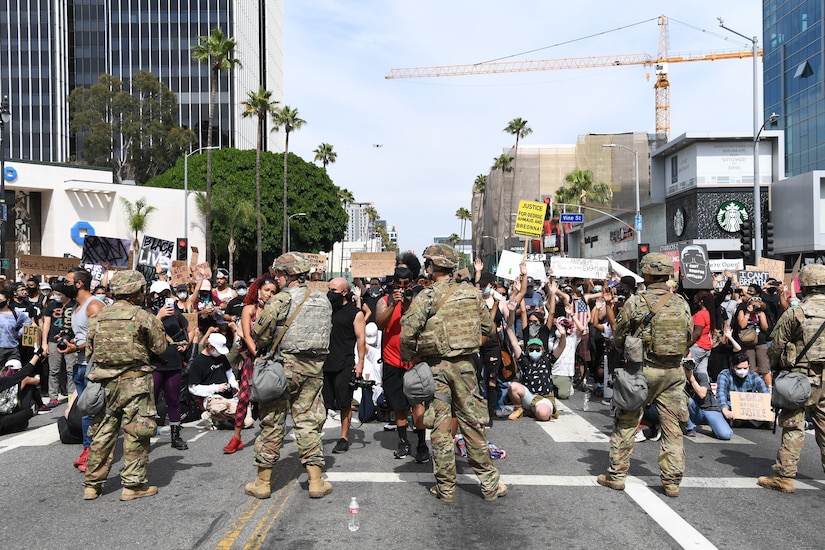
Service members stand in front of protesters.

Lengyel said that when he joined the Air Force more than four decades ago, the National Guard was used as a strategic reserve. Today, he said, its is an important component of the operational force, trained and equipped with modern weapons and ready to support combatant commanders globally.

Paratrooper Descent

Army paratroopers descend after jumping from a C-17 aircraft during training at Andersen Air Force Base, Guam, June 30, 2020, as part of Spartan Flex, an operation to exercise joint capabilities in the Indo-Pacific region.

People's Republic of China Military Exercises in the South China Sea

July 2, 2020

The Department of Defense is concerned about the People’s Republic of China (PRC) decision to conduct military exercises around the Paracel Islands in the South China Sea on July 1-5. 

The designated area where the exercises are due to take place encompass contested waters and territory. Conducting military exercises over disputed territory in the South China Sea is counterproductive to efforts at easing tensions and maintaining stability. The PRC’s actions will further destabilize the situation in the South China Sea.  Such exercises also violate PRC commitments under the 2002 Declaration on the Conduct of Parties in the South China Sea to avoid activities that would complicate or escalate disputes and affect peace and stability.

The military exercises are the latest in a long string of PRC actions to assert unlawful maritime claims and disadvantage its Southeast Asian neighbors in the South China Sea.  The PRC’s actions stand in contrast to its pledge to not militarize the South China Sea and the United States' vision of a free and open Indo-Pacific region, in which all nations, large and small, are secure in their sovereignty, free from coercion, and able to pursue economic growth consistent with accepted international rules and norms.

The Department of Defense will continue to monitor the situation with the expectation that the PRC will reduce its militarization and coercion of its neighbors in the South China Sea. We urge all parties to exercise restraint and not undertake military activities that might aggravate disputes in the South China Sea.

Department of Defense Statement on Gen. Gustave Perna's Confirmation

July 2, 2020

Secretary of Defense Dr. Mark T. Esper issued the following statement:

"Today, I’m proud to announce the U.S. Senate has officially confirmed General Gustave F. Perna as Chief Operating Officer of Operation Warp Speed (OWS). With experience as Commander of the Army’s Materiel Command (AMC), General Perna is exceptionally well qualified to help lead this historic operation to accelerate the development, manufacturing, and distribution of COVID-19 medical countermeasures. I have every confidence General Perna will carry out the duties of this mission with proficiency and professionalism, and the Department of Defense is committed to ensuring he has the resources, authority, and support he needs throughout this process."

Killeen Woman Faces Federal Charge in Connection with the Disappearance of U.S. Army Specialist Vanessa Guillen

Today, federal authorities filed a criminal complaint against 22-year-old Cecily Aguilar in connection with the disappearance of U.S. Army Specialist Vanessa Guillen, announced U.S. Attorney John F. Bash, U.S. Army Criminal Investigative Command (USACID) Special Agent in Charge Vanessa Neff at Fort Hood, and FBI Special Agent in Charge Christopher Combs, San Antonio Division.

The criminal complaint charges Aguilar with one count of conspiracy to tamper with evidence. According to the complaint, 20-year-old U.S. Army Specialist Aaron Robinson told Aguilar that he killed a female soldier by striking her in the head with a hammer while on Ft. Hood on April 22, 2020.  Robinson further admitted to Aguilar that he transferred the woman’s body off of Ft. Hood to a remote site in Bell County.  Subsequently, Robinson enlisted the help of Aguilar in disposing of the dead female’s body.  The complaint further alleges that at a later time Aguilar recognized the deceased, whom she helped Robinson mutilate and dispose of, as Vanessa Guillen. The remains found in Bell County have yet to be formally identified by authorities.

The complaint further states that earlier this week, Robinson shot and killed himself when confronted by police.

Upon conviction, Aguilar faces up to 20 years in federal prison and a maximum $250,000 fine.  She remains in custody at this time awaiting her Initial Appearance in federal court in Waco. The hearing is expected to take place early next week. 

Agents and investigators from USACID, FBI, Texas Rangers, Bell County Sheriff’s Office, Killeen Police Department, Belton Police Department, Texas Parks and Wildlife and the U.S. Marshals Service are continuing to investigate this case.  Assistant U.S. Attorneys Mark Frazier and Greg Gloff are prosecuting this case on behalf of the government. 

A criminal complaint is merely a charge and should not be considered as evidence of guilt.  The defendant is presumed innocent until proven guilty in a court of law.

Wednesday, July 01, 2020

DOD Recognition for Qualifying COVID-19 Operations and Activities

July 1, 2020

Recently, the department approved award of the Armed Forces Service Medal and Humanitarian Service Medal to recognize service members for their qualifying participation in COVID-19 operations or activities.  Both Active and Reserve Component members are eligible for such recognition. 

The period of award for both medals is from Jan.31, 2020, to a future “to be determined” termination date.  Given the global nature of the COVID-19 pandemic, there is no designated ‘area of eligibility’; rather, award authorities determine eligibility based on the nature of the member’s participation in qualifying DoD COVID-19 operations and activities. 

Military Department Secretaries determine eligibility for award to service members in his or her respective Military Department based on DoD award criteria.  The Chief of the National Guard Bureau determines eligibility for National Guard members who do not fall under the purview of a Secretary of a Military Department.  

Service members are not eligible for both medals based on the same activities, deployment, or period of service.  Due to the global nature of the COVID-19 pandemic, as an exception, the Armed Forces Service Medal is authorized for award for 30 consecutive or non-consecutive days of qualifying service.  

Additionally, the Armed Forces Service Medal deployment requirement is waived for non-deployed service members, provided the members were re-assigned from their normal duties to primarily perform duties related to DoD COVID-19 operations or activities for 30 consecutive or non-consecutive days.  

Due to the health risk posed by COVID-19, award of the Armed Forces Service Medal is authorized for one day of qualifying service if that service resulted in the member contracting the virus. (Note: Similar waivers are not required for the Humanitarian Service Medal because award criteria do not include a deployment requirement or a minimum period of qualifying service for award.)

More details can be found in the related memo here.