Sunday, August 31, 2025

WWII Hero Honored at U.S. Open Tennis Championships

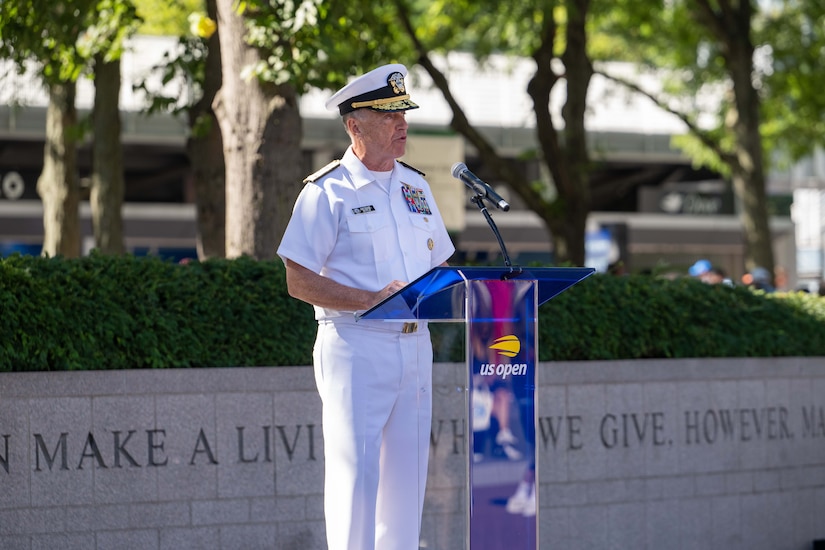
The U.S. Tennis Association hosted the 2025 Lt. Joe Hunt Military Appreciation Day yesterday at Arthur Ashe Stadium, in Queens, New York. 

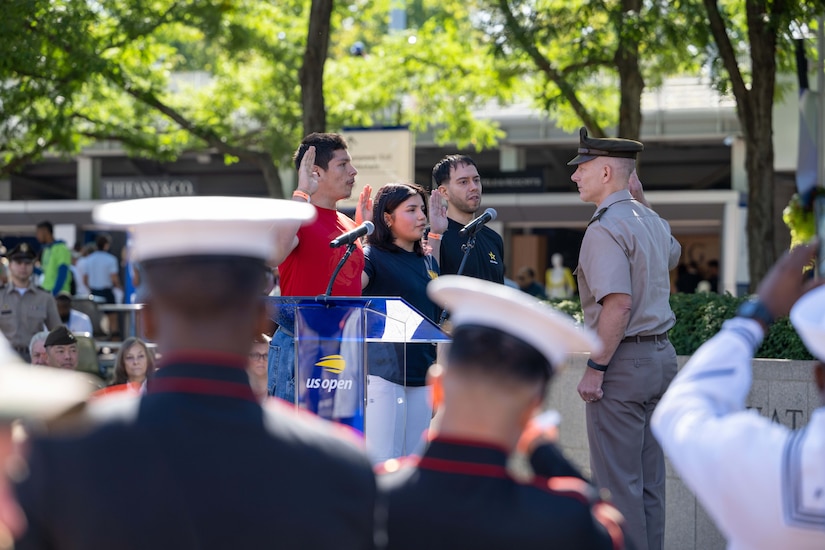
A man wearing a formal military uniform stands at a podium and speaks during an outdoor ceremony.

This U.S. Open tennis tournament event is dedicated to honoring and recognizing members of the U.S. military, named in honor of Hunt, the only U.S. Open champion to die in service to his country. 

Several speakers at the event paid tribute to Hunt. 

More than a tennis player, Hunt was the U.S. Nationals champion, an NCAA champion, a Naval Academy graduate and a Navy football star. Like so many of his generation, he put aside his personal achievement to answer his nation's call, said Navy Rear Adm. Michael Boyle, director of the Navy staff. 

After the Japanese attack on Pearl Harbor on Dec. 7, 1941, Hunt "traded aces on the court for the challenge of becoming an ace in the sky, earning his wings of gold as a naval aviator," he said. 

This year marks 80 years since his sacrifice, and it also marks a historic milestone: the 250th birthday of the United States, Navy, Marine Corps and Army, Boyle noted. 

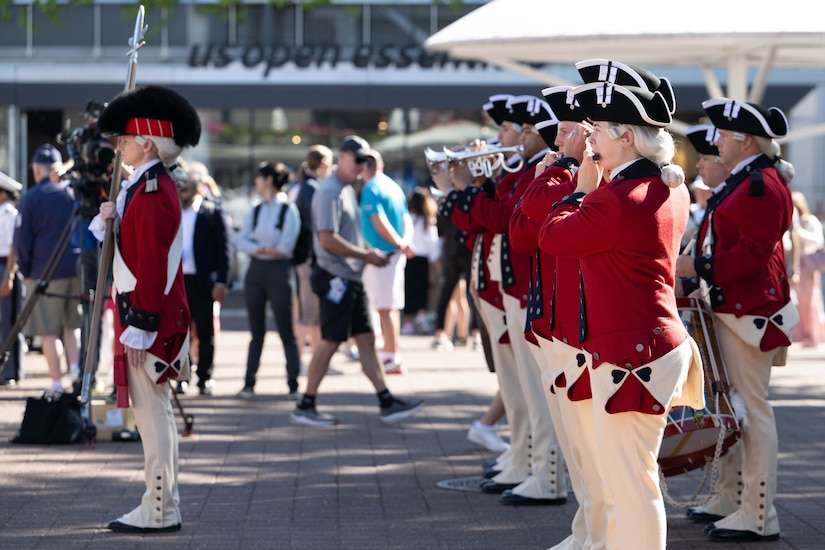
People dressed in colonial period uniforms stand in formation and play instruments at an outdoor event.

"Our sacred duty is to fight with toughness, tenacity and integrity to defend this nation. That is what 250 years of service means," he added. 

Joe Hunt, grand-nephew of Lt. Joe Hunt, said, "The military has a code which says we shall never forget, and that is what this day is very much about. To those of you who wear and have worn the uniform, we will not forget your service.  

"We truly appreciate your sacrifice and the sacrifice of your families, and we will never forget you," he added. 

Yesterday's events included an oath of enlistment ceremony, military family engagements and performances by the Old Guard Fife and Drum Corps, as well as the Navy Sea Chanters. 

More About Lt. Joe Hunt 

Hunt won the 1943 U.S. Open Tennis Championships in New York City while on leave from the Navy in early September of that year. 

He is the only man in history to win the U.S. national boys' (then 15-and-under), juniors' (18-and-under), collegiate and U.S. men's singles titles.  

Hunt also played football at the U.S. Naval Academy, winning a game ball in the 1941 Army-Navy game after beating Army 14-6 in Philadelphia, Nov. 29, 1941. Eight days later, the Japanese bombed Pearl Harbor, Hawaii. 

Due to wartime needs, Hunt's class graduated early on Dec. 19, 1941, instead of in the spring of 1942. Upon graduation, he was assigned to the destroyer USS Rathburne, an antisubmarine warfare training ship homeported in San Diego.  

At the end of September 1943, Hunt was assigned to the destroyer USS Kearny, which escorted a merchant convoy to Casablanca, Morocco. However, he wanted to fly and was eager for combat duty, according to his grand-nephew Joe Hunt, a Seattle attorney who was named for his great uncle.  

Hunt requested a transfer to aviation, and it was granted. His training began at Naval Air Station Dallas on Dec. 30, 1943. In May 1944, he received advanced aviation training at Naval Air Station Pensacola, Florida. He wanted to defend his tennis title that year, but his leave request was denied. 

On Feb. 2, 1945, Hunt's F6F Hellcat fighter aircraft crashed into the Atlantic Ocean east of Daytona Beach, Florida, during a training flight. Hunt and his aircraft were never recovered. 

Hunt left behind a wife, Jacque Virgil Hunt, whom he married in 1942.  

Hunt was inducted into the International Tennis Hall of Fame in Newport, Rhode Island, in 1966. 

On Sept. 1, 2014, Hunt was honored on center court at Arthur Ashe Stadium during the U.S. Open, an event he won 71 years earlier.  

Every year since 2019, the U.S. Open has celebrated his service and honored service members and veterans on "Lt. Joe Hunt Military Appreciation Day." 

Thursday, August 28, 2025

Army Medical Researchers Hunt for Indicators of Heat Stress Risk

Heat-related injuries are a persistent threat to warfighters, especially during ruck marches and timed runs. Physiologists have long sought to understand why some people are able to withstand the effects of heat for longer periods, while others of the same age and physical condition are prone to experiencing potentially dangerous symptoms.

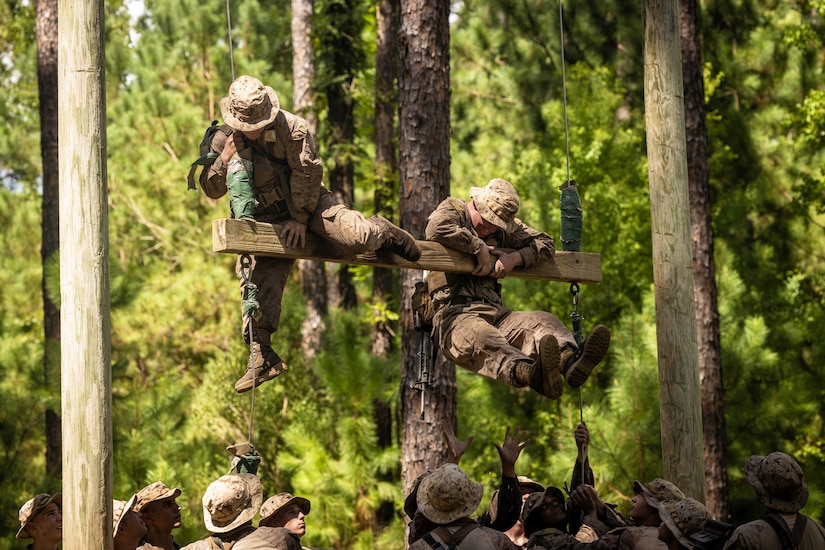
Two Marine Corps recruits climb a wooden structure as dozens of fellow recruits provide support from below in a wooded area.

A team of researchers at the U.S. Army Research Institute of Environmental Medicine is seeking to solve that mystery by identifying specific physiological characteristics of people who can withstand extreme heat stress during training. By helping to identify risk factors and prevention strategies for heat-related illnesses, the research could lead to improved recovery and return-to-duty protocols that better protect the health of warfighters, thereby improving their readiness, endurance and lethality. 
 
Exertional heatstroke — a severe form of heat illness typically marked by high body temperature and altered mental status such as disorientation and loss of consciousness — affects nearly 500 service members per year. The Medical Surveillance Monthly Report recently found that the overall incidence rate of EHS among military personnel increased in 2024 after three years of steady decline.  

Gabrielle Giersch, a research physiologist in USARIEM's Thermal and Mountain Medicine Division, is leading the study and said that the research into identifying risk factors and biomarkers associated with resilience to heat stress will help fill key gaps in the Defense Department's understanding of heat-related illness. 
 
"Heat illnesses pose a serious threat not just to individuals, but also to units and deployability, and they impose a significant financial cost as well," Giersch said. "We don't have a lot of data on the factors that contribute to the onset of heat illness or optimal recovery time. This study is designed to help us develop better criteria for determining the return-to-duty requirements for heat illness [sufferers] by identifying what puts people at risk and how those risk factors affect them." 
 
Earlier this summer, Giersch and her team traveled to Fort Rucker, Alabama, where they recruited 24 volunteer soldiers assigned to the 1st Battalion, 145th Aviation Regiment, to serve as the study's control group. Prior to participating in a 5-mile run and an 8-mile ruck march as part of their regular physical training, the volunteers provided blood and urine samples and were fitted with instrumentation to monitor their heart rate, skin temperature and core temperature.

Marines carry a log while walking through murky waters.

They also completed a brief questionnaire on their health history. In follow-up visits, the research team collected blood and urine samples from the volunteers at six-hour intervals for an additional 24 hours — the same frequency that care providers in emergency departments and hospitals take samples from actual heat illness patients. The samples will be analyzed to identify the prevalence of biological molecules that can be correlated with a volunteer's ability to better withstand the onset of EHS. 
 
"The 24 individuals who participated in the initial data collection represented a pretty wide spectrum of race, sex, fitness status and body mass index," Giersch said. "We haven't analyzed the blood samples yet, but the core temperature data showed that several people reached high temperatures without experiencing any symptoms of EHS and cooled off very quickly, which gives us a very good indication that we have a really good control group to identify what individuals who don't become heat illness casualties look like relative to those who do." 
 
Giersch said the team hopes to enlist special operations forces as volunteers to participate in similar data collection events throughout the summer. The team is specifically seeking data from the elite warfighter population because they tend to experience a higher rate of heat-related illnesses thanks to the intensity of their training.  

The team aims to publish their findings next year. The outcomes of this study will also be used to inform future updates to the Army's medical bulletin, "Heat Stress Control and Heat Casualty Management," which provides guidance for developing and implementing programs for preventing, diagnosing and treating heat-related injuries — crucial for ensuring a swift return to duty and improving unit readiness rates.

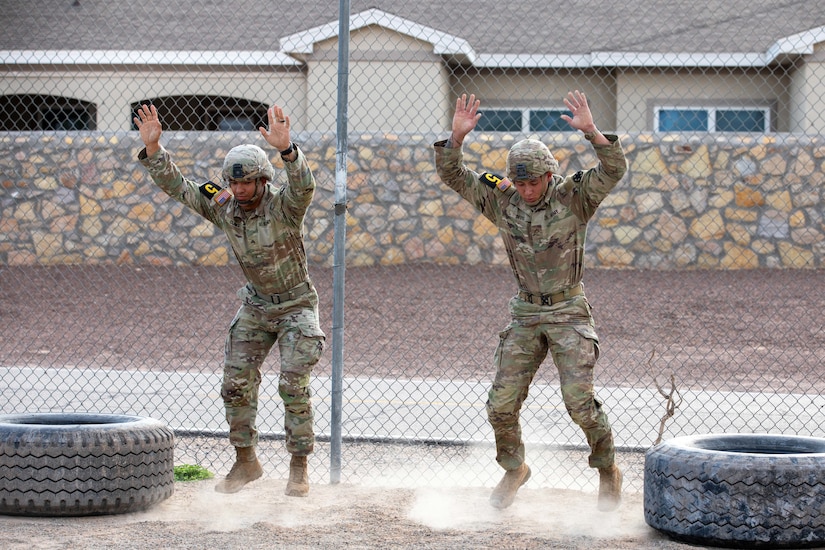
Two soldiers in tactical gear jump in between tires in front of a fence.

 
In addition to informing policy decisions and pushing the boundaries of our understanding of heat-related injury, Giersch said the study has also been of intense personal interest to the soldiers who volunteered to participate in it. 
 
"There is so much intrinsic value for the volunteers in this study," she said. "People were constantly coming up to me and asking what their core temperature was, when we'd have their blood data and similar questions. They want to see the papers when they get published and learn how our study impacts policy. They really want to make life better for their future battle buddies, whether they know them or not. That makes it all worthwhile."

Wednesday, August 27, 2025

Paratroopers Make History With Army's First Drone-on-Drone Strike

 Aug. 27, 2025 

By Army Capt. Jennifer French, 173rd Airborne Brigade

For Army 1st Lt. Francesco La Torre, the Army's first drone-on-drone strike wasn't exactly a Hollywood moment. 

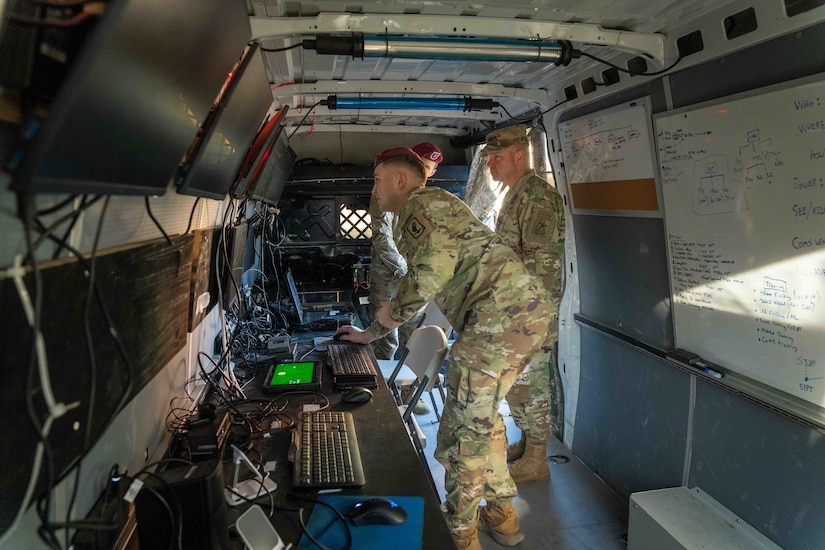
A man in a camouflage military uniform looks at a computer screen while moving a mouse. Another soldier in similar attire looks at the screen. Both men and another soldier in the background are standing in a long vehicle with a line of computers and monitors on the left side.
"In [the Star Wars movie], 'A New Hope,' Luke Skywalker flies an X-Wing through the Death Star trench and blows it up," La Torre said. "This wasn't like that. It was way harder. Honestly, it felt more like Darth Vader shooting down rebel pilots. He might be the villain, but he's also one of the best pilots in the galaxy." 
 
That was the image in La Torre's mind as his team with the 173rd Airborne Brigade achieved a milestone once unimaginable for conventional Army units: destroying an aircraft in flight using a first-person-view drone carrying an explosive charge. 
 
The strike took place earlier this month during the Army's Unmanned Aerial Systems and Launched Effects Summit, held Aug. 11-15 at Fort Rucker, Alabama. The live-fire event was led by the brigade's bayonet innovation team in partnership with the Pennsylvania Army National Guard and engineers from Army Combat Capabilities Development Command. 

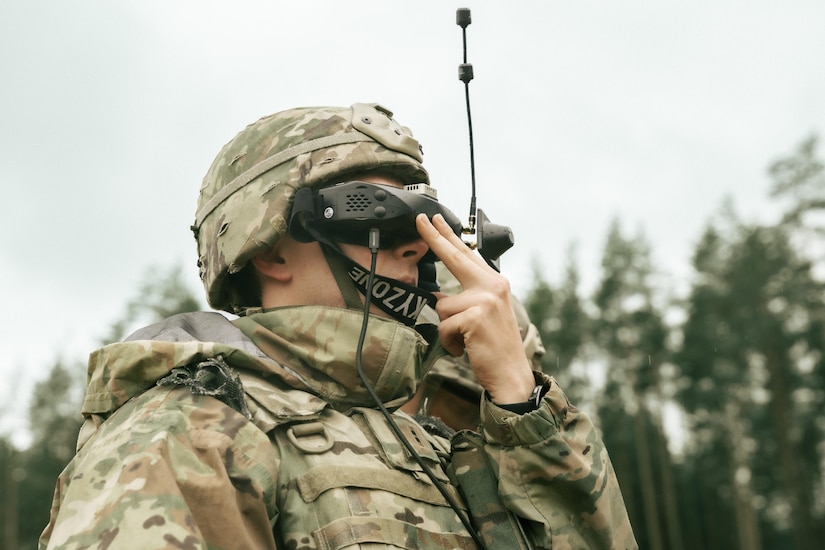
A soldier in a camouflage military uniform and helmet adjusts tactical goggles on his face.

 
"When I heard [Army] Chief [Warrant Officer 2] Nate Shea say, 'Arming,' when he was lined up behind the fixed wing threat UAS, I knew he'd take it down," La Torre said. "A few seconds later he detonated the claymore [mine], and I looked up from my end-user device to see the fixed-wing [aircraft] drop out of the sky." 
 
The success came after weeks of training. Paratroopers flew for hours each day, building muscle memory while rehearsing how to engage a fast-moving aircraft. Army Chief Warrant Officer 2 Andrew Topits familiarized himself with the fixed-wing platform a month in advance, while Shea practiced with inactive claymores. Once on the ground at Fort Rucker, the operators flew daily in changing weather, preparing for a target that could appear anywhere across the range. 
 
Technical skill proved as important as piloting. 
 
"The ability to train and solve problems immediately afterwards was critical to mission success," La Torre said. "The team was soldering, disassembling, reassembling and performing [quality assurance] around the clock while rehearsals were underway. While tactical units and technicians may not share the same language, they do share an intellectual curiosity and desire to succeed." 
 
La Torre emphasized what it means for the average paratrooper. 

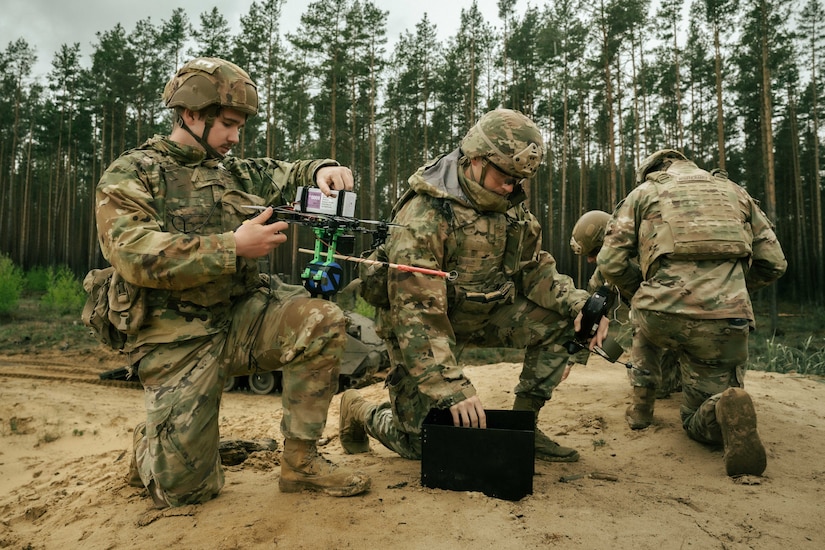
A group of soldiers in camouflage military uniforms kneel in the sand. A soldier on the left is holding a drone, while the soldier to the right is holding a remote. There are trees in the background.

 
"With the right kit, paratroopers will be able to utilize a low-cost system with preexisting munitions to execute a wide variety of mission tasks — and have the power to protect their unit from an endemic threat," he said. 
 
The drone demonstration showed that innovation doesn't have to come from the top. 
 
"It feels extremely satisfying to have this level of impact, but solving these kinds of problems should not be alien to junior officers, or any leader," La Torre said. "Every year the Army produces leaders at all levels who are better educated now than ever before. At the end of the day, rank is immaterial when it comes to problem-solving." 
 
For La Torre, the milestone reflects how far the 173rd Airborne Brigade has come. 

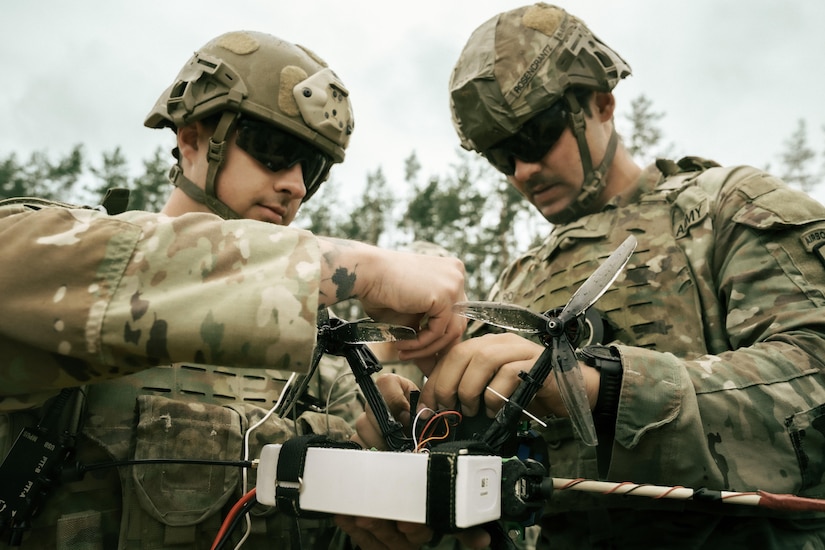
Two soldiers in camouflage military uniforms work on a drone.

 
"At this time last year, this kind of training was a pipe dream for conventional units," he said. "For the engagement itself, Chief Shea did an incredible job and so did Chief Topits. It's such a difficult mission profile for both aircraft." 
 
Lessons from the bayonet innovation team fed directly into Fort Rucker's new lethal UAS course, directed by Army Capt. Rachel Martin and Army Maj. Wolf Amacker. The course consolidates milestones within the Army's UAS community and serves as a hub for education and experimentation. 
 
"The more testing and experimentation we do, the less we must teach theoretically and the more we can back claims with real data," La Torre said. "Safe and effective experimentation allows commanders to understand the true nature of the risks they assume with these systems and helps make this training more commonplace." 
 
For La Torre, the boundaries are clear: safety and scalability. 
 
"We must safely conduct training, testing and experimentation," he said. "We also must make sure everything we do is exportable to other units so they can do the same. I'm confident what we've done is scalable, and the lethal UAS course at Fort Rucker will centralize the growth of lethal UAS engagements while also serving as a hub for subject matter experts to gather and exchange lessons learned."

FIM-92 Stinger: A concise history, capabilities, and combat record

Few weapons have shaped modern low-altitude air defense as visibly as the FIM-92 Stinger. A shoulder-fired, “fire-and-forget” surface-to-air missile (MANPADS), Stinger put credible anti-air capability into the hands of small units and irregular forces alike. This article surveys its origins and development, how militaries employ it, where it’s been used, and the system’s enduring strengths and weaknesses—along with how production has been sustained amid renewed demand.

Origins and development

The Stinger traces back to the U.S. Army’s effort to replace the FIM-43 Redeye with an all-aspect, more resilient MANPADS. Work began in 1967 under the “Redeye II” concept; the program was redesignated FIM-92 “Stinger” in 1972. Following a turbulent test program in the 1970s, production of the FIM-92A started in 1978, and the first units achieved Initial Operational Capability in 1981. Subsequent variants added dual-band IR/UV seekers and, critically, a reprogrammable microprocessor (RMP) that let the missile’s logic be updated for new threats without replacing hardware (FIM-92C “RMP,” FIM-92E “RMP Block I,” later FIM-92J life-extension). 

What the Stinger is—and how it works

At its core, Stinger is a supersonic, shoulder-launched missile guided by a passive seeker that homes on a target’s heat/UV signature. The current U.S. employment handbook emphasizes several properties:

  • Fire-and-forget guidance: Once the operator obtains lock and fires, the missile guides itself, letting the gunner move, take cover, or engage a second target.

  • IR/negative-UV homing with modified proportional navigation: guidance tuned for low-altitude aircraft, helicopters, and (in later updates) small uncrewed aerial systems (UAS).

  • Organic IFF support: an interrogator and antenna integrated with the gripstock help reduce fratricide risk under rules of engagement.

  • Tactical “planning range” of ~4 km (unclassified), with engagement geometry and target aspect strongly affecting outcomes.

  • Battery-Coolant Unit (BCU) constraints: once a BCU is activated it provides power and seeker cooling for at most 45 seconds, after which it must be replaced.

These are not abstract brochure claims—they are baked into field planning, training, and logistics.

On the hardware side, the designation record summarizes performance figures and evolution across variants. A typical Stinger round weighs roughly 10 kg (missile) and ~15–16 kg for a ready-to-fire unit, accelerates to around Mach 2+, and uses a ~3 kg blast-fragmentation warhead with impact/proximity/self-destruct fuzing (the proximity mode becoming more important against drones). The system ceiling is commonly cited near 3.8 km, with effective range around 4–5 km depending on target and environment; RMP Block II (cancelled in production) would have pushed the kinematic envelope further. 

Employment: teams, vehicles, and networks

A Stinger “team” (two soldiers is common) can deploy dismounted or from vehicles. The weapon’s modularity lets it serve as the missile component on Avenger turrets (HMMWV-mounted), Linebacker/Bradley derivatives, and newer M-SHORAD Stryker configurations, augmenting the human gunner with sensors, cueing, and stabilized mounts. For planning, Army guidance stresses integrating Stinger with early-warning sensors, airspace control measures, and combined-arms maneuver, not just parking a gunner on a ridgeline.

Where the Stinger has been used

The system’s combat debut came swiftly in the 1980s, but it never left the stage. Highlights include:

  • Soviet–Afghan War (1980s): Stinger’s arrival—widely associated with improved attrition of Soviet helicopters and attack aircraft—became a symbol of how portable air defense could blunt low-altitude air power. While narratives of “war-winning” effects are debated, authoritative technical histories still situate Stinger as “heavily used” in Afghanistan with hundreds of worldwide shoot-downs attributed to the type. 

  • Post-Cold War through GWOT: U.S. and allied forces retained Stingers for point defense, convoy overwatch, and base defense, often via Avenger or mounted applications. (These roles expanded and contracted as threat perceptions shifted.)

  • Ukraine (2022-present): Stinger was among the first air-defense systems transferred. By September 2024, the United States had provided over 2,000 Stinger missiles to Ukraine, and the system continues to feature in Ukraine’s layered SHORAD mix against helicopters, attack aircraft, cruise missiles, and drones. 

Strengths

Mobility and simplicity. A two-person team can move the weapon to where the fight is, with minimal logistics compared to radar-guided systems. For light infantry or dispersed territorial defense, that flexibility matters.

Fire-and-forget autonomy. Passive homing removes the need for illuminators or continuous guidance beams, reducing emissions and operator workload after launch.

All-aspect, multi-band seeker logic. Dual IR/UV sensing and reprogrammable processors (RMP) have kept Stinger viable against flares and background clutter—an ongoing “software war” against countermeasures. Upgrades like FIM-92J add proximity fuzing and refined logic for small, low-signature targets. 

Interoperability. From shoulder-launch to Avenger and M-SHORAD on Stryker, Stinger scales from pop-up ambush shots to networked, mobile air defense with cueing from radars and command networks. 

Proven combat record. Across decades and theaters, Stinger has repeatedly shown utility at the tactical edge, especially where larger systems can’t be everywhere at once. 

Weaknesses and limitations

Envelope constraints. Stinger is a short-range, line-of-sight system. With a planning range near 4 km and a ceiling around 3.8 km, fast jets at medium altitude or standoff munitions lie largely outside its sweet spot. Terrain masking can both help (ambush) and hinder (blocked sight lines).

Countermeasures. Modern aircraft bring flares, exhaust suppressors, flight profiles, and increasingly DIRCM (Directional Infrared Countermeasures). Army planning explicitly accounts for the “countermeasures environment” and the need to integrate sensors/cueing to maximize engagement quality. Even with IR/UV discrimination and updated software, sophisticated countermeasures stress MANPADS performance.

Time and power budget. The BCU hard limit—about 45 seconds of power/cooling per activation—adds pressure in high-tempo engagements and demands disciplined crew drills (don’t “burn” BCUs while waiting). Logistics must ensure sufficient BCUs alongside missile stocks.

Training and identification risk. Stinger includes an IFF subsystem, but IFF does not by itself authorize firing; rules of engagement and positive identification remain critical, especially in cluttered airspace with friendly UAS and coalition aviation. 

Aging inventory and obsolescence risk. After the U.S. last accepted new Stingers in 2005, parts obsolescence and atrophied production capacity became issues—until recent wars renewed demand. (See “Production and sustainment,” below.)

Tactics and use on today’s battlefield

Modern doctrine treats Stinger as part of a layered air-defense ecosystem rather than a silver bullet. A few practical patterns:

  • Ambush and area denial: Teams choose positions with good fields of view and short decision loops (observer-gunner pair, radio cueing). Short-range drones can be engaged with proximity-fuzed rounds or, in vehicle mounts, with integrated guns/sensors.

  • Mobility with maneuver forces: On M-SHORAD Strykers or Avengers, Stingers provide moving bubbles of protection for armored/mechanized units, especially against helicopters, loitering munitions, and low flyers. 

  • Cueing and command-and-control: Early warning from radars and airspace control nets matters—giving gunners seconds they won’t otherwise have to power BCUs, gain lock, and achieve a valid shot.

Production and sustainment: from “warm line” to multinational demand

The full-scale return of state-on-state conflict highlighted a dilemma: Western nations had drawn down stocks and allowed production lines to cool. In May 2022, the U.S. Army awarded Raytheon a $624.6 million contract modification for Stinger missiles and gear, the first major buy for new rounds in years, with deliveries projected into 2026. The award notice is explicit about the Stinger procurement and timelines. 

Demand is not just American. In July 2024, NATO’s procurement agency placed a nearly $700 million multinational order for Stinger missiles—an RTX (Raytheon) spokesman told Reuters the buy would keep the production line running through 2029. That order reflects both Ukraine’s consumption and allied recapitalization as European states rebuild short-range air-defense capacity. 

CRS analysis of U.S. defense production for Ukraine provides useful context: the United States had transferred more than 2,000 Stingers to Ukraine as of September 2024, while Army and industry worked through obsolescent parts and workforce gaps to restart production of a Cold War-era missile for twenty-first-century threats. 

Bottom line

The Stinger endures because it solves a timeless tactical problem: how to give small units a credible, mobile, immediately available answer to low-altitude air threats. Its strengths—mobility, autonomy, multi-band seeker logic, and interoperability—are balanced by weaknesses inherent to short-range, passive homing systems operating against modern countermeasures. In Ukraine and elsewhere, Stinger is no panacea; it is one indispensable layer. As allies recapitalize stocks and industry warms production back up, expect Stinger (and its successors) to remain a fixture of SHORAD doctrine—especially where drones and helicopters menace troops at the edge of the fight. 

References (APA)

Congressional Research Service. (2024, September 16). Defense production for Ukraine: Background and issues for Congress (R48182). https://www.everycrsreport.com/reports/R48182.html (EveryCRSReport)

Parsch, A. (2024, December 15). Raytheon (General Dynamics) FIM-92 Stinger. Directory of U.S. Military Rockets and Missiles. https://designation-systems.net/dusrm/m-92.html (designation-systems.net)

Reuters. (2024, July 9). NATO agency places $700 mln order for Stinger anti-aircraft missiles. https://www.reuters.com/business/aerospace-defense/nato-agency-places-700-mln-order-stinger-anti-aircraft-missiles-2024-07-09/ (Reuters)

U.S. Army, Center for Army Lessons Learned. (2018). Maneuver Leader’s Guide to Stinger (CALL Handbook 18-16). https://api.army.mil/e2/c/downloads/2023/01/19/18849503/18-16-maneuver-leaders-guide-to-stinger-handbook-apr-18-public.pdf

U.S. Department of Defense. (2022, May 27). Contracts for May 27, 2022 (Raytheon—Stinger missiles). https://www.defense.gov/News/Contracts/Contract/Article/3046664/ (U.S. Department of Defense)

Note: All sources are publicly accessible and verifiable as of August 27, 2025.
Tuesday, August 26, 2025

Navy Reservist Achieves Dream of Becoming an NFL Cheerleader


Aug. 25, 2025 |

By Tyler Grimes, Naval Supply Systems Command Fleet Logistics Center Jacksonville

As the NFL prepares to launch another exciting season, one Navy Reserve sailor is preparing for her own big debut.

Navy Petty Officer 2nd Class Alexis Gloster, a logistics specialist assigned to Naval Supply Systems Command Fleet Logistics Center Jacksonville, Florida, will step onto the sidelines this year as one of the newest members of the Jacksonville Jaguars cheerleading squad.

For Gloster, the accomplishment represents the fulfillment of a lifelong dream — one she has worked toward while balancing the demands of military service.

"After serving five years on active duty, I wanted the flexibility to pursue other dreams while still serving my country," said Gloster, who has now served a total of nine years in the Navy. "The Navy Reserve has given me the best of both worlds — remaining part of something bigger than myself while continuing to grow personally and professionally."

One of those dreams was professional cheerleading.

"I've loved performing and cheerleading for as long as I can remember," she said. "Becoming an NFL cheerleader was a way to share that passion on a huge stage while also making a positive impact in the community."

Earlier this year, the Fort Lauderdale, Florida, native auditioned for the Jaguars cheer squad. The process was rigorous, stretching across multiple rounds and lasting two weeks.

"We had to learn and perform choreography under pressure, complete an interview and stand out among more than 300 candidates," she recalled. "It really pushed me to be the best version of myself every single day. When I was selected, it made the moment even more special. It was intense but so rewarding."

Now, with the NFL preseason underway, Gloster is focused on balancing her Navy Reserve duties with the commitments of cheerleading on a national stage.

"It's definitely a balancing act, but the discipline and time management I've learned in the Navy help me stay on top of both," she said. "When you love what you're doing in both worlds, it makes the hard work worth it."

For Gloster, her role with the Jaguars is about more than performing in front of thousands of fans on Sundays.

"It's bigger than the field — it's about inspiring others, representing an incredible organization and connecting with people in meaningful ways," she said. "I feel so proud to wear both uniforms, the Navy's and the Jaguars'. They represent two very different worlds, but both are built on teamwork, dedication and heart."

Capt. Roger Dubé, Navy Reserve NAVSUP FLC Jacksonville commanding officer, said Gloster's role as a professional cheerleader could help with the Navy's recruiting efforts and set a good example for other Navy reservists to pursue their dreams.

"[She] is one of our unit's hard-chargers and also serves as our command fitness leader," Dubé said. "She is humble about her achievements as I was unaware of her selection as a professional cheerleader. We're looking forward to seeing her lead the games' crowds with her vibrant smile and energy."

As she looks ahead to her first season as an NFL cheerleader while continuing to serve in the Navy, Gloster hopes her story will motivate others to keep reaching for their goals.

"I hope my story shows others that you don't have to choose just one dream — you can chase them all," she said.

Guard Members Partner With Local Authorities to Render Life-Saving Aid in Multiple Incidents


Aug. 26, 2025 

By Army Master Sgt. Whitney Hughes  

"It was chaotic — people were running and screaming," said Army Staff Sgt. Zachary Graham, a member of the South Carolina National Guard assigned to the D.C. Safe and Beautiful Task Force, Joint Task Force District of Columbia.

Moments earlier, a man had been struck by a train and thrown across a Washington Metro station platform in Washington, Aug. 20. Graham and his fellow soldiers, all members of the 4th Battalion, 118 Infantry Regiment, immediately secured the scene, called 911 and assisted first responders in rendering first aid, ultimately reviving the man to the point that he was conscious and moving when EMTs transported him.

"Everybody was panicking but able to keep a clear head and make the phone call to 911 to get an ambulance on the way," said Army Spc. Nicholas Garrison, who was on patrol with Graham at the NoMa-Gallaudet U Metro station. "Our presence was important for getting him help as quickly as possible."

This was one of several life-threatening incidents in the past week where members of the task force were first on the scene to provide aid to local citizens and assist local authorities.

In an event at Union Station, two D.C. Army National Guard military police officers were conducting a joint patrol with the Amtrak Police Department, Aug. 15, when they encountered an unconscious man.

Army Sgt. Jay Whited, a team leader assigned to the 372nd Military Police Battalion, said the man appeared to have fainted and did not look well. They resuscitated him and contacted emergency services. Whited said the police suspected the man was experiencing a narcotic overdose and asked the guard members to help secure the scene while they administered naloxone, a medication used to reverse the effects of opiates.

"We are pretty uniquely positioned here, like all National Guard units, but even more so because it's D.C. and it's so small," he said. "We are uniquely experienced as well, and we integrate with local agencies well because we have done it so many times."

In addition to the metro incidents, guard members intervened during the assault of a U.S. Park Police officer, alerted the D.C. Metropolitan Police Department to a man brandishing a knife and making verbal threats at the Waterfront Washington Metro station and helped the U.S. Drug Enforcement Administration locate a missing child in southwest Washington.

Army Brig. Gen. Leland D. Blanchard, interim commanding general of the D.C. National Guard, stated that approximately 2,000 guard members are supporting the task force and providing critical assistance to local law enforcement officers. 

"The members of the District of Columbia National Guard are highly trained and capable of assisting our interagency partners to keep our district safe," he said.