Tuesday, December 02, 2025

NY National Guard Volunteers Give Lift to Trees for Troops

Seven New York National Guard soldiers and airmen joined local veterans Dec. 1 to load 150 Christmas trees onto a truck at Ellms Family Christmas Tree Farm in Ballston Spa, New York. 

A man, standing in the back of a delivery truck, hands a tree to another man.
This was the 21st year that tree farmers in the area donated to the Trees for Troops program. The donated trees are destined for service members and their families around the country. 
 
This year, soldiers of the New York Army National Guard's 42nd Infantry Division Headquarters, based in Troy, New York, and the Air National Guard's 109th Airlift Wing, Stratton Air National Guard Base, Scotia, New York, pitched in to help load the trees. 
 
Five hundred and fifty members of the 42nd Infantry Division are deployed to the Middle East and 200 airmen assigned to the 109th are deployed in support of Operation Deep Freeze, a National Science Foundation research mission in Antarctica. 
 
The volunteers made loading the trees easy, said Garth Ellms, owner of the Ellms Family Farm. 

Two men unload a tree from a delivery truck.
"We have a lot of troops that come in and so they work fast," Ellms said. "FedEx handles actually all the trucking of the trees for free throughout the entire country." 
 
For some volunteers, showing up was a way to pay back for receiving trees in the past. 
 
"The first time I did it, it was in 2021, and it was a great experience," said New York Air National Guard Staff Sgt. Mitchell Mihalko, a recruiter assigned to the 109th Airlift Wing. "How could I say no to an opportunity like this?" 
 
"2022, the winter of that holiday season, I was deployed, [and] I received a tree while I was deployed," Mihalko said. "So, to be on both ends of the spectrum, to see the start and the finished product, it made me feel like I had a duty to come back and to return the favor." 

Three men unload trees from a delivery truck.
In New York, trees will be delivered in December to military families at Fort Drum, West Point, the Niagara Falls Air Reserve Station and the U.S. Coast Guard Sector in New York City, along with other deliveries to 88 other military sites around the country. 
 
Fresh-cut Christmas trees are gathered at regional farms and retail lots, then picked up and processed through distribution centers for delivery to military bases. 
 
The movement and the morning load out of trees included members of the FedEx shipping team who volunteered to be part of the Trees for Troops event. 
 
Getting an opportunity to sign up for the event was easy for Mark Burby, a FedEx employee who said he has volunteered to be on the load-out team five times. 
 
"I'm a veteran, and I'm the senior guy," Burby said. "It's about helping out other vets." 

A man, standing in the back of a delivery truck, hands a small tree to a woman.
Since 2005, Trees for Troops has provided 326,273 Christmas trees to military families and troops in the United States and overseas. 
 
Military volunteers from the National Guard turn out each year to load and unload the trees, knowing they will be delivered to other military families. 
 
It is a very satisfying feeling to be part of that, said Air National Guard Tech. Sgt. Elizabeth Felix. 
 
"I'm happy to be here; it's such an honor," Felix said. "This is great support for the troops and that's why I'm here to give my time." 
 
Trees are expected to be delivered to military bases next week for distribution.  

DOW Awards $55 Million Grant for Nathan F. Twining Elementary & Middle School at Grand Forks Air Force Base, North Dakota

The Department of War's Office of Local Defense Community Cooperation awarded Grand Force Air Force Base Public School District No. 140 a $55,249,082 grant as the federal share of a larger $69,061,352 project to construct a new Nathan F. Twining Elementary/Middle School at Grand Forks Air Force Base, North Dakota. 

This project will address facility capacity and condition deficiencies that placed Nathan F. Twining Elementary and Middle School at 70th on the 2019 Deputy Secretary of Defense "Public Schools on Military Installations Priority List" (Priority List).  Upon completion, 500 pre-kindergarten through eighth-grade students will be supported through the project.

Funding for this grant is provided under the Department's Public Schools on Military Installations Program.  In making these funds available, the Office of Local Defense Community Cooperation must give priority consideration to military installations that have schools with the most serious capacity and facility condition deficiencies, as determined by the Priority List. 

A multi-disciplined Federal Evaluation Team, with representatives from the Assistant Secretaries of the Air Force, Army, Navy, and the Office of Local Defense Community Cooperation reviewed the school project to ensure the award appropriately addresses the noted capacity and facility condition deficiencies.

In correcting the identified facility condition and capacity issues at the Nathan F. Twining Elementary and Middle School, this grant keeps faith with service members, improves the quality of education for defense-connected students, aids in the recruitment and retention of vital skills at Grand Forks Air Force Base, and enhances partnerships between the community and the installation.

Hurricane Hunters Wrap Up 2025 Season After Flying Into Three Category 5 Storms

The 2025 Atlantic hurricane season officially ended Nov. 30, closing another demanding chapter for the Air Force Reserve's 53rd Weather Reconnaissance Squadron, known as the Hurricane Hunters. 

A man in a camouflage military uniform guides equipment from a forklift into the back of a military aircraft.

 
The squadron flew 927.9 hours this year across the Atlantic, eastern Pacific and central Pacific basins, collecting critical data that improved forecasts, saved lives and once again demonstrated the unit's no-fail mission. 
 
From their first flight into Hurricane Erick, June 18, to their final mission into Hurricane Melissa, Oct. 30, the 53rd WRS crews faced one of the most intense storm seasons in recent memory. This year's taskings included three Category 5 hurricanes and the second sub-900 millibar storm the squadron had flown into in as many years. 
 
The Hurricane Hunters kicked off the season when a WC-130J Super Hercules aircrew departed Keesler Air Force Base, Mississippi, for Hurricane Erick in the eastern Pacific. That marked the first operational flight of the 2025 season and the start of what forecasters predicted would be an active year for tropical systems. 

A graphic with numbers from the 2025 hurricane season is displayed over an image of tropical storms around the Caribbean and Atlantic Ocean.

 
"Our job is to fly directly into the storm and collect vital information such as wind speeds, pressure, temperature and humidity," said Air Force 1st Lt. Mark McCoy, 53rd WRS aerial reconnaissance weather officer. "While satellites provide a significant amount of information, the data we gather within the storm is unique and cannot be captured from space. That information helps the National Hurricane Center refine forecasts and gives people more time to prepare."
 
The squadron, assigned to the 403rd Wing, is the only War Department unit that flies into tropical systems to gather real-time atmospheric data. Using a fleet of 10 WC-130J Super Hercules aircraft, the squadron operates year-round and is prepared to support 24-hour operations during the peak of hurricane season. Data from its flights is transmitted in real time to the National Hurricane Center and shared with the National Oceanic and Atmospheric Administration, the Navy and other domestic and international forecasting agencies. 
 
"Every time we fly into a storm, we're collecting data that can directly impact how communities prepare and respond," said Air Force Lt. Col. Steve Burton, 53rd WRS director of operations and the deployed detachment commander. "We train all year for this. What we do helps save lives and property."
 
According to Warren Madden from the National Hurricane Center, the squadron's 2025 missions were defined not by quantity, but by intensity.

In the Atlantic basin, the squadron flew into Hurricanes Barry, Chantal, Erin, Fernand, Gabrielle, Humberto, Imelda, Jerry and Melissa, as well as an early August flight in the northern Gulf of America and another in late August near the Windward Islands. In the eastern Pacific, crews flew into Hurricanes Erick and Lorena, and in the central Pacific, they supported missions into Hurricane Kiko. 

Several people in military camouflage uniforms walk around a large gray military aircraft sitting on a tarmac.

 
"What was unusual this year was the overall lack of activity in both the Gulf and in the Caribbean," Madden said. "We only flew one named storm in the Gulf — Barry — along with two northern Gulf [flights]. Chantal was the only system that produced direct wind impacts to the continental U.S., and Melissa was the only storm we flew in the Caribbean." 
 
What stood out was the strength of several storms. 
 
"Three of the systems — Erin, Humberto and Melissa — reached Category 5 strength, and Melissa became the second sub-900 millibar storm we've flown [into] in as many seasons," Madden said, referencing 2024's Hurricane Milton. "That level of intensity in consecutive years is rare."
 
The Hurricane Hunters' most demanding mission of 2025 came late in the season, when Tropical Storm Melissa rapidly intensified over the Caribbean. On Oct. 21, the 53rd WRS deployed aircraft to a forward operating location in Curaçao, positioning closer to the system as it strengthened into a Category 5 hurricane. Over a seven-day period, the squadron flew 17 missions and 170 flight hours into Melissa, conducting around-the-clock operations to support National Hurricane Center forecasts. 

An aerial view of the inside of a hurricane from a military aircraft, with a wall of clouds going around in a circle.

 
Flying Super Hercules aircraft at roughly 10,000 feet, the crews penetrated Melissa's eye two to four times per mission, releasing equipment that measured temperature, humidity, wind speed and direction, and barometric pressure from the aircraft down to the ocean surface. 
 
"That information was delivered directly to the National Hurricane Center to improve forecast accuracy as Melissa intensified," Burton said. 
 
The deployment took place during a federal government shutdown, which complicated travel, funding and coordination. 
 
"Despite the administrative hurdles, our Hurricane Hunters continued operations uninterrupted, ensuring forecasters received the critical data needed to protect lives," said Air Force Col. Jaret Fish, 403rd Wing commander. "Our airmen demonstrated the flexibility and dedication that make the reserve force vital to the nation's readiness." 
 
Burton said the shutdown only underscored the team's professionalism and focus. 
 
"Even with the challenges, our crews stayed focused," Burton said. "We knew communities were already feeling Melissa's impact. Every data point we gathered fed into forecasts that helped officials make lifesaving decisions. That's why we do this mission." 
 
Hurricane Melissa devastated the Caribbean with 185-mph winds, torrential rain and flooding, with Jamaica being the hardest hit and suffering widespread destruction and infrastructure failures. The United Nations and U.S. State Department estimate $6 billion to $7 billion in damage to Jamaica, deadly flooding and landslides in Haiti, coastal flooding in Cuba, and at least 90 deaths across the region, including 45 in Jamaica, where Melissa made landfall near New Hope, Oct. 28. 
 
By staging out of Curaçao, the Hurricane Hunters reduced flight time to the storm's center, enabling more frequent eye penetrations and higher-density equipment coverage during Melissa's peak intensity. That increased cadence provided near real-time data that helped forecasters and emergency managers issue more accurate warnings and evacuation guidance. 

A large gray military aircraft takes off from a runway during daytime.

 
With the last scheduled hurricane mission completed Oct. 30, the Hurricane Hunters spent November transitioning to winter storm reconnaissance operations in support of the National Winter Season Operations Plan. These atmospheric river missions collect data over the Pacific Ocean to help predict heavy rainfall and flooding events that affect the western U.S. 
 
"The hurricane season may be over, but our mission never really stops," Fish said. "Whether it's tropical cyclones or atmospheric rivers, our airmen deliver data that directly supports national preparedness and disaster response."
 
From the first flight into Erick to the last eyewall penetration of Melissa, the 53rd WRS's 2025 season reaffirmed the critical role of manned reconnaissance in weather forecasting. 
 
Fish said the crews flew through some of the most intense storms on record, noting, "their work saves lives, protects property and provides the science that forecasters rely on every day. We're proud of what they accomplished."

Coast Guard Heavy Icebreaker Departs Seattle for Antarctic Deployment

The Coast Guard cutter Polar Star departed Seattle, Nov. 27, commencing its 29th deployment to Antarctica in support of Operation Deep Freeze.

The operation is an annual joint military mission to resupply the U.S. Antarctic stations in support of the National Science Foundation, the lead agency for the U.S. Antarctic Program. Historic investment in the "One Big Beautiful Bill" of nearly $25 billion includes $9 billion specifically for icebreakers and infrastructure in the Arctic and Antarctic. This massive investment in icebreakers will secure U.S. access, security and leadership in the polar regions.  

As the Coast Guard prepares to revitalize its icebreaking fleet, the Polar Star remains the only U.S. vessel capable of breaking a navigable channel through the ice to reach McMurdo Station, the largest Antarctic station and the logistics hub of the U.S. Antarctic Program.  

Each year, the cutter serves a vital role in ensuring surface access for fuel and supply ships through the Ross Sea to resupply U.S. Antarctic bases. The Polar Star's mission directly protects the security, freedom and prosperity for the U.S., our allies and partners.

"[The] Polar Star's crew does remarkable work maintaining and operating this ship," said Coast Guard Capt. Jeff Rasnake, commanding officer of the ship. "Each year brings unique challenges, and I'm proud to say this crew has risen to meet them all. The way we've come together over the course of maintenance, and our logistical preparations is exciting as we enter the operational phase of our annual deployment cycle."

Commissioned in 1976, the Polar Star is 399 feet long and weighs 13,500 tons with a 34-foot draft. Despite reaching nearly 50 years of age, it remains the world's most powerful nonnuclear icebreaker with the ability to produce up to 75,000 shaft horsepower.

The continuous effort the crew commits to maintaining the aging cutter ensures the nation's access to the continent and the economic, environmental and national security interests in the polar regions. The Polar Star will continue to support Operation Deep Freeze until new polar and Arctic security cutters enter service in the coming decade.

Since 1955, members of the Coast Guard, Air Force, Navy and Army have proudly supported the U.S. Antarctic Program by providing supplies to McMurdo Station. 

Monday, December 01, 2025

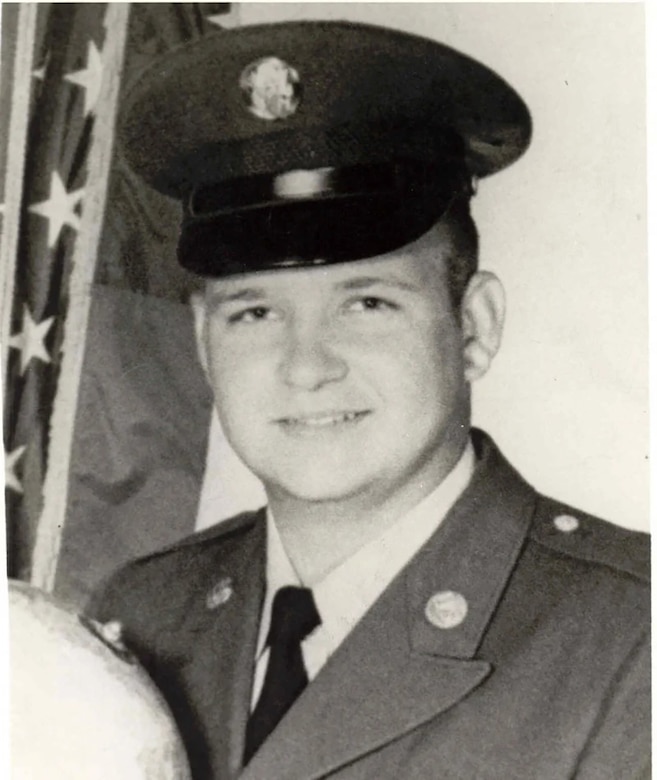
Medal of Honor Monday: Marine Corps Staff Sgt. William Windrich

Marine Corps Staff Sgt. William Gordon Windrich was only in Korea for a short time, but the skills he'd honed during World War II helped him lead his cold, dirty and disheveled comrades to freedom during one of the most savage battles in modern military history.  

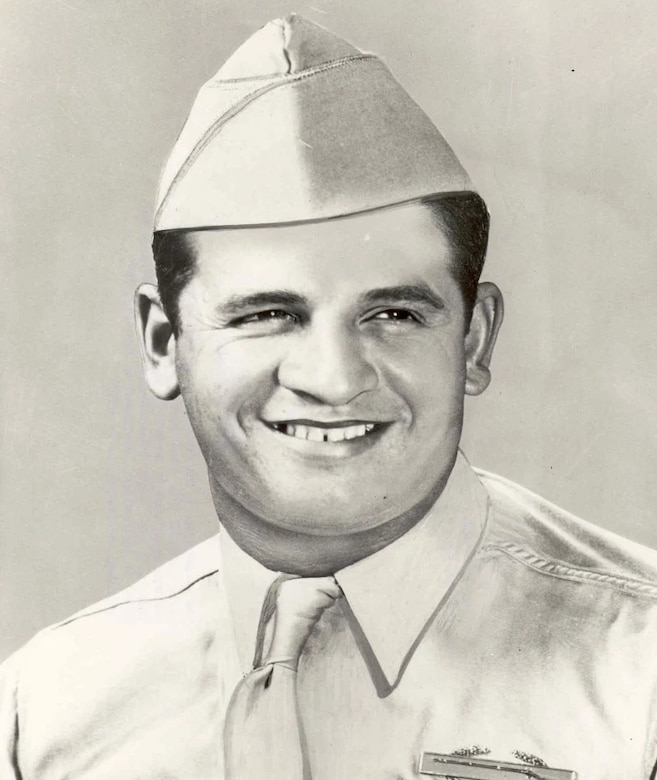
A man poses stoically for a photo.

Windrich didn't survive the Battle of Chosin Reservoir to tell his own story, but his heroics led him to posthumously receive the Medal of Honor.  

Windrich was born May 14, 1921, in Chicago to World War I veteran Herman Windrich and his wife, Marguerite. He had a sister named Virginia. 

When Windrich was young, the family moved to nearby Hammond, Indiana, where their father worked as a foreman at the city's only oil refinery.  

Windrich attended several public schools before dropping out and enlisting in the Marine Corps Reserve in June 1938. By November 1940, he was called up to active duty. 

During World War II, "Windy," as he was called, spent nearly two years in the South Pacific as a machine-gunner, seeing action during the Battle of Tarawa in the Gilbert Islands. He was discharged soon after the war ended and, after returning home, earned his GED diploma. At some point, he married his hometown girlfriend, Margaret. They had a daughter named Alita.  

Dozens of men in cold-weather gear lounge near a line of military vehicles in the snow.

Civilian life didn't suit Windrich, however. So, in February 1946, he reenlisted in the Marine Corps. That summer, while serving aboard the USS Mount McKinley, Windrich took part in the atomic bomb testing at Bikini Atoll. In the years that followed, he served in positions in around Washington and in China.  

Windrich was on military police duty at Camp Pendleton, California, when the Korean War broke out in the summer of 1950. As part of the 1st Provisional Marine Brigade, he was one of the first Marines to see action in the conflict. He took part in the Inchon landing and the capture of Seoul before being transferred to Company I of the 3rd Battalion, 5th Marines, 1st Marine Division.  

Windrich was the company's platoon sergeant during the infamous Battle of Chosin Reservoir, where about 30,000 troops from the United Nations, many of whom were U.S. Marines and soldiers, chased defeated North Korean army soldiers up the Korean Peninsula to try to force them over the border into China. When they reached the Chosin Reservoir, however, about 120,000 Chinese troops surged south over the border instead, ambushing U.N. troops and cutting them off from their main supply route.  

The nearly three-week battle was one of the most brutal in military history, waged in below-zero temperatures, heavy snow and frigid winds.  

Hundreds of men in cold-weather gear sit and stand alongside a line of military vehicles on a mountainside in the snow.

On the night of Dec. 1, 1950, the enemy launched a sudden attack on the forward elements of Company I's position on Hill 1520. As Marines fell, Windrich organized a group of men and spearheaded an assault toward the top of the hill to confront the enemy forces.  

Despite intense enemy automatic weapons, mortar and grenade fire, the group was able to effectively hold back the attackers while the remaining troops withdrew to safer ground. However, the assault group was decimated in the process. Most of the men were either wounded or killed, including Windrich, who suffered a head wound from a bursting grenade.

Windrich fell back to where his company had repositioned themselves. After refusing medical attention, he organized a new group of volunteers to evacuate the fallen Marines on the frozen hillside.  

Windrich then placed the rest of the troops on the left flank of the defensive sector as the enemy attacked again. Windrich was severely wounded in the leg and couldn't stand, but he refused to leave the fight, shouting words of encouragement and directing his team's fire until the attack was pushed back. Even then, he continued to direct his platoon to set up defensive positions. Eventually, Windrich succumbed to the bitter cold and excessive blood loss.  

"He allowed himself to be placed on a stretcher, and as he lay down, he told one of the men carrying him that he just wanted to go to sleep. Then he died," read a 1985 article on Windrich in his hometown newspaper, The Times. 

A man plays a bugle in the middle of a graveyard full of white crosses.

Windrich's bravery and devotion to duty inspired the men around him to hold the line despite the tremendous odds against them. Eventually, they were able to fight their way south to freedom. But the battle took its toll. The U.S. reported more than 12,000 casualties, including more than 3,000 dead. 

Windrich's fellow Marines weren't able to carry his body down the 70 miles of mountainous terrain, so he was left behind with the promise from commanders that they would come back for all the fallen Americans when they could.  

Windrich is one of 17 men who received the Medal of Honor for valiant actions during the battle. On Feb. 8, 1952, his widow and daughter received the nation's highest honor for valor on his behalf during a Pentagon ceremony.  

A grave marker is highlighted prominently among a field of other matching grave markers.

More than four years after the Battle of Chosin Reservoir ended, the promise to bring Windrich's body home was fulfilled, and his remains were repatriated. On July 29, 1955, he was buried in Arlington National Cemetery, Virginia. 

Near his hometown in Lake County, Indiana, residents and visitors can read about Windrich's heroics on a section of the Korean War veterans memorial that's dedicated to him. The National Museum of the Marine Corps in Triangle, Virginia, has also erected a Chosin Few Battle Monument in honor of those who fought there. 

Thursday, November 27, 2025

Defense Logistics Agency Team Continues Thanksgiving Support for Service Members Around the World

Wherever America's troops are serving around the globe, they will experience the taste and smells of home this Thanksgiving holiday, thanks to the Defense Logistics Agency's Troop Support Subsistence team.

Service members in camouflage military uniforms serve food to other service members in similar attire that are standing in a cafeteria buffet line.

One of the largest annual efforts for the supply chain, the team ensured more than 380,000 pounds of traditional Thanksgiving food and other treats were delivered for the 2025 holiday. 

"It is the most significant event that has the greatest influence on the morale of the warfighter and their families," said Robin Whaley, DLA's chief of subsistence for customers outside the continental U.S. 

Careful planning, coordination with multiple parties and attention to detail all go into making sure items arrive in time for the holiday, Whaley added. 

Varying troop strength around the globe each year adds to the importance of being precise in the ordering process. 

"Holiday requirements are like fingerprints in that no two are alike," said John Sheehan, TSS director of customer operations. "The ebb and flow of one holiday item to the next is based on the fluid troop requirements and preferences from year to year." 

For the team, there is always a sense of pride in completing this mission. 

"There is excitement in knowing we are giving the warfighters a representation of their home and knowing the work we do helps them feel more connected to their families and communities," said Army Master Sgt. Jose Montero, TSS noncommissioned officer in charge. "I feel extremely proud knowing an extremely talented, committed team ... worked diligently to ensure every warfighter has a hot meal for Thanksgiving."

A person is carving a baked turkey with a large knife.

For Army Chief Warrant Officer 4 Shemika Harris, a TSS military food advisor, this was her first experience being on the planning side of ensuring holiday meals for the warfighter. 

"I'm absolutely impressed by the effort and genuine concern that the Defense Logistics Agency Troop Support Subsistence team puts into this mission," Harris said. "They approach each holiday with a sense of pride and purpose knowing that these meals mean far more than just food." 

This Thanksgiving holiday, military dining facilities can expect to receive:  

  • 152,626 pounds of turkey; 
  • 124,022 pounds of beef;  
  • 66,054 pounds of ham;  
  • 38,081 pounds of shrimp;  
  • 6,512 cans of sweet potatoes;  
  • 15,282 cases of pies, cakes;  
  • 792 cases of eggnog;  
  • and other holiday treats.

DLA Troop Support annually supplies America's armed forces with more than $25 billion worth of food, uniforms, protective equipment, medicine and medical supplies, and construction and equipment items. 

Projecting Power From the Tower

From the top of Ramstein Air Base's air traffic control tower, the view of the local German countryside stretches for miles. From that vantage point, 86th Operations Support Squadron air traffic controllers navigate the arrival and departure of every aircraft within the airspace.

A military cargo aircraft flies by an air traffic control tower. There are cars parked outside of the building.

 
In a small room on top of the control tower, a team of airmen works 24/7 to sequence aircraft and coordinate with host-nation partners to ensure safe, uninterrupted flight operations. 
 
"Our job never stops," said Air Force Staff Sgt. Lana Fischer, 86th OSS air traffic control watch supervisor. "We work nights, weekends and holidays."

"We never let our guard down," she continued. "One mistake on our end could have a dire impact, so we run checklists and briefs constantly. Our No. 1 rule is to ensure safe airfield operations." 
 
The tower provides air traffic services for the base's surrounding area from the surface to 3,600 feet using both visual and radar feeds. They do all of this while simultaneously meeting every standard required to fly within the local airspace.
 
Daily operations inside the tower require tight teamwork.

A man's face is illuminated as he stares at a screen while seated in a dark room.

 
"It's a very close-knit environment," said Air Force Master Sgt. Paige Smith, 86th OSS air traffic control chief controller. "You're working in a small space together every day, so the team becomes like family. I was stationed here 10 years ago, and it still feels the same. I love coming to work with these people." 
 
To Smith, the job is like solving a puzzle. Sequencing aircraft with different performance characteristics requires constant recalculation in real time. 
 
"You see a potential conflict out the window and you start working through the solution in your head," Smith said. "Which aircraft needs spacing? Who needs priority? You see your plan play out in front of you and that's the part I love."
 
Ramstein Air Base's air traffic controllers play a vital role in missions far beyond Germany. From aeromedical evacuation movements to distinguished visitor support, many of the Air Force's nationally visible operations begin or end under a tower's control. 
 
"We're called the Global Gateway for a reason," Smith said. "A lot of what happens downrange starts here. We may not always know the details, but we know we're a piece of it by keeping the airfield open and safe."

A man in a military camouflage uniform sits at a desk while he looks out the surrounding windows. Bright light from the sun pierces through the front window.

 
Every arrival and departure goes through multiple units before entering or leaving the base. 
 
The ground controlled approach facility controls a wider proximity of airspace around the installation that the airmen in the tower cannot see. The GCA radar team sequences aircraft until they are roughly 5 miles outside the range of the flight line before they transition them to the tower, who takes control of the final approach and landing.
 
Departure works in reverse; the tower works the aircraft from its parking spot through takeoff and up to 5 miles away before handing it off to the GCA for further support. 
 
"They work the larger host nation controlled airspace," Smith said. "If GCA is closed, then we work directly with our host-nation partners at Langen, Germany, but most of the time we hand aircraft back and forth with GCA. It's one mission, just different pieces of the airspace." 
 
Air Force air traffic controllers are increasingly becoming dual-rated, meaning they gain experience in both tower and radar operations. Ramstein Air Base supports that initiative by rotating qualified airmen between the tower and GCA duties.

A man's face is illuminated as he stares at a screen while seated in a dark room.

 
"We want people to have breadth in the career field," Smith said. "It makes you a more agile controller. Our [training] school teaches the foundation for both operations, but you get certified while performing on-the-job duties at your first base." 
 
The responsibility of controlling airfield operations requires diligent focus, discipline and continuous support from every controller. 

Tuesday, November 25, 2025

The Heart of the Boat: Inside the Auxiliary Division of the USS Wyoming

Deep below the surface, in the steel belly of the Ohio-class USS Wyoming submarine, there is a place where wrenches never stop turning, pipes never fully sleep and the heartbeat of the ship is kept alive by a small band of mechanics who call themselves "A-Gangers." 
 
To the untrained eye, the work might look like grease, noise and endless troubleshooting. To those who wear the "A-Gang" shirt on their backs, it's something much more: family, tradition and one of the most respected jobs on the entire boat. 
 
"[The] auxiliary division handles basically anything on the boat that isn't electrical or nuclear," said Navy Seaman Elvin Pruitt III, USS Wyoming machinist mate. "Plumbing, high-pressure hydraulics, diesel and mechanical systems, if it moves, pumps, drains, cools, floods, shifts or breaks, we own it." 
 
Their systems include air, water, hydraulics, compressors, valves and pumps. It's a job with no shortcuts. A job that doesn't stop underway or in port. A job that rarely gets the spotlight.  

And yet, every person who interviewed for this article said the same thing in different ways: It's one of the most respected jobs on board. 

That's because no matter what happens, someone eventually turns to the auxiliary division and says, "We need you." 

Pruitt described the division in one word: family. 
 
"We're kind of on the outside of every group [on the boat], which means we just bond closer with each other," he said. 

A woman wearing a tan T-shirt writes on a piece of paper attached to a clipboard while standing in the engine room of a military submarine. A man in similar attire works behind her.

 
Another sailor, Navy Petty Officer 1st Class Alexis Cornelison, the auxiliary division leading petty officer, who initially worked on surface ships, put it differently: "My whole little family is right there," she said. "The camaraderie is what keeps me here."  

Even in a male-dominated environment, the women aboard formed the strongest sisterhood she's ever experienced. 
 
"I don't think I'll ever have friends like this again," she explained. "We've been through everything together — good, bad, all of it." 

The division looks out for each other in ways that go beyond the job. When Cornelison's grandfather died, she said the crew didn't hesitate. They told her to go home, be with her family and they would take care of everything while she was gone. 

"No questions, no hoops, no stress; that's family," she said. "And it's why I'm glad I got to be part of this." 
 
Their paths to A-Gang are as different as their personalities. 
 
Navy Petty Officer 2nd Class Joseph Hillard's father was a part of an auxiliary division on an older sub. Cornelison started as a cook in the surface fleet and then fought for years to switch into engineering before volunteering for submarines once it became open to females. 

A man wearing a tan T-shirt opens a valve in the engine room of a military submarine.

She laughed at how unexpected her journey has been.  

"I told my family I liked mechanics, and they said, 'Who are you?'" she recalled. "Everyone thought I'd be an English major or something. But here I am, loving my life on a submarine." 
 
Regardless of how they got here, they all agreed on something important: You don't really choose the auxiliary division ... you jump in, and the job chooses you. 
 
"It's not something you can sit and debate in the recruiter's office," she said. "You have to get thrown into it. Either you love it or you don't." 
 
A-Gang's tempo swings hard depending on whether the boat is submerged or tied to the pier. Underway life is steady, predictable and intense. But being in port is a whole other beast.  

"Honestly, it's busier," Hillard said.  

Contractors moving in and out.  Shipyard workers everywhere. Deadlines, repairs and upgrades.  

"It's more stressful in port," he said. "Underway, we stand our watch, and we work. In port, it feels like everything is happening at once." 
 
When asked about the best part of the job, every single one of them said it differently, but it always came back to this: Solving a problem no one else could solve and finally getting a stubborn system to run right. 
 
"That feeling of troubleshooting something over and over, and then you finally get it right, it's amazing," Cornelison said. "Nobody knew what was wrong, and then you just … figure it out." 

A man wearing a tan T-shirt works in the engine room of a military submarine.

For some, the job is a launching pad into a civilian career. 
 
"It's one of the best [jobs] you can have," said Pruitt and Hillard. "You can go anywhere. Any blue-collar job you want." 

For others, it's a calling, a source of pride. A tradition passed from father to son or discovered in the most unexpected way. And for all of them, it's something they'll never forget. Hard. Dirty. Respected. Full of challenges, full of laughter and full of family. 

A job that runs a submarine in the shadows; unseen, but never unvalued. On the USS Wyoming, A-Gang isn't just a division. It's the backbone of the boat. The keepers of the systems. The unspoken pulse that makes the strategic deterrence mission possible.  

And in the cramped passageways and diesel-scented spaces where they work side by side, they've built something rare: A place where tradition still matters, where leaders raise the next generation and where the hardest jobs bring the closest bonds. 

Monday, November 24, 2025

Air Force Bolsters Airpower Readiness During Arctic Gold

The 354th Fighter Wing conducted readiness exercise Arctic Gold 26-1 at Eielson Air Force Base, Alaska, Nov. 17-19.

A military fighter jet sits on an airport taxiway. Snow is covering the ground and trees in the background.

 
The exercise is designed to test the wing's ability to quickly generate, deploy and sustain combat-ready airpower in a high-threat environment. 
 
"A lot of work and planning was put into getting this exercise to run efficiently and effectively, taking into account all of the separate factors that affect the way things play out and what we can accomplish towards the mission," said Air Force Master Sgt. Zachary Kugler, exercise program director. "We use key takeaways and lessons learned to shape the way we generate airpower in the future and how we can apply it to both exercises and real-world scenarios." 
 
During the exercise, the 354th Operations Group tested its mission capabilities and readiness by deploying F-35A Lightning IIs from both the 355th Fighter Squadron and the 356th Fighter Squadron, supported by F-16 Fighting Falcons from the 18th Fighter Interceptor Squadron.

A military fighter jet takes off from a snowy runway. Snow covered trees are in the background and a partly cloudy sky.
A man driving a forklift moves a large container into a building while another man walks alongside the forklift outside. There are trees in the background with snow on them.
"The 354th OG is charged with providing combatant commanders with combat-ready forces in order to meet mission objectives and priorities," said Air Force Lt. Col. Lloyd Wright, 354th OG deputy commander. "This [is] accomplished by organizing, training and equipping our component squadrons who project power in the Pacific area of responsibility and maintain the [Air Force's] northernmost strategic runway." 
 
Airmen carried the weight of the hands-on mission execution, building pallets, moving people and cargo, operating vehicles in extreme conditions and sustaining the pace required to generate combat power. 
 
"Operating in the Arctic forces you to think differently, and our airmen proved that they not only understand the constraints but thrive in them," said Air Force Lt. Col. Peter Daigle, 354th Logistics Readiness Squadron commander. "We rehearsed cold-weather processes, validated our deployment readiness, and stress tested the systems that enable fighter generation in one of the harshest climates on Earth."

Dozens of people wearing camouflage military uniforms stand around a counter talking. There are several different books lying on the counter and some of the service members are holding folders.

 
Daigle also highlighted the airmen's ability to utilize technical skills and versatility, and to make sound decisions even outside their normal jobs, providing the tactical edge necessary in order to accomplish the mission. 
 
"Every exercise gives us data, but Arctic Gold gave us clarity; our priorities are centered on sharpening the logistics foundations of our wing that makes us a combat-credible force, ensuring our squadron commanders continue to develop leaders who can think critically, operate independently and take initiative," Daigle said. "The future fight will reward agility, creativity and technical mastery — and that starts with how we train." 

Army Aviation Soldiers Begin Training With Stalker UAS at Fort Rucker

Army aviation soldiers began training with the VXE30 Stalker uncrewed aircraft system at Fort Rucker, Alabama, Nov. 18, in preparation for equipment fielding next month.  

This system incorporates observations from the modern battlefield, including reduced noise and visual signature, vertical takeoff capability and cost-saving munitions technology — underscoring the Army's push to integrate cutting-edge systems into training at Fort Rucker and Fort Huachuca, Arizona.

Five people in camouflage attire and some in casual attire kneel on the ground outside, inspecting a small aircraft.
Army Maj. Wolf Amacker, UAS and Tactics Branch chief of the Army Aviation Center of Excellence's Training and Doctrine Directorate, said the event represented a milestone in training the Army's layered reconnaissance strategy. 
 
"This is the first time in years that we will be utilizing a Group 2, almost Group 3 size UAS in support of an Army course at Fort Rucker, since before the Shadow was really employed," Amacker said. 
 
The War Department categorizes UAS into Groups 1 through 5 based on weight, normal operating altitude and speed. Group 1 UAS are small, weighing 20 pounds or less, and operate below 1,200 feet above ground level at speeds of up to 100 knots. Group 2 UAS have a maximum takeoff weight between 21 and 55 pounds, operate below 3,500 feet above ground level and fly at speeds under 250 knots. Group 3 UAS, which included the Army's RQ‑7B Shadow, weigh between 56 and 320 pounds at takeoff, operate up to 18,000 feet above mean sea level and fly at speeds under 250 knots. 
 
The Stalker aircraft is built on a modular open systems approach and can adapt to new sensors, payloads and technologies to support changing operational needs. 
 
Amacker noted that the Army Aviation Center of Excellence's 1st Aviation Brigade identified the Stalker during the recent UAS summit. It moved quickly to acquire the system for training, ensuring students gain hands‑on experience with the latest reconnaissance technology. 
 
Army Maj. Rachel Martin, director of the Air Cavalry Leaders Course and Unmanned Advanced Lethality Course, emphasized the Stalker's flexibility compared to legacy systems.
 
"This system can take off and land vertically like a quadcopter, then transition to forward flight where it goes deadly silent," Martin said. "Its reduced visual and acoustic signature makes striking a target at 300 feet very likely, something that wasn't possible with louder systems, like the Shadow."

A person in a camouflage military uniform lies on the ground outside, under the wing of a small aircraft, to attach an item.

 
The system integrates into the Army's Common Lethality Integration Kit, allowing soldiers to select warheads at the user level and employ both newly designed payloads and existing munitions, such as 81 mm mortars. 
 
"What's great about this is that it's modular and fits on multiple [uncrewed aircraft systems]," Martin said. "It's a cheaper solution that can be rapidly reproduced." 
 
Martin noted the dramatic cost difference compared to traditional systems.  

"Instead of a Hellfire missile costing $100,000 to $150,000 per round, this solution costs about $800," she said. "That disparity is significant, and it reflects lessons from the Ukrainian fight, where cheaper solutions are proving decisive." 
 
Amacker added that the Army is exploring ways to print training rounds in‑house, further expanding opportunities for instruction while reducing reliance on traditional procurement systems. 
 
"This is the Army thinking outside the box," Martin said. "We're leveraging commercial technology to meet immediate needs in a faster, more affordable way." 
 
Training with the Stalker is scheduled to begin in December, ensuring instructors can incorporate the system into courses and prepare soldiers to employ it in tactical missions at the battalion and brigade levels.

Medal of Honor Monday: Army Lt. Col. Edward Silk

When Army Lt. Col. Edward A. Silk realized that his platoon wasn't going to put a dent in the enemy positions firing at them in France during World War II, he went on a one-man rampage to take the guns out himself. Miraculously, his mission succeeded. For his heroics, he received the Medal of Honor.

A man in a uniform and cap poses for a photo.

Silk was born June 8, 1916, in Johnstown, Pennsylvania, to Irish immigrants Michael and Mary Silk. He was the youngest of 11 children.

When Silk was 2, his father died in an accident at the local Bethlehem Steel mill, according to the newspaper The Daily Herald out of Everett, Washington. His mother tried to care for all 11 children on her own, but she couldn't, so she eventually moved with her four youngest to Illinois to live at Mooseheart Child City, a residential child care community run by the Loyal Order of Moose, of which Silk's father was part. Mooseheart provides children and families in need with stability, support and education.

Silk did well at Mooseheart. According to the Moose organization, he played football for the high school and chose to stay an extra year due to job scarcity from the Depression so he could get training in ornamental concrete work. After graduating in 1935, he attended St. Bonaventure College in western New York for a time before eventually dropping out to join the workforce.

In April 1941, months before the U.S. entered World War II, Silk joined the Army Reserve. At some point he married his girlfriend, Dorothy Weimer, and had a son named Jerry. 

Two tanks move through small, winding streets in a dilapidated town.

Silk was ordered to active duty Aug. 31, 1942. He earned a commission at Fort Benning, Georgia, before being sent to France in October 1944 with the 398th Infantry, 100th Infantry Division. About two months later, his brazen courage earned him the nation's highest medal for valor.

On Nov. 23, 1944, then-1st Lt. Silk's battalion was tasked with seizing high ground overlooking Moyenmoutier, France, ahead of a planned attack to liberate the city. Silk was commanding a weapons platoon in Company E that took the lead at dawn. By noon, they'd reached the edge of the woods near St. Pravel, where scouts saw in the valley below an enemy sentry standing guard outside a farmhouse.

Almost immediately, the scouting squad was pinned down by intense gunfire coming from within the house. Silk's platoon returned fire, but after about 15 minutes, there was no letting up in the enemy gunfire. So, Silk decided to take matters into his own hands.

He ran 100 yards across an open field before taking shelter behind a low stone wall directly in front of the farmhouse. After firing into the door and windows with his carbine, Silk then vaulted over the wall sheltering him and dashed another 50 yards through a hail of enemy gunfire to the left side of the house. He then tossed a grenade through an open window. The explosion that followed silenced the enemy machine gun and killed its two gunners.

Soldiers walk past rubble in a destroyed city.

When Silk tried to move to the right side of the house, another enemy machine gun began firing on him from a nearby woodshed. Summoning every ounce of courage he had, Silk rushed that position head-on, dodging direct fire to get close enough to throw more grenades, which destroyed that gun and its gunners as well.

By that point, Silk had run out of grenades — but not fortitude. Silk ran to the back side of the farmhouse, where he began to throw rocks through the window, demanding the remaining enemy soldiers' surrender. "Twelve Germans, overcome by his relentless assault and confused by his unorthodox methods, gave up to the lone American," Silk's Medal of Honor citation said.

Thanks to his decision to take on the burden of the attack alone, Silk's battalion was able to continue its advance on Moyenmoutier and eventually liberate the city.

Two men smile and shake hands on a lawn. Others sit in chairs in the background, clapping.

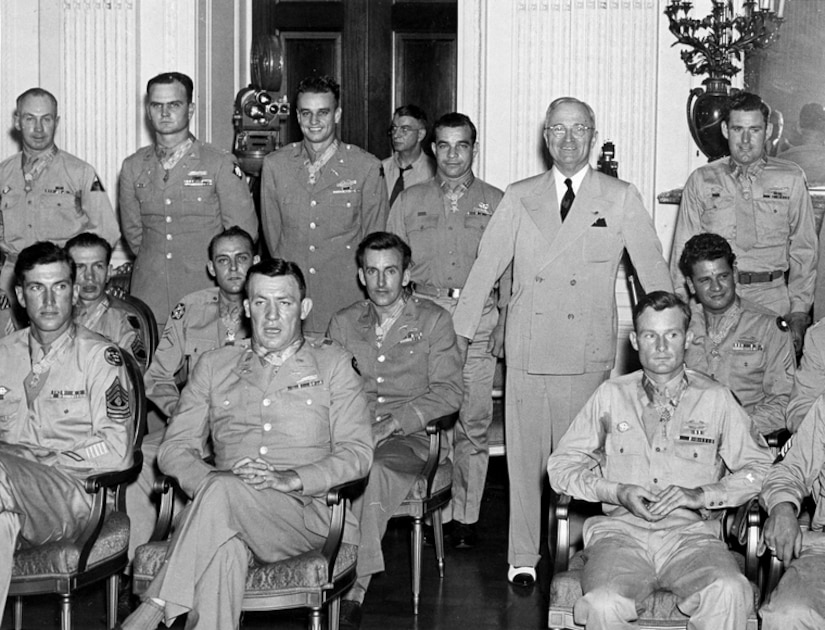
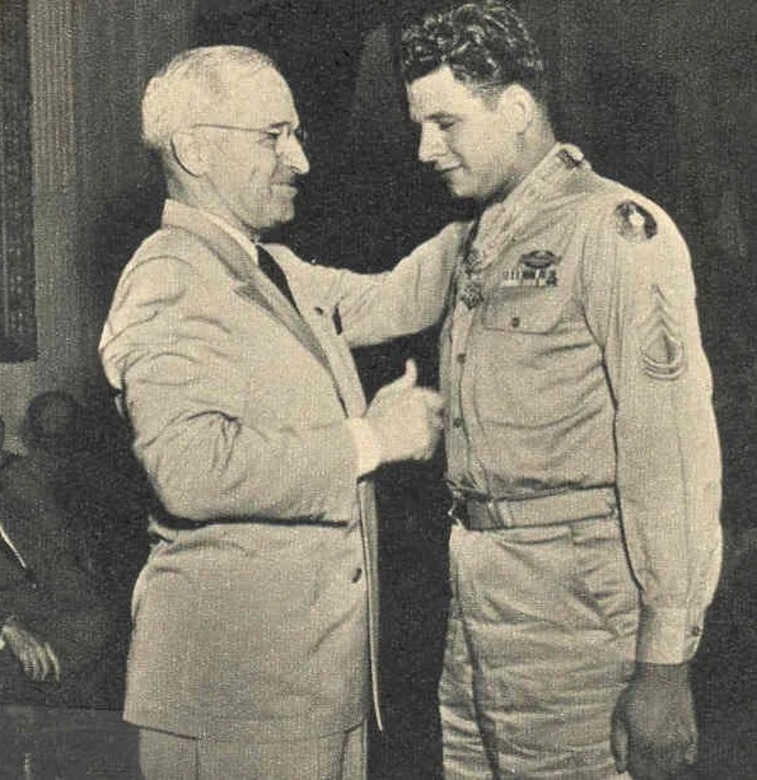
Silk returned home in September 1945 as a hero. On Oct. 12, 1945, he and 14 other deserving service members received the Medal of Honor from President Harry S. Truman during a White House ceremony.

Silk remained in the Army after the war, working for a time while still on active duty as a patient consultant for the Department of Veterans Affairs. One of his last posts was with the 7822nd Station Complement Unit in Stuttgart, Germany.

By 1952, Silk had risen to the rank of lieutenant colonel. He and his wife went on to have two more children, Judith and Daniel.

In December 1954, Silk took command of the ROTC unit at Canisius College (now university) in Buffalo, New York, as a professor of military science and tactics.

Two rows of service members stand at attention on a lawn. A band and an audience are in the background.

Sadly, about 10 months later, Silk fell critically ill due to intestinal ulcers. He underwent at least three surgeries at a local military hospital before succumbing to complications on Nov. 19, 1955. He was only 39.

During his funeral services, the newspaper The Buffalo News reported that 600 ROTC cadets from Canisius marched behind Silk's hearse for 3 miles to St. Joseph's Cathedral, where his services were held. Silk was then buried in Arlington National Cemetery.

In 2004, Johnstown renamed a bridge in the hometown hero's honor. At the time, his daughter told newspapers that her father was a strict disciplinarian, but he was kind and had a great sense of humor.  

This article is part of a weekly series called "Medal of Honor Monday," in which we highlight one of the more than 3,500 Medal of Honor recipients who have received the U.S. military's highest medal for valor. 

Saturday, November 22, 2025

Army Pilots First Autonomous Dining Facility in South Korea

The 19th Expeditionary Sustainment Command opened the Army's first autonomous dining facility, Nov. 12, in South Korea, to explore how automation can improve food service operations. The pilot dining facility, called Market 19, combines automated food preparation, cooking and serving with soldier oversight. 

A soldier wearing a camouflage military uniform chooses a meal on a touchscreen tablet.

 
"This pilot helps us evaluate how automated cooking systems can make Army dining operations more consistent, efficient and resilient," said Chief Warrant Officer River Mitchell, food advisor, 19th ESC.  

Mitchell emphasized that the effort is not about replacing people but about strengthening the ability to feed soldiers "anytime, anywhere." 
 
"The pilot originated as a 19th ESC initiative," he added.  

Planning for the pilot facility began in early May as an opportunity for 19th ESC to innovate upon the Army food program.  

"Market 19 represents successful and efficient collaboration between the U.S. Army, [South] Korea and industry partners," he said. "It was formally approved under the Pacific Multi-Domain Training and Experimentation Capability program in coordination with U.S. Army Pacific."  

The Pacific Multi-Domain Training and Experimentation Capability program is an Army Pacific initiative that tests and evaluates new technologies to enhance sustainment and readiness across the Indo-Pacific region. The project supports PMTEC experimentation and uses funding from the Pacific Deterrence Initiative, which advances deterrence and operational capability in the region. 

"Our aim is to add capacity and consistency in feeding operations without changing the current workforce," Mitchell explained. "The autonomous kitchen uses robotic cooking modules programmed to prepare meals from fresh ingredients following standard Army recipes."  

A soldier dressed in a camouflage military uniform reaches for a bowl of food sitting in the window of an autonomous food preparation system.

Soldiers and civilians can select menu items on a touchscreen interface, and the system automatically portions, cooks and plates each meal. 
 
"Human oversight remains critical," Mitchell said. "Our culinary specialists still handle food safety, ingredient prep and quality control."  

All ingredients come from the Defense Logistics Agency Troop Support supply chain and the Army food catalog, ensuring the same nutrition and safety standards as traditional facilities. 
 
Each meal display includes clear nutritional information, giving soldiers better visibility into what they are eating. Menu options are performance-oriented and include Korean dishes such as bibimbap, kimchi fried rice and budae jjigae. 
 
"This system gives us a 24/7 feeding capability that supplements — not replaces — our existing dining operations," Mitchell said.  

The pilot operates within the Camp Walker Dining Facility with soldiers and contracted staff jointly evaluating performance. Culinary specialists manage quality assurance and nutrition education. They also supplement meals with additional food options. The culinary specialists who prepare the meal recipes and ingredients for the machine have been trained extensively by both Army and local national chefs. 
 
"The goal is to free our [culinary specialists] to focus on readiness training and improving meal quality," Mitchell said. "Automation is one way we can modernize without losing our human touch." 
 
He explained that integrating robotic technology into dining operations allows the Army to stay ready under any conditions, from garrison to field environments, while preserving the expertise of its culinary specialists. 

The pilot supports the Army's ongoing modernization efforts and also aligns with the Holistic Health and Fitness program by giving soldiers consistent access to balanced, nutritious meals that sustain performance and recovery. 

A close-up photo of six bowls containing various fresh ingredients.
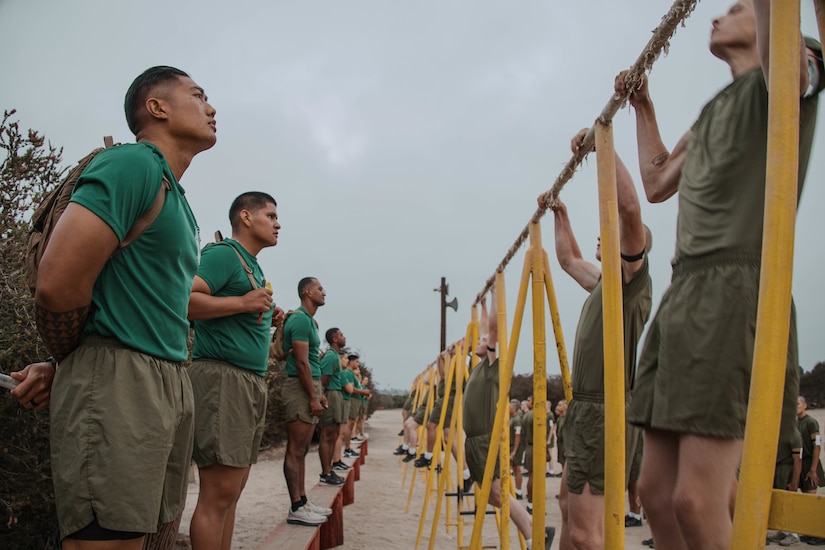
 
"Consistent, quality food directly supports readiness," Mitchell said. "If a soldier eats well, that soldier performs well."  

The six-month pilot will conclude with an assessment on expanding autonomous capabilities and will give the kitchen a chance to implement changes based on gathered feedback. 
 
"The data we collect here will guide decisions about future locations and applications," Mitchell said. "We want to see how this can support sustainment both in the Pacific and eventually in the continental United States."  

He emphasized that the current phase is strictly evaluative. 
 
"This is an experiment," Mitchell said. "We're testing performance, soldier feedback and long-term reliability before considering anything broader." 

Friday, November 21, 2025

First, Second Ladies Visit Military Installations in North Carolina

In a mutual demonstration of support and appreciation, First Lady Melania Trump and Second Lady Usha Vance visited Marine Corps Base Camp Lejeune and Marine Corps Air Station New River in North Carolina, Nov. 19, engaging with service members, military families and students at Department of Defense Education Activity schools on both installations. 

A woman wearing business casual attire stands in front of a lectern while speaking into a microphone. A large American flag is in the background.
A woman wearing business attire stands in front of a lectern while speaking into a microphone.
This landmark visit marked the first joint trip to both installations for both ladies, underscoring their commitment to the military community. 

With a shared goal of acknowledging the sacrifices made by those serving or deployed this holiday season, the visit provided an invaluable opportunity for both women to connect with service members and families. 

Upon arrival at the airport in Richlands, North Carolina, Trump and Vance were greeted by Marine Corps Brig. Gen. Ralph J. Rizzo, Jr., commanding general of Marine Corps Installations East-MCB Camp Lejeune; his wife, Mila Rizzo; and Lisa Worth, wife of Marine Corps Lt. Gen. Calvert Worth, commanding general of the II Marine Expeditionary Force. 

Rizzo spoke about the significance of the visit, emphasizing the attention it gave to the military community. 

"It is deeply meaningful to welcome the first and second ladies who have come here to express gratitude to our installation, to our Marine Corps, to our Marines, sailors and their families," he said. "This visit shines an important light on the strength of our Marines and sailors and especially on the resilience of our military families." 

Trump and Vance first visited Lejeune High School, where they discussed with students how artificial intelligence is being used in school projects. Trump launched the Nationwide Presidential AI Challenge in August, inviting K-12 students and educators across America to participate, noting the challenge will prepare the next generation with a base understanding of this important new technology.

Two women wearing business casual attire pose for a photo with dozens of children in a gymnasium. The kids in the front two rows are wearing military camouflage uniforms, while the other kids wear casual attire,

Later, they joined students and volunteers from the USO to build care packages for deployed service members with the 22nd Marine Expeditionary Unit. 

The party then transitioned to MCAS New River to visit DeLalio Elementary School, where the women joined students and families of deployed service members to create Thanksgiving crafts. 

Finally, Trump and Vance each took turns addressing an audience of about 1,500 service members and families in a mega hangar, surrounded by various aircraft and assets that comprise the Carolina Marine Air-Ground Task Force. After a brief introduction by Rizzo, Vance told the attendees, "We are so grateful to you for carrying on the Marine Corps' proud traditions of duty, honor and service."

She went on to praise the local military community. 

"I am so impressed by your commitment to building strong communities and schools," Vance said. "Military families are truly the model for our country and for my own family." 

Vance then welcomed Trump on stage. 
 
Trump's speech centered on the transformative potential of AI and its pivotal role in the future of warfare. 

Referencing her earlier interactions with students at Lejeune High School, she said, "To win the AI war, we must train our next generation, for it's America's students who will lead the Marine Corps in the future." 

The first lady also took the opportunity to recognize exceptional service, presenting Marine Corps Sgt. Blake Donoher, an aircraft avionics technician assigned to Marine Medium Tiltrotor Squadron 365, as the 24th Marine Expeditionary Unit Warrior of the Month and Marine Corps Cpl. Daishamari Cannon, an aviation maintenance data specialist assigned to the same squadron, as the unit Noncommissioned Officer of the Quarter. 

She then turned her focus on those in the audience, especially those with loved ones currently deployed. 

"The [Camp] Lejeune and [MCAS] New River community impressed me today," she said, adding, "Military families are the quiet strength of our nation; your love, patience and courage give our service members the confidence to serve with honor and the comfort of knowing home is always waiting." 

In a final expression of gratitude, the first lady conveyed her appreciation for the opportunity to experience the dedication and commitment firsthand. 

"It has been a memorable day and an honor to meet the men and women of the United States Marine Corps," Trump said. "To you and your families who give so much for our country, thank you."