Tuesday, December 02, 2025

NY National Guard Volunteers Give Lift to Trees for Troops

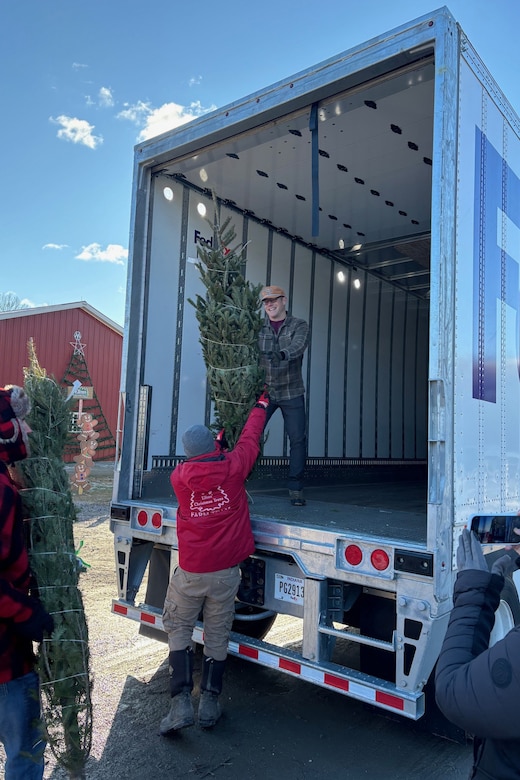
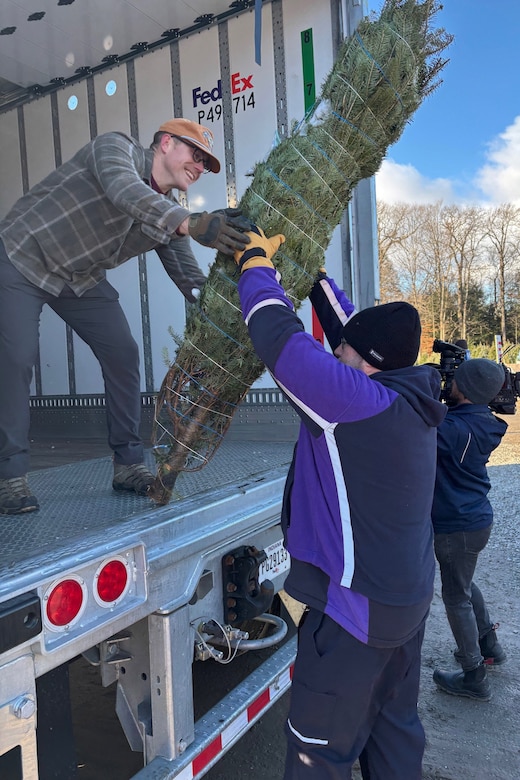
Seven New York National Guard soldiers and airmen joined local veterans Dec. 1 to load 150 Christmas trees onto a truck at Ellms Family Christmas Tree Farm in Ballston Spa, New York. 

A man, standing in the back of a delivery truck, hands a tree to another man.
This was the 21st year that tree farmers in the area donated to the Trees for Troops program. The donated trees are destined for service members and their families around the country. 
 
This year, soldiers of the New York Army National Guard's 42nd Infantry Division Headquarters, based in Troy, New York, and the Air National Guard's 109th Airlift Wing, Stratton Air National Guard Base, Scotia, New York, pitched in to help load the trees. 
 
Five hundred and fifty members of the 42nd Infantry Division are deployed to the Middle East and 200 airmen assigned to the 109th are deployed in support of Operation Deep Freeze, a National Science Foundation research mission in Antarctica. 
 
The volunteers made loading the trees easy, said Garth Ellms, owner of the Ellms Family Farm. 

Two men unload a tree from a delivery truck.
"We have a lot of troops that come in and so they work fast," Ellms said. "FedEx handles actually all the trucking of the trees for free throughout the entire country." 
 
For some volunteers, showing up was a way to pay back for receiving trees in the past. 
 
"The first time I did it, it was in 2021, and it was a great experience," said New York Air National Guard Staff Sgt. Mitchell Mihalko, a recruiter assigned to the 109th Airlift Wing. "How could I say no to an opportunity like this?" 
 
"2022, the winter of that holiday season, I was deployed, [and] I received a tree while I was deployed," Mihalko said. "So, to be on both ends of the spectrum, to see the start and the finished product, it made me feel like I had a duty to come back and to return the favor." 

Three men unload trees from a delivery truck.
In New York, trees will be delivered in December to military families at Fort Drum, West Point, the Niagara Falls Air Reserve Station and the U.S. Coast Guard Sector in New York City, along with other deliveries to 88 other military sites around the country. 
 
Fresh-cut Christmas trees are gathered at regional farms and retail lots, then picked up and processed through distribution centers for delivery to military bases. 
 
The movement and the morning load out of trees included members of the FedEx shipping team who volunteered to be part of the Trees for Troops event. 
 
Getting an opportunity to sign up for the event was easy for Mark Burby, a FedEx employee who said he has volunteered to be on the load-out team five times. 
 
"I'm a veteran, and I'm the senior guy," Burby said. "It's about helping out other vets." 

A man, standing in the back of a delivery truck, hands a small tree to a woman.
Since 2005, Trees for Troops has provided 326,273 Christmas trees to military families and troops in the United States and overseas. 
 
Military volunteers from the National Guard turn out each year to load and unload the trees, knowing they will be delivered to other military families. 
 
It is a very satisfying feeling to be part of that, said Air National Guard Tech. Sgt. Elizabeth Felix. 
 
"I'm happy to be here; it's such an honor," Felix said. "This is great support for the troops and that's why I'm here to give my time." 
 
Trees are expected to be delivered to military bases next week for distribution.  

DOW Awards $55 Million Grant for Nathan F. Twining Elementary & Middle School at Grand Forks Air Force Base, North Dakota

The Department of War's Office of Local Defense Community Cooperation awarded Grand Force Air Force Base Public School District No. 140 a $55,249,082 grant as the federal share of a larger $69,061,352 project to construct a new Nathan F. Twining Elementary/Middle School at Grand Forks Air Force Base, North Dakota. 

This project will address facility capacity and condition deficiencies that placed Nathan F. Twining Elementary and Middle School at 70th on the 2019 Deputy Secretary of Defense "Public Schools on Military Installations Priority List" (Priority List).  Upon completion, 500 pre-kindergarten through eighth-grade students will be supported through the project.

Funding for this grant is provided under the Department's Public Schools on Military Installations Program.  In making these funds available, the Office of Local Defense Community Cooperation must give priority consideration to military installations that have schools with the most serious capacity and facility condition deficiencies, as determined by the Priority List. 

A multi-disciplined Federal Evaluation Team, with representatives from the Assistant Secretaries of the Air Force, Army, Navy, and the Office of Local Defense Community Cooperation reviewed the school project to ensure the award appropriately addresses the noted capacity and facility condition deficiencies.

In correcting the identified facility condition and capacity issues at the Nathan F. Twining Elementary and Middle School, this grant keeps faith with service members, improves the quality of education for defense-connected students, aids in the recruitment and retention of vital skills at Grand Forks Air Force Base, and enhances partnerships between the community and the installation.

Hurricane Hunters Wrap Up 2025 Season After Flying Into Three Category 5 Storms

The 2025 Atlantic hurricane season officially ended Nov. 30, closing another demanding chapter for the Air Force Reserve's 53rd Weather Reconnaissance Squadron, known as the Hurricane Hunters. 

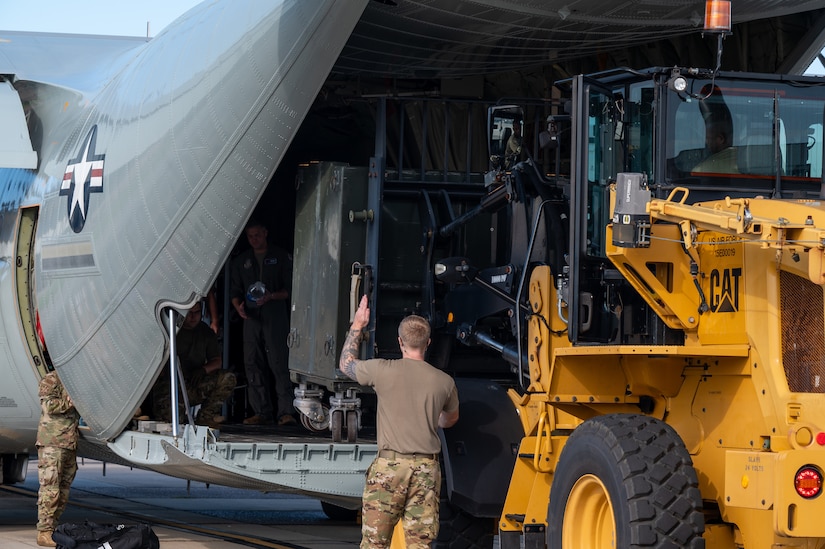
A man in a camouflage military uniform guides equipment from a forklift into the back of a military aircraft.

 
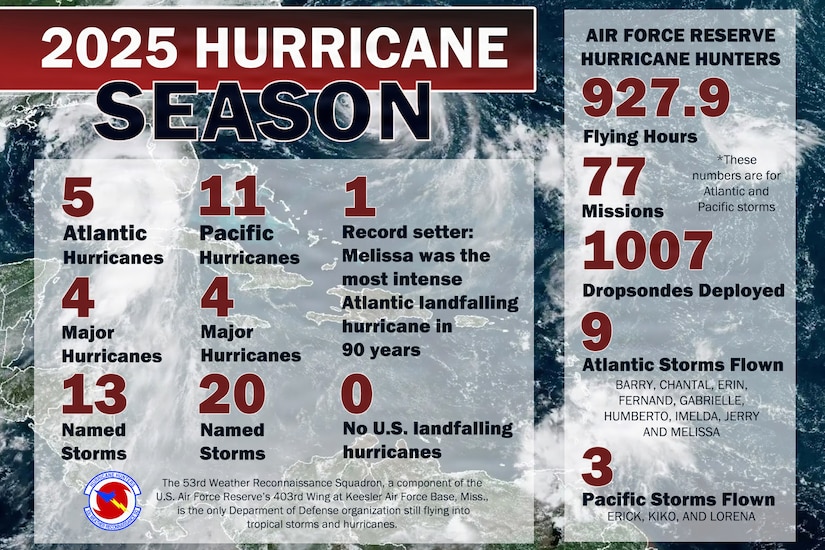
The squadron flew 927.9 hours this year across the Atlantic, eastern Pacific and central Pacific basins, collecting critical data that improved forecasts, saved lives and once again demonstrated the unit's no-fail mission. 
 
From their first flight into Hurricane Erick, June 18, to their final mission into Hurricane Melissa, Oct. 30, the 53rd WRS crews faced one of the most intense storm seasons in recent memory. This year's taskings included three Category 5 hurricanes and the second sub-900 millibar storm the squadron had flown into in as many years. 
 
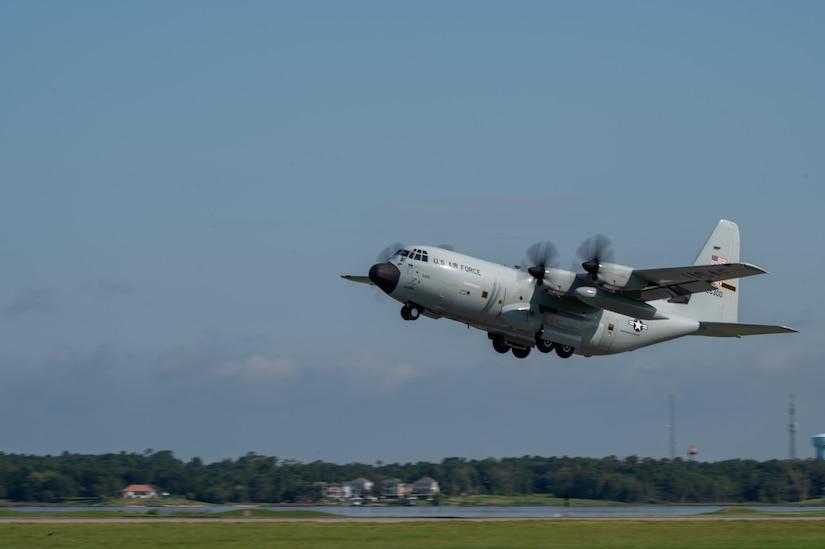
The Hurricane Hunters kicked off the season when a WC-130J Super Hercules aircrew departed Keesler Air Force Base, Mississippi, for Hurricane Erick in the eastern Pacific. That marked the first operational flight of the 2025 season and the start of what forecasters predicted would be an active year for tropical systems. 

A graphic with numbers from the 2025 hurricane season is displayed over an image of tropical storms around the Caribbean and Atlantic Ocean.

 
"Our job is to fly directly into the storm and collect vital information such as wind speeds, pressure, temperature and humidity," said Air Force 1st Lt. Mark McCoy, 53rd WRS aerial reconnaissance weather officer. "While satellites provide a significant amount of information, the data we gather within the storm is unique and cannot be captured from space. That information helps the National Hurricane Center refine forecasts and gives people more time to prepare."
 
The squadron, assigned to the 403rd Wing, is the only War Department unit that flies into tropical systems to gather real-time atmospheric data. Using a fleet of 10 WC-130J Super Hercules aircraft, the squadron operates year-round and is prepared to support 24-hour operations during the peak of hurricane season. Data from its flights is transmitted in real time to the National Hurricane Center and shared with the National Oceanic and Atmospheric Administration, the Navy and other domestic and international forecasting agencies. 
 
"Every time we fly into a storm, we're collecting data that can directly impact how communities prepare and respond," said Air Force Lt. Col. Steve Burton, 53rd WRS director of operations and the deployed detachment commander. "We train all year for this. What we do helps save lives and property."
 
According to Warren Madden from the National Hurricane Center, the squadron's 2025 missions were defined not by quantity, but by intensity.

In the Atlantic basin, the squadron flew into Hurricanes Barry, Chantal, Erin, Fernand, Gabrielle, Humberto, Imelda, Jerry and Melissa, as well as an early August flight in the northern Gulf of America and another in late August near the Windward Islands. In the eastern Pacific, crews flew into Hurricanes Erick and Lorena, and in the central Pacific, they supported missions into Hurricane Kiko. 

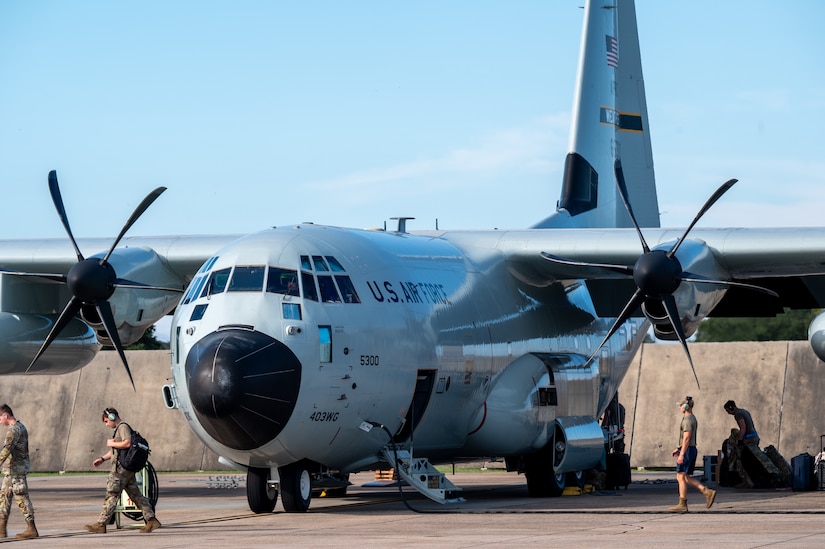
Several people in military camouflage uniforms walk around a large gray military aircraft sitting on a tarmac.

 
"What was unusual this year was the overall lack of activity in both the Gulf and in the Caribbean," Madden said. "We only flew one named storm in the Gulf — Barry — along with two northern Gulf [flights]. Chantal was the only system that produced direct wind impacts to the continental U.S., and Melissa was the only storm we flew in the Caribbean." 
 
What stood out was the strength of several storms. 
 
"Three of the systems — Erin, Humberto and Melissa — reached Category 5 strength, and Melissa became the second sub-900 millibar storm we've flown [into] in as many seasons," Madden said, referencing 2024's Hurricane Milton. "That level of intensity in consecutive years is rare."
 
The Hurricane Hunters' most demanding mission of 2025 came late in the season, when Tropical Storm Melissa rapidly intensified over the Caribbean. On Oct. 21, the 53rd WRS deployed aircraft to a forward operating location in Curaçao, positioning closer to the system as it strengthened into a Category 5 hurricane. Over a seven-day period, the squadron flew 17 missions and 170 flight hours into Melissa, conducting around-the-clock operations to support National Hurricane Center forecasts. 

An aerial view of the inside of a hurricane from a military aircraft, with a wall of clouds going around in a circle.

 
Flying Super Hercules aircraft at roughly 10,000 feet, the crews penetrated Melissa's eye two to four times per mission, releasing equipment that measured temperature, humidity, wind speed and direction, and barometric pressure from the aircraft down to the ocean surface. 
 
"That information was delivered directly to the National Hurricane Center to improve forecast accuracy as Melissa intensified," Burton said. 
 
The deployment took place during a federal government shutdown, which complicated travel, funding and coordination. 
 
"Despite the administrative hurdles, our Hurricane Hunters continued operations uninterrupted, ensuring forecasters received the critical data needed to protect lives," said Air Force Col. Jaret Fish, 403rd Wing commander. "Our airmen demonstrated the flexibility and dedication that make the reserve force vital to the nation's readiness." 
 
Burton said the shutdown only underscored the team's professionalism and focus. 
 
"Even with the challenges, our crews stayed focused," Burton said. "We knew communities were already feeling Melissa's impact. Every data point we gathered fed into forecasts that helped officials make lifesaving decisions. That's why we do this mission." 
 
Hurricane Melissa devastated the Caribbean with 185-mph winds, torrential rain and flooding, with Jamaica being the hardest hit and suffering widespread destruction and infrastructure failures. The United Nations and U.S. State Department estimate $6 billion to $7 billion in damage to Jamaica, deadly flooding and landslides in Haiti, coastal flooding in Cuba, and at least 90 deaths across the region, including 45 in Jamaica, where Melissa made landfall near New Hope, Oct. 28. 
 
By staging out of Curaçao, the Hurricane Hunters reduced flight time to the storm's center, enabling more frequent eye penetrations and higher-density equipment coverage during Melissa's peak intensity. That increased cadence provided near real-time data that helped forecasters and emergency managers issue more accurate warnings and evacuation guidance. 

A large gray military aircraft takes off from a runway during daytime.

 
With the last scheduled hurricane mission completed Oct. 30, the Hurricane Hunters spent November transitioning to winter storm reconnaissance operations in support of the National Winter Season Operations Plan. These atmospheric river missions collect data over the Pacific Ocean to help predict heavy rainfall and flooding events that affect the western U.S. 
 
"The hurricane season may be over, but our mission never really stops," Fish said. "Whether it's tropical cyclones or atmospheric rivers, our airmen deliver data that directly supports national preparedness and disaster response."
 
From the first flight into Erick to the last eyewall penetration of Melissa, the 53rd WRS's 2025 season reaffirmed the critical role of manned reconnaissance in weather forecasting. 
 
Fish said the crews flew through some of the most intense storms on record, noting, "their work saves lives, protects property and provides the science that forecasters rely on every day. We're proud of what they accomplished."
Coast Guard Heavy Icebreaker Departs Seattle for Antarctic Deployment

The Coast Guard cutter Polar Star departed Seattle, Nov. 27, commencing its 29th deployment to Antarctica in support of Operation Deep Freeze.

The operation is an annual joint military mission to resupply the U.S. Antarctic stations in support of the National Science Foundation, the lead agency for the U.S. Antarctic Program. Historic investment in the "One Big Beautiful Bill" of nearly $25 billion includes $9 billion specifically for icebreakers and infrastructure in the Arctic and Antarctic. This massive investment in icebreakers will secure U.S. access, security and leadership in the polar regions.  

As the Coast Guard prepares to revitalize its icebreaking fleet, the Polar Star remains the only U.S. vessel capable of breaking a navigable channel through the ice to reach McMurdo Station, the largest Antarctic station and the logistics hub of the U.S. Antarctic Program.  

Each year, the cutter serves a vital role in ensuring surface access for fuel and supply ships through the Ross Sea to resupply U.S. Antarctic bases. The Polar Star's mission directly protects the security, freedom and prosperity for the U.S., our allies and partners.

"[The] Polar Star's crew does remarkable work maintaining and operating this ship," said Coast Guard Capt. Jeff Rasnake, commanding officer of the ship. "Each year brings unique challenges, and I'm proud to say this crew has risen to meet them all. The way we've come together over the course of maintenance, and our logistical preparations is exciting as we enter the operational phase of our annual deployment cycle."

Commissioned in 1976, the Polar Star is 399 feet long and weighs 13,500 tons with a 34-foot draft. Despite reaching nearly 50 years of age, it remains the world's most powerful nonnuclear icebreaker with the ability to produce up to 75,000 shaft horsepower.

The continuous effort the crew commits to maintaining the aging cutter ensures the nation's access to the continent and the economic, environmental and national security interests in the polar regions. The Polar Star will continue to support Operation Deep Freeze until new polar and Arctic security cutters enter service in the coming decade.

Since 1955, members of the Coast Guard, Air Force, Navy and Army have proudly supported the U.S. Antarctic Program by providing supplies to McMurdo Station. 

Monday, December 01, 2025

Medal of Honor Monday: Marine Corps Staff Sgt. William Windrich

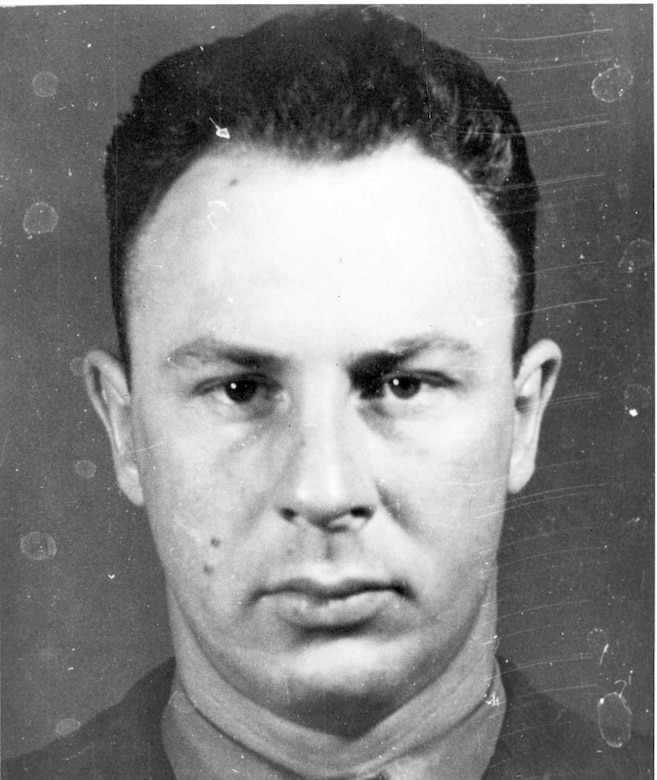
Marine Corps Staff Sgt. William Gordon Windrich was only in Korea for a short time, but the skills he'd honed during World War II helped him lead his cold, dirty and disheveled comrades to freedom during one of the most savage battles in modern military history.  

A man poses stoically for a photo.

Windrich didn't survive the Battle of Chosin Reservoir to tell his own story, but his heroics led him to posthumously receive the Medal of Honor.  

Windrich was born May 14, 1921, in Chicago to World War I veteran Herman Windrich and his wife, Marguerite. He had a sister named Virginia. 

When Windrich was young, the family moved to nearby Hammond, Indiana, where their father worked as a foreman at the city's only oil refinery.  

Windrich attended several public schools before dropping out and enlisting in the Marine Corps Reserve in June 1938. By November 1940, he was called up to active duty. 

During World War II, "Windy," as he was called, spent nearly two years in the South Pacific as a machine-gunner, seeing action during the Battle of Tarawa in the Gilbert Islands. He was discharged soon after the war ended and, after returning home, earned his GED diploma. At some point, he married his hometown girlfriend, Margaret. They had a daughter named Alita.  

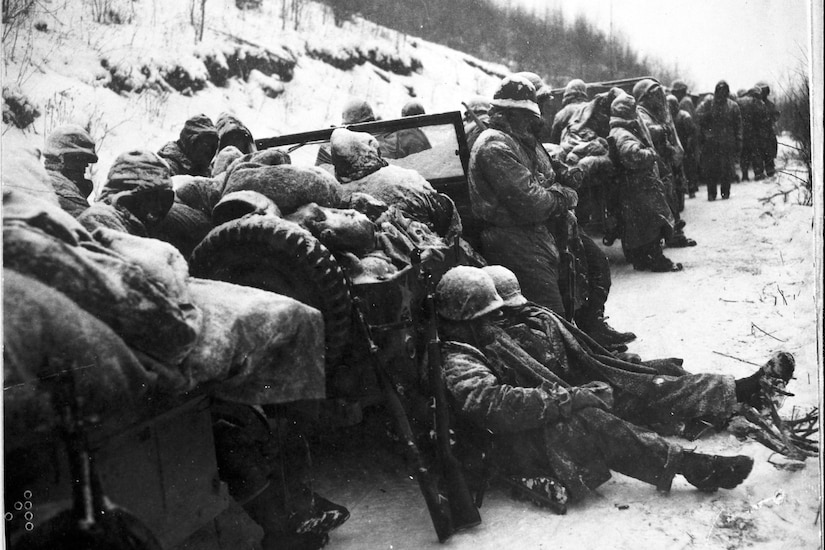
Dozens of men in cold-weather gear lounge near a line of military vehicles in the snow.

Civilian life didn't suit Windrich, however. So, in February 1946, he reenlisted in the Marine Corps. That summer, while serving aboard the USS Mount McKinley, Windrich took part in the atomic bomb testing at Bikini Atoll. In the years that followed, he served in positions in around Washington and in China.  

Windrich was on military police duty at Camp Pendleton, California, when the Korean War broke out in the summer of 1950. As part of the 1st Provisional Marine Brigade, he was one of the first Marines to see action in the conflict. He took part in the Inchon landing and the capture of Seoul before being transferred to Company I of the 3rd Battalion, 5th Marines, 1st Marine Division.  

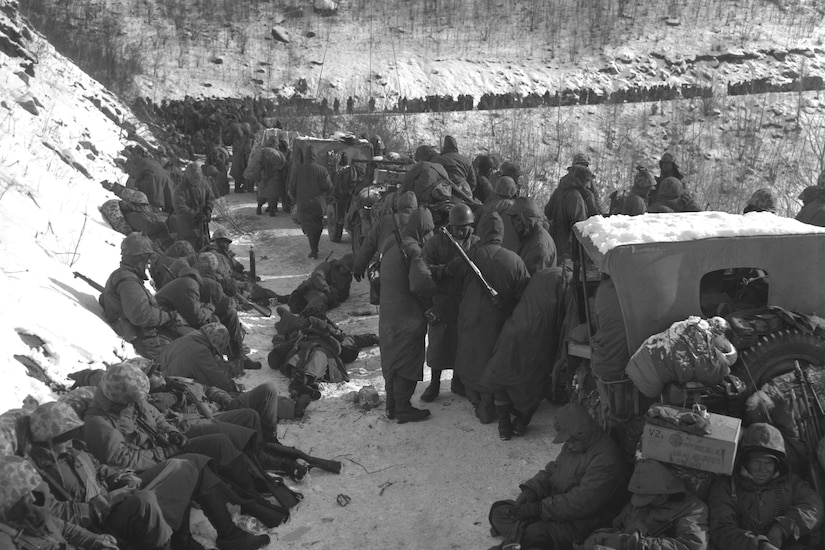
Windrich was the company's platoon sergeant during the infamous Battle of Chosin Reservoir, where about 30,000 troops from the United Nations, many of whom were U.S. Marines and soldiers, chased defeated North Korean army soldiers up the Korean Peninsula to try to force them over the border into China. When they reached the Chosin Reservoir, however, about 120,000 Chinese troops surged south over the border instead, ambushing U.N. troops and cutting them off from their main supply route.  

The nearly three-week battle was one of the most brutal in military history, waged in below-zero temperatures, heavy snow and frigid winds.  

Hundreds of men in cold-weather gear sit and stand alongside a line of military vehicles on a mountainside in the snow.

On the night of Dec. 1, 1950, the enemy launched a sudden attack on the forward elements of Company I's position on Hill 1520. As Marines fell, Windrich organized a group of men and spearheaded an assault toward the top of the hill to confront the enemy forces.  

Despite intense enemy automatic weapons, mortar and grenade fire, the group was able to effectively hold back the attackers while the remaining troops withdrew to safer ground. However, the assault group was decimated in the process. Most of the men were either wounded or killed, including Windrich, who suffered a head wound from a bursting grenade.

Windrich fell back to where his company had repositioned themselves. After refusing medical attention, he organized a new group of volunteers to evacuate the fallen Marines on the frozen hillside.  

Windrich then placed the rest of the troops on the left flank of the defensive sector as the enemy attacked again. Windrich was severely wounded in the leg and couldn't stand, but he refused to leave the fight, shouting words of encouragement and directing his team's fire until the attack was pushed back. Even then, he continued to direct his platoon to set up defensive positions. Eventually, Windrich succumbed to the bitter cold and excessive blood loss.  

"He allowed himself to be placed on a stretcher, and as he lay down, he told one of the men carrying him that he just wanted to go to sleep. Then he died," read a 1985 article on Windrich in his hometown newspaper, The Times. 

A man plays a bugle in the middle of a graveyard full of white crosses.

Windrich's bravery and devotion to duty inspired the men around him to hold the line despite the tremendous odds against them. Eventually, they were able to fight their way south to freedom. But the battle took its toll. The U.S. reported more than 12,000 casualties, including more than 3,000 dead. 

Windrich's fellow Marines weren't able to carry his body down the 70 miles of mountainous terrain, so he was left behind with the promise from commanders that they would come back for all the fallen Americans when they could.  

Windrich is one of 17 men who received the Medal of Honor for valiant actions during the battle. On Feb. 8, 1952, his widow and daughter received the nation's highest honor for valor on his behalf during a Pentagon ceremony.  

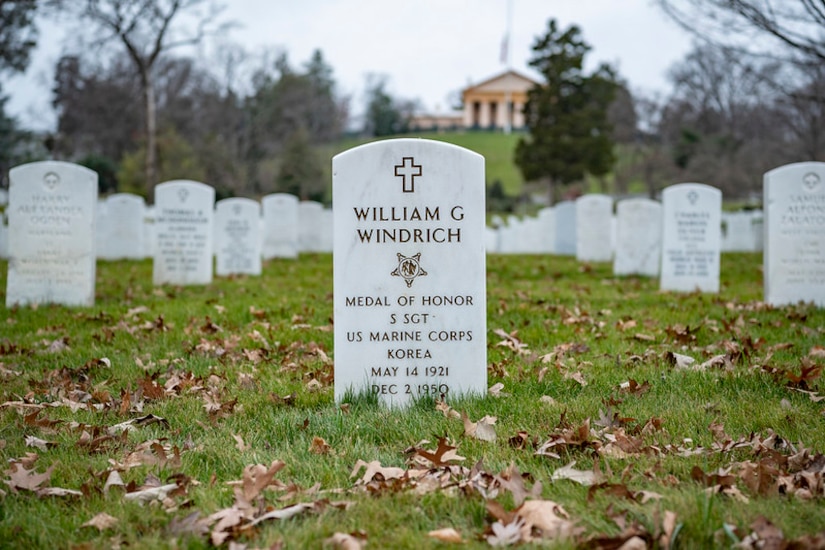
A grave marker is highlighted prominently among a field of other matching grave markers.

More than four years after the Battle of Chosin Reservoir ended, the promise to bring Windrich's body home was fulfilled, and his remains were repatriated. On July 29, 1955, he was buried in Arlington National Cemetery, Virginia. 

Near his hometown in Lake County, Indiana, residents and visitors can read about Windrich's heroics on a section of the Korean War veterans memorial that's dedicated to him. The National Museum of the Marine Corps in Triangle, Virginia, has also erected a Chosin Few Battle Monument in honor of those who fought there.