As the War Department rebuilds the defense industrial base — the thousands of private businesses that provide the hardware and weapons America's military uses to defend the nation — it will also ensure those businesses have the personnel to build those weapons.
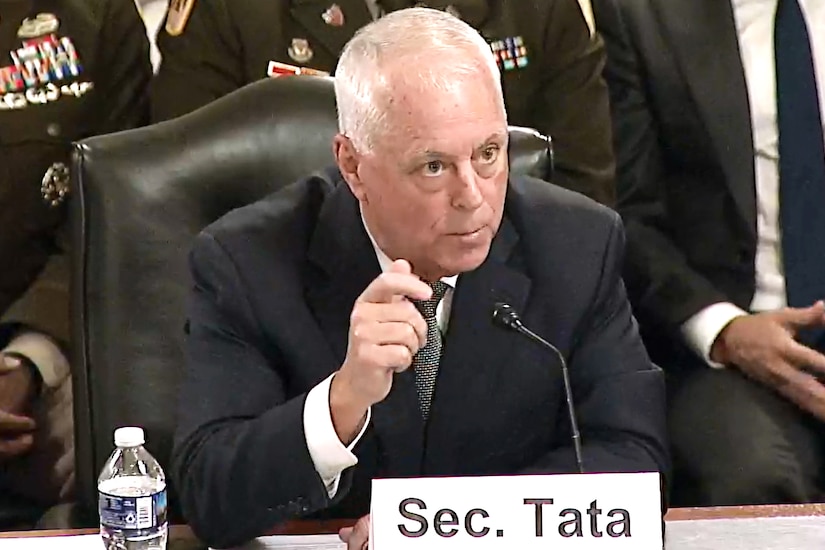
While testifying yesterday before the Senate Armed Services Committee's personnel subcommittee, Anthony J. Tata, the undersecretary of war for personnel and readiness, said DOW has established Project Patriot Pipeline, an initiative to unify dozens of disparate training and workforce development programs for service members, military spouses and federal civilians.
Tata said Project Patriot Pipeline is a direct result of Secretary of War Pete Hegseth's focus on the arsenal of freedom.
"As [the secretary] has traveled around the country to bolster our defense industrial base, we in the personnel and readiness domain asked ourselves the question: 'How are we going to resource this with the talent necessary to expand the arsenal of freedom and complete the mission?'" Tata said.
Through the department's arsenal of freedom effort, Hegseth has been working closely with industry partners to rebuild America's military might, which includes both the defense industrial base and the government-owned depots — the organic industrial base — that repair and refurbish weapon systems like tanks and helicopters or manufacture munitions.
Insofar as the workforce or potential workforce is concerned, the War Department has visibility of active-duty, National Guard and Reserve military personnel, federal civilian employees and military spouses. For those already in uniform, Tata said, the pipeline aims to retain that talent.
"Within each one, we want to encourage reenlistment, and we want to encourage reenlistment into ... high-demand, low-density military occupational skills," he said.
Tata noted that the department is aligning military bonuses with the services to ensure service members with the right skill sets are encouraged to reenlist. However, if they choose not to stay in uniform, they can continue to serve the nation as civilians through Project Patriot Pipeline.
"If they choose to leave service, we want to capture that training and investment that we made in their training," Tata said. "If they're an aviation maintainer in the military, we want them to be a depot aviation maintainer. And so, we are tweaking tuition assistance and SkillBridge time to be able to incentivize folks that want to migrate into the defense industrial base to try to incentivize them into those key skill sets."
SkillBridge is a program that enables retiring and separating service members to conduct on-the-job training in the private and civil sectors so they can successfully transition to a civilian job. As part of the program, service members spend time before their separation from service with one of thousands of partner businesses and agencies, learning job skills transferable to the private sector.
Through Project Patriot Pipeline, the War Department hopes SkillBridge can be used to guide departing service members back into service to their nation, as civilians in the defense industrial base or within one of the organic industrial base depots.
Tata described the urgency in opening the Patriot Pipeline, as the War Department expects there may soon be shortfalls in civilian workers in critical aviation fields.
"We have a real issue with our aviation depot maintainers," he said. "We're going to drop off a cliff here pretty soon, and demand is going to go way up, [depending] upon the platform that we're talking about. And so, we are trying to get ahead of that by incentivizing people ... to stay within the defense industrial base."
In addition to service members, Tata said it's not unreasonable to believe that military spouses could also help the defense industrial base.
"We have a huge military spouse employment effort going on ... where we have the SkillBridge-like program that they can do the internships, and then begin to work," he said. "We have money where we can pay for scholarships. We're going to increase that to incentivize them to go into the defense industrial base, whether that's healthcare, education, aviation maintainer, welder [or] shipbuilder. ... Our spouses deserve these opportunities, and we've allowed for direct hiring authority in many of these areas."
Finally, Tata said the War Department has many civilian employees who serve in a variety of areas, and he would like to see them keep working, if possible, moving into the most critical areas.
"We want them to 'reenlist,' so to speak, and re-up within the civilian domain, to go into things such as the Golden Dome [missile defense system], cyber and these real critical, high-demand, low-density areas where we need the real talent," he said.
Tata said military personnel, federal civilian employees and military spouses all have the possibility to help strengthen the nation by contributing to the arsenal of freedom through Project Patriot Pipeline.








 Posts
Posts

