Thursday, December 18, 2025

K9 Holistic Health Is Doggone Delightful

For the handlers of the 525th Military Working Dog Detachment, 18th Military Police Brigade, readiness isn't just about the mission — it's about maintaining the total health of their most trusted partners.
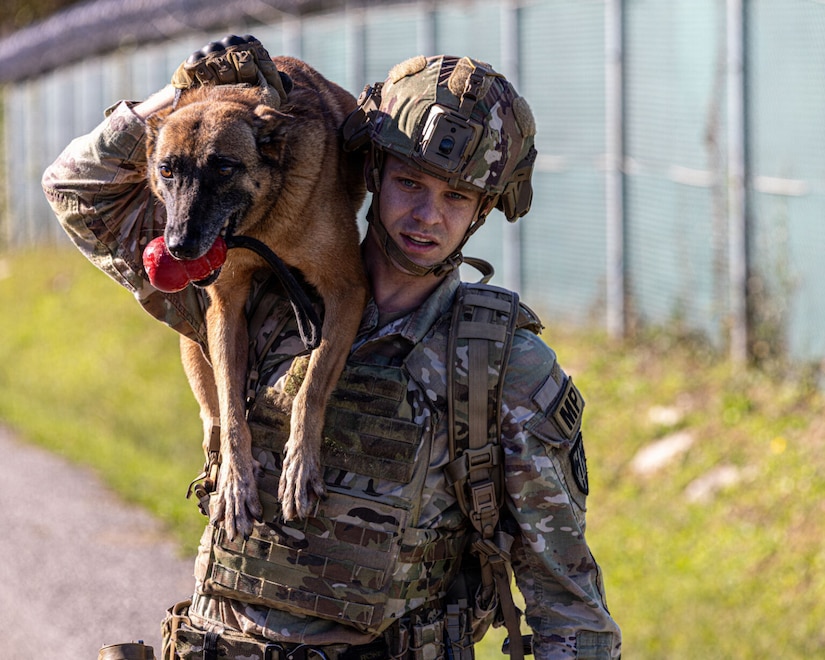
A soldier walks with a dog on his shoulder. The dog has a red squishy ball in its mouth.

Through the U.S. Army's new Canine Holistic Health and Fitness program, the detachment based in Vicenza, Italy, is redefining what it means to be mission-ready, one paw at a time. 
 
The Army established the K9H2F program under Army Directive 2025-16 to enhance the wellness, performance and quality of life of MWDs Aug. 21. The directive mandates all Army MWD units to implement comprehensive health and welfare standards, aligning with War Department and Army veterinary care policies. 
 
Modeled after the Soldier Holistic Health and Fitness system, K9H2F takes a science-based, whole-dog approach — addressing physical fitness, nutrition, behavioral health and recovery. For the 525th MWD team, that means every dog receives the same level of conditioning and care as any elite military athlete in uniform. 
 
"Our dogs are tactical athletes," said Army Staff Sgt. Payton R. May, kennel noncommissioned officer in charge, 525th MWD Detachment, 18th Military Police Brigade. "They train hard, they work hard and they deserve the same attention to fitness, nutrition and injury prevention that we give our soldiers. The H2F program helps us keep them in top condition so they can perform safely and effectively in any environment." 
 
A key component of the directive, the Partner and Wellness program, ensures handlers and their assigned MWDs relocate together during permanent changes of station, strengthening continuity and the human-K9 bond.
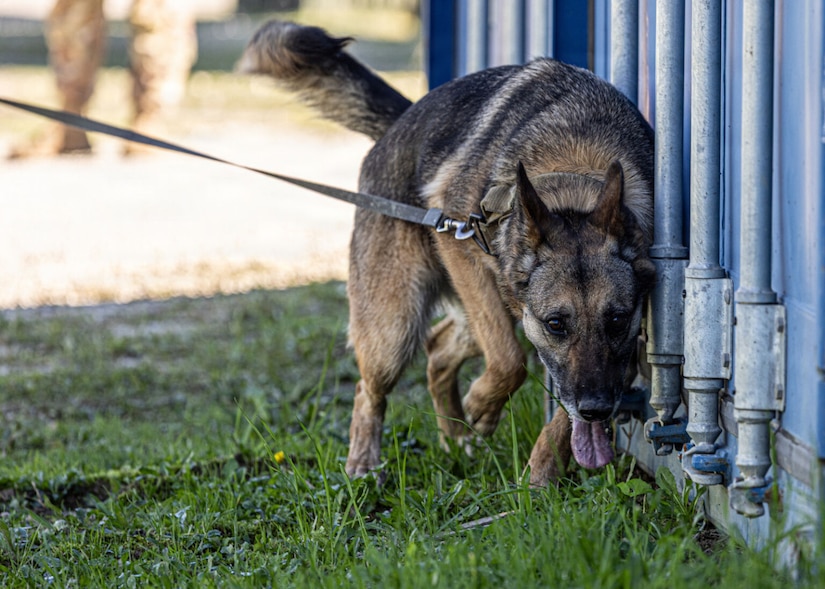
A dog sniffs the grass.

 
"When I [moved] to Italy, being able to bring my dog with me made a huge difference," said Army Spc. Matthew C. Skalisky, a patrol explosive detector dog handler assigned to the 525th MWD. "It helps us maintain that trust and teamwork that can't be replaced. The PAW program makes sure that bond doesn't get broken." 
 
Each MWD now follows structured conditioning routines designed to build strength, endurance and agility while reducing the risk of injury. Specialized diets, recovery protocols and enrichment activities round out their regimen, ensuring each dog remains physically capable and mentally resilient. 
 
According to Army Sgt. Maj. Viridiana Lavalle, Headquarters, Army Military Working Dog program manager, the initiative marks a major step forward in modern K9 care. 
 
"Proactive and data-driven K9 care is essential for optimizing the performance and longevity of MWDs, directly impacting mission readiness and effectiveness," Lavalle said. "By leveraging advanced analytics to monitor health metrics, exercise regimens and behavioral patterns, handlers can implement tailored care strategies that enhance the holistic health of MWDs." 
 
This strategic approach not only improves the physical capabilities of these vital assets but also supports K9 mental resilience, ensuring they are fully prepared for the demands of their critical roles.
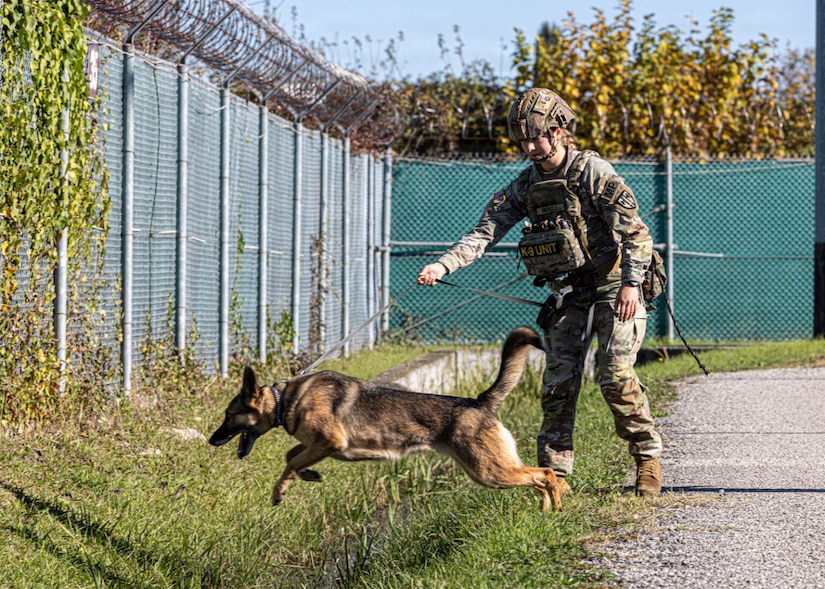
A soldier holds a dog by a leash as they search a grassy area.

 
"Ultimately, investing in comprehensive K9 care through data-driven insights enhances operational effectiveness, contributing to mission success and the overall safety of military personnel," Lavalle added. 
 
The holistic approach extends beyond the kennel. Handlers train alongside veterinary and behavioral specialists to better understand each dog's unique needs, improving communication and enhancing mission effectiveness. 
 
"The bond between handler and dog is everything," May said. "When you have that trust, that connection, the dog performs with confidence. The H2F program helps us strengthen that bond through better training, stress management and recovery practices." 
 
From explosive and narcotics detection to patrol duties across Europe and Africa, the 525th's military working dogs play a vital role in safeguarding soldiers and installations. The K9H2F program ensures those capabilities remain sharp on every mission, in every environment. 
 
"Investing in our dogs' health is investing in readiness," said Army Spc. Abigail M. Bentle, a patrol narcotics detector dog handler assigned to 525th MWD. "They're not just assets, they're teammates. When they're healthy, confident and capable, our entire formation is stronger."
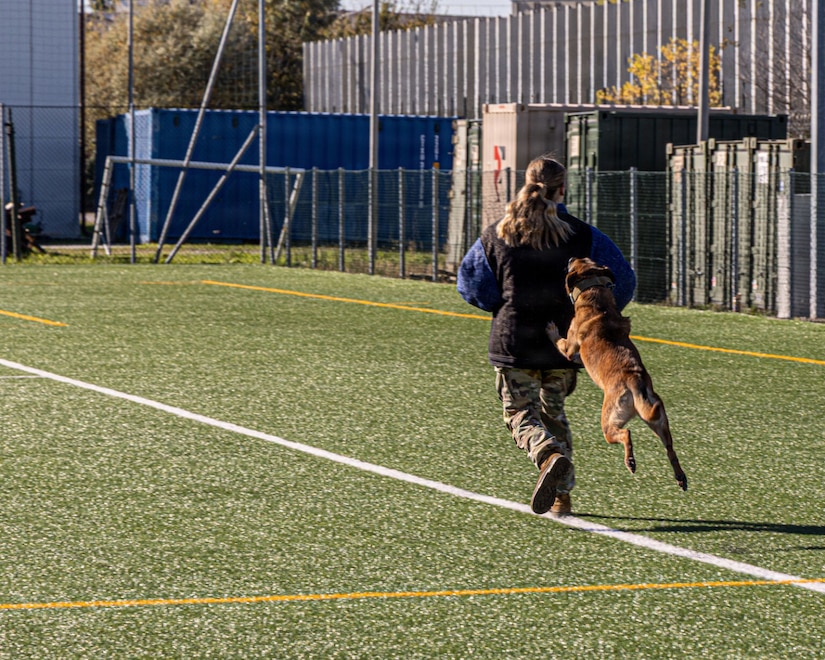
A dog runs toward the back of a woman wearing a padded suit.

 
Under the directive, the Army Provost Marshal General oversees program criteria and compliance, while the Surgeon General of the Army coordinates implementation guidance. Commanders are required to meet new kennel and enrichment standards within 90 days, and the policy will be incorporated into Army Regulation 190-12 within two years. 
 
For the soldiers and K9s of the 525th MWD Detachment, holistic fitness isn't just a program; it's a commitment to excellence that keeps both handlers and their four-legged partners ready for any mission. 

Hegseth, Senior Leaders Honor Military's Top Recruiters

Secretary of War Pete Hegseth and other senior War Department officials honored the military's top recruiters today during the inaugural Recruitment Excellence Forum at the Pentagon.

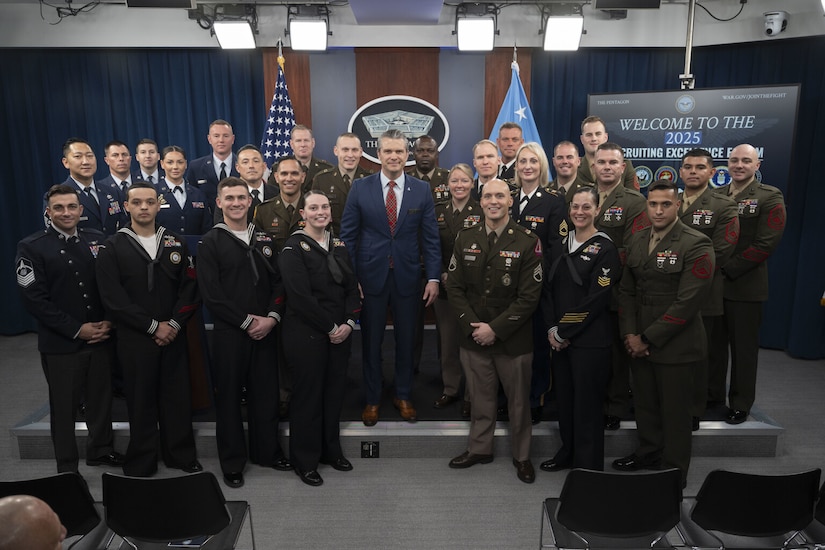
A large group of people in various dress military uniforms pose for a photograph with a man in the center of the group wearing civilian business attire.

A byproduct of Hegseth's recently established Recruitment Task Force, the event aimed to recognize the hard work put in by 26 of the most successful recruiters from the departments of the Army, Navy and Air Force during fiscal year 2025. 

"This is to say thank you — first and foremost — and to recognize excellence, which is what we want to do here, in every service: [recognize] the best of the best, incentivize everybody [to] work hard and [then] reward that," Hegseth told the recruiters while gathered in the Pentagon's press briefing room. 

The secretary praised the recruiters for achieving the highest number of enlisted accessions in the past 15 years, with all branches averaging a roughly 104% mission completion rate. 

"There's a lot of things contributing to [why] someone may or may not qualify to get into the military [and] you guys cut through all of that. You find great Americans who want to serve, and you've signed them up in record numbers," Hegseth said. 

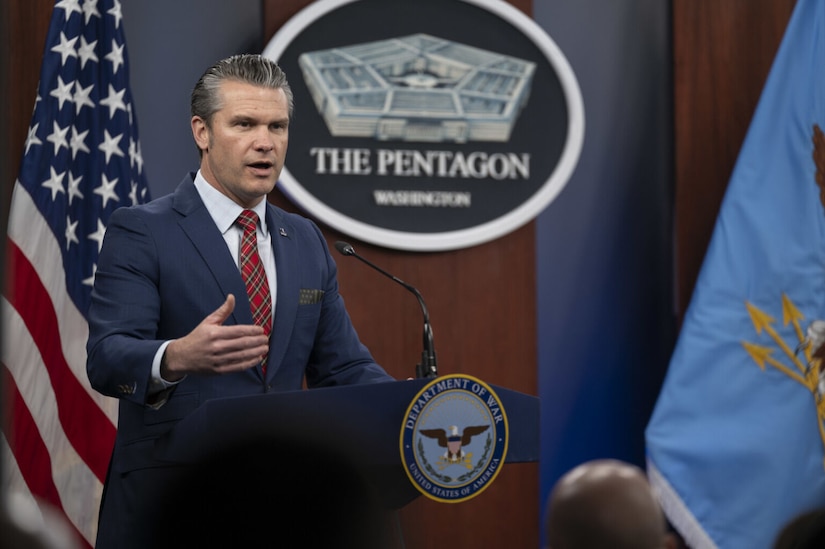
A man in business attire stands behind a lectern speaking into a microphone. A seal on the lectern shows an eagle and reads, “Department of War.” Behind the man is an American flag and a sign depicting a five-sided building that reads, “The Pentagon.”

He noted that recruiting is closely monitored at the highest levels — including as high up as the White House — because it serves as a "feedback loop" from the American people.  

"You can talk about polls, [and] you can talk about money, but men and women willing to serve and put on the uniform is a reflection of the belief they have in civilian leadership and military leadership," Hegseth said.  

Along with recognizing the recruiters, Hegseth said the forum was an opportunity for the department to get feedback from the recruiters on how their jobs could be made easier — a sentiment echoed by other senior War Department leaders who attended the event. 

"What we want to hear is how [we] can help you. You're the best of the best; you're the most successful [recruiters] out there. How can we help you be more successful, and how can we help those that come behind you be more successful?" Undersecretary of War for Personnel and Readiness Anthony J. Tata said at the start of a roundtable discussion. 

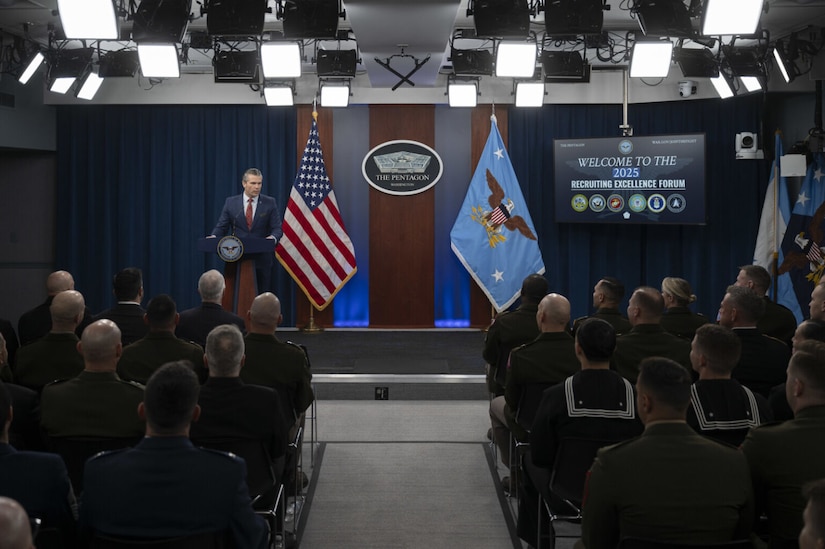
A man in business attire stands behind a lectern speaking into a microphone. Behind the man is an American flag, another flag with a large eagle in the center and a sign depicting a five-sided building that reads, “The Pentagon. A large group of people, their backs to the camera, are listening to the man speak.

"[Recruiting is] tough work. … You're convincing and talking to people about making a life-changing decision about service, and that is really difficult work," Chief Pentagon Spokesman and Senior Advisor Sean Parnell told the recruiters during the roundtable. 

"And we just want to let you know from the top of this building that you're appreciated … [and] we're going to do everything that we can to empower you, to cut red tape and to help you accomplish your mission," he added. 

Many of the recruiters in attendance explained what motivates them to do such a demanding and often taxing job. 

"It's 100% because of the impact that we make on young lives, on the individuals that I recruit that [might be] homeless, that don't have anything going for themselves … and they want to do something bigger with their lives and just serve their country," said Marine Corps Gunnery Sgt. Abel Layton Jr., a recruiter assigned to El Paso, Texas. 

"Watching them come back as Marines — that's 100% the main reason why I enjoy doing this job," he added. 

"[Recruiting is] important to me, and I think it's important to everyone I know who's in recruiting, because we are dedicated to the organization — and the goals and values of the organization — and [to] aligning those goals and values with the American public," explained Army Staff Sgt. Ryan Dupuis, a National Guard recruiter assigned to Denver. 

"We don't take people and give them a job; we take civilians, and we make them members of the military," he added. 

Some of the recruiters also expressed their appreciation for being invited to Washington and for being recognized by the Recruiting Excellence Forum. 

"It's an absolute honor to be here, first of all. It's really awesome to be recognized for the work that we're doing day in and day out, because it's not easy to be on recruiting duty, and I don't think a lot of people really understand it until they've been in it," said Navy Petty Officer 1st Class Ashley Lynch, a recruiter assigned to Atlanta. 

"For them to put on something like this and to recognize the work that we're doing, I think it speaks volumes," she added. 

Hegseth closed out his remarks by once again underscoring the War Department's commitment to equipping the recruiting community with the tools it needs for success. 

"Our job is to create an environment to make you more successful as sailors, as warfighters … [and], if we're making your job easier and making you more effective, then we're doing our job correctly," he said. 

"Please give us all the information that you have … [and] feed it to our folks while you're here today so that we can improve even more," Hegseth told the recruiters, adding, "And just keep being the best of the best."