Thursday, June 11, 2026

Carrying the Torch: 815th Airlift Squadron Assumes Airlift Mission in Africa

There was no formal ceremony marking the transition at Camp Lemonnier, Djibouti. No guidon passed from one commander to another. Instead, a moment represented something larger; the passing of a torch that lights the path of Air Force airlift across the U.S. Africa Command area of responsibility.
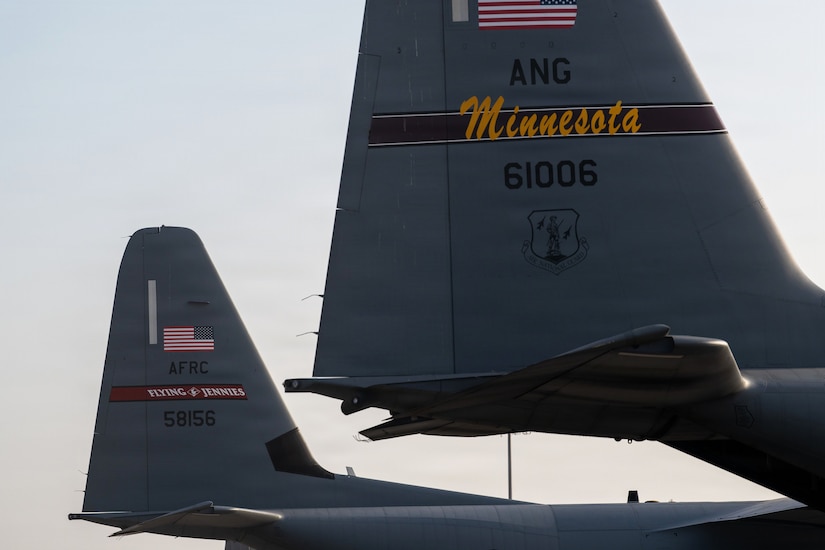
The back of two military aircraft parked side by side.

After months of operations throughout Africa, airmen assigned to the Minnesota Air National Guard 133rd Airlift Wing concluded a historic deployment for their wing as airmen assigned to the Air Force Reserve 815th Airlift Squadron, known as the Flying Jennies, carry on the torch for the next rotation. 
 
For the 133rd Airlift Wing, the deployment carried significance as the wing's final planned deployment with the Air Force C-130H3 Hercules. It concludes a 30-year era of trusted service with the C-130H model aircraft, which is being replaced across the wing by the newer C-130J model as part of the Minnesota Air National Guard's ongoing modernization efforts. 
 
"The men and women of the 133rd Airlift Wing are closing out a truly historic deployment," said Air Force Lt. Col. Denny Paulsen, outgoing commander of 75th Expeditionary Airlift Squadron. "The significance of this being our final planned deployment with the C-130H model added meaning to every mission and fueled an elevated level of motivation across our team."
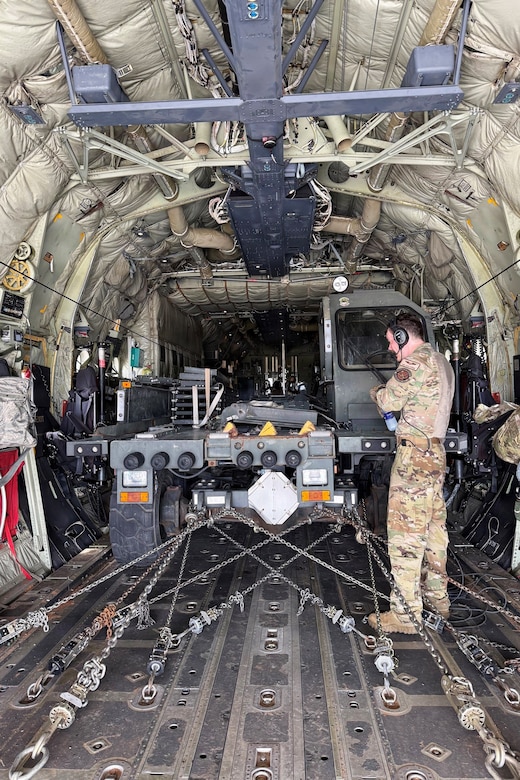
A man wearing a camouflage military uniform stands in the back of a military aircraft while looking at a military loading vehicle.
The 75th Expeditionary Airlift Squadron, under the 449th Air Expeditionary Group, carries a high operational tempo, being the sole Air Force airlift capability for the African continent. The mission demands no-fail execution, ensuring cargo and personnel reach their destinations on time.

Their efforts included supporting operations driving security, economic, humanitarian and anti-terrorism efforts designated among Africom's highest priorities, earning recognition from senior leaders across the Horn of Africa. 
 
"This deployment brought an operations tempo and urgency that exceeded what is typical," Paulsen said. "The dedication, professionalism and skill of our squadron were on full display through multiple high-visibility operations that demanded absolute precision." 
 
According to Paulsen, the 133rd Airlift Wing leaves behind a legacy built from decades of service with the C-130H, capping a deployment that showcased the aircraft's enduring value and the professionalism of the airmen who flew and maintained it. 
 
"All of Minnesota can be proud of what the airmen of the 133rd Airlift Squadron have accomplished," Paulsen said. "Their performance has left a lasting mark on our state and on the legacy of the C-130H." 
 
Now, the Flying Jennies assigned to the Air Force Reserve 815th Airlift Squadron from Keesler Air Force Base, Mississippi, take the reins. Flying the Air Force C-130J-30 Super Hercules, the airmen and airframe bring expanded airlift capabilities and a history of operational excellence. 
 
Under the leadership of Air Force Lt. Col. Stephanie Brown, incoming commander of the 75th Expeditionary Airlift Squadron, the squadron arrives ready to provide tactical airlift, contingency operations, aeromedical evacuation and rapid mobility support to increase operational capability across Africa. 
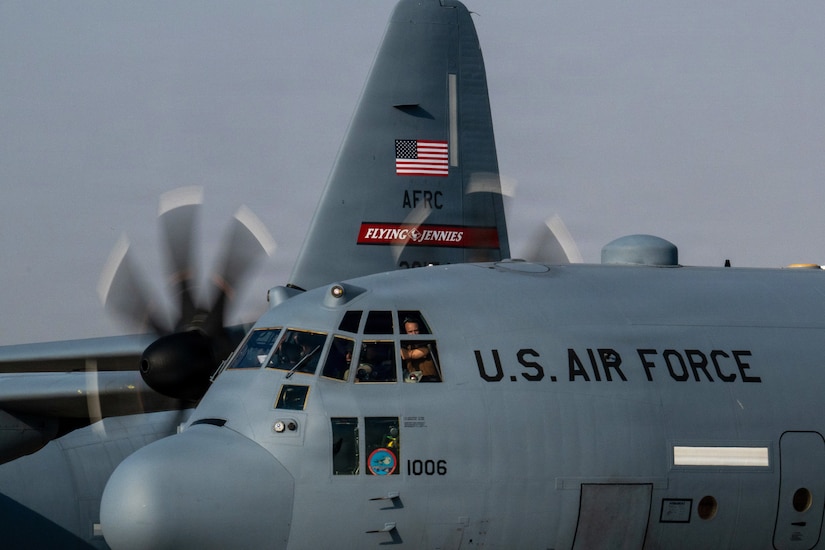
A military aircraft taxis on a flight line. The pilots are in the cockpit.

 
"The airmen and team of the 815th Airlift Squadron stand ready to support the Africom and Combined Joint Task Force – Horn of Africa area of responsibility," Brown said. "This deployment is the culmination of a two-year Air Force's force generation 'level 300' training plan and Air Force Reserve Command certification." 
 
That two-year preparation consisted of a series of highly complex, joint and international exercises to stress test their tactical capabilities to ensure the team was ready to sustain full-spectrum readiness in their area of responsibility. 
 
The transition reflects one team completing its chapter while another immediately carries the mission forward. The final C-130H crews of the 133rd Airlift Wing passed the torch to the Flying Jennies to continue redefining responsive air mobility support for the joint force, allies and partners across the African continent.
Task Force Civil Affairs Team Conducts Subject Matter Expert Exchange in Libya

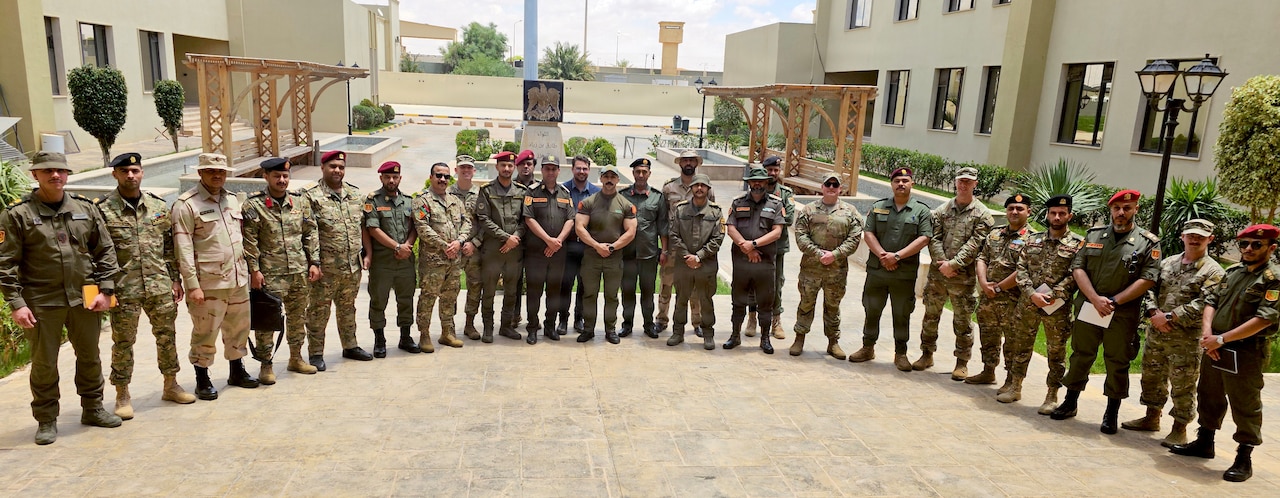
Two dozen men in military uniforms pose for a group photo outside in a courtyard.

Soldiers assigned to the Civil Affairs Team Libya, U.S. Army Southern European Task Force, Africa, conducted a military-to-military subject matter expert exchange with representatives of the Libyan National Army and the Government of National Unity in Benghazi, Libya, May 19-22.

This exchange was the first in what the civil affairs team plans to be a series of exchanges with partner forces representing the two distinct political entities that currently control Libya. Through the end of the fiscal year, exchanges with both the LNA and the GNU will occur monthly. This gives the civil affairs team a place from which to witness a new chapter in Libya's evolving history.

Since the fall of Muammar Gaddafi in 2011, Libya has experienced vast security improvements, according to U.S. Army Maj. Miles Dunning, civil affairs team lead.

Dunning explained that various governments recognize the LNA as Libya's legitimate government, while others recognize the GNU, but the preferred end state is a unified Libya with a combined armed forces' capability to combat terrorism in the region.

"What we're trying to do as [U.S. Army Southern European Task Force, Africa] — and specifically civil affairs — is get both entities to the negotiating table with the overall goal to unify Libya under one government," Dunning said. "The way we do that at [the task force], at the civil affairs level, is by conducting military-to-military exchanges with both partner forces … to facilitate a space where those partner forces can come together, cooperate and have face-to-face conversations through knowledge exchanges."

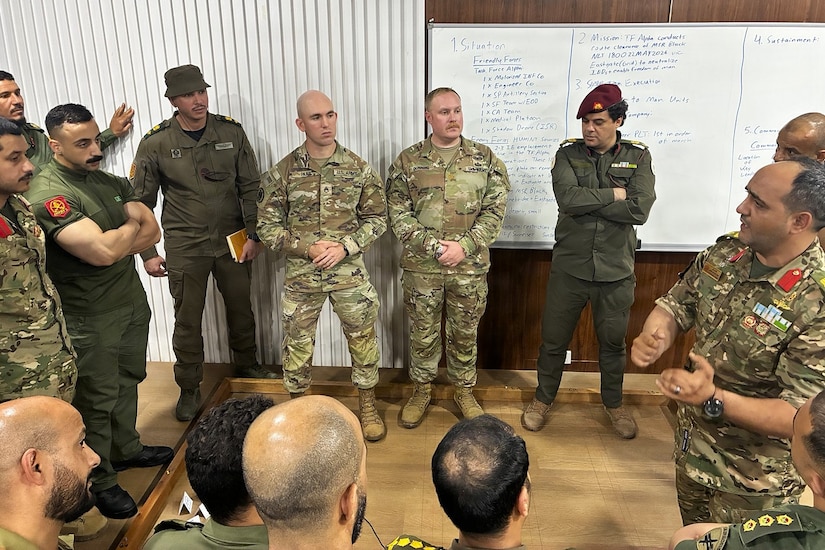
A dozen men in military uniforms stand in a circle watching another man in similar attire speak inside a classroom.

Twenty-one military officers, ranging from O-3 to O-6, represented both groups. Dunning noted that both partner forces seemed interested in making progress toward a stronger, more stable country.

"They get along together very well from what we've seen," Dunning said. "Both parties are amenable to a lasting peace and are eager to work with each other to continue these exchanges in the future. From what we observed, both partner forces were very cordial."

This event also marked the first time a task force has conducted an exchange with partner forces in Libya. Dunning emphasized that it represented a pivotal step in building relationships between the military forces of the U.S., LNA and GNU.

"It is specifically [the task force] that has been tasked to do these military-to-military exchanges with Libyan partners," Dunning said. "We are the only conventional U.S. Army force that has a presence in Libya after this engagement."

As part of the U.S. contribution to the knowledge exchange, the civil affairs team discussed how the U.S. Army conducts combined arms operations. This conversation went on to include U.S. warfighting functions, the military decision-making process, troop leading procedures and the operations order.

During a tabletop exercise — the exchange's culminating event — partner forces received a scenario in which they were operating in a fictitious country, and they had to complete a road-clearance operation from one village to another. Given specific resources to complete this notional task, representatives from both partner forces described how they would accomplish the mission.

"Insights [from this exchange] will enable successful rapport building between the U.S. and both Libyan partner forces," Dunning said, adding, these exchanges offer a distinct opportunity to participate in open dialogue and will set the stage for future operations, increasing partner force cooperation and facilitating communication between the LNA and GNU.

Dunning noted that these exchanges increase the U.S.'s ability to work with a partner force by providing a better understanding of how they operate. In return, those partner forces receive a better understanding of how U.S. forces operate, which will improve combined operations in the future.

"This was a groundbreaking event, and it has been many years in the making with a lot of parties," Dunning said. "People have put in hundreds of man-hours to make this happen, and my team was very lucky to be tasked with this mission. It is the first time a conventional U.S. Army element from any organization has been to Libya in 16 years, so it was a big deal and a big first step in reestablishing a military relationship with Libya."