Wednesday, May 13, 2026

Washington National Guard Aviation Crews Train for Wildfire Season

Aviation crews assigned to the 1st Battalion, 168th Aviation Regiment, Washington Army National Guard, partnered with Central Pierce Fire and Rescue to conduct water bucket training near Puyallup, Washington, May 7, preparing for the state's wildfire season.
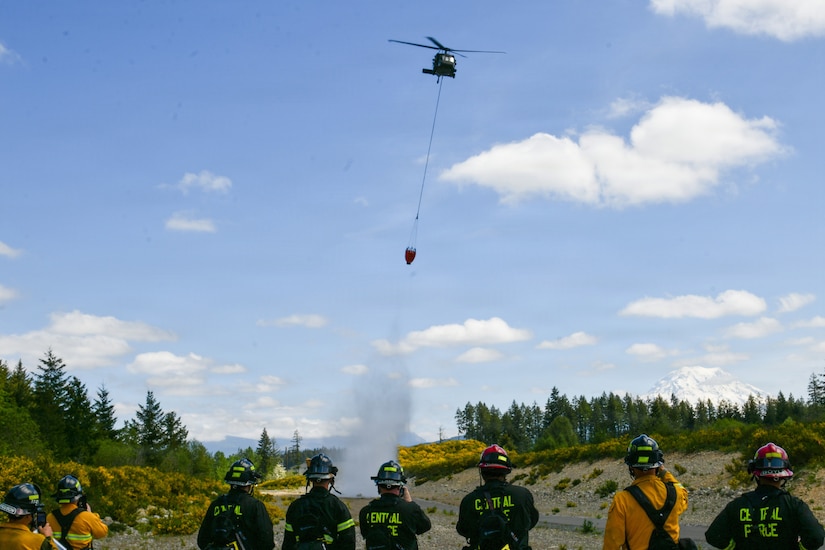
A military helicopter drops water on the ground in an open area surrounded by trees as eight people in firefighter uniforms observe in the foreground.

Throughout the exercise, firefighters and aviation crews rehearsed aerial wildfire response operations, practicing water bucket drops, air-to-ground communication procedures and coordination between firefighters and aircrews.

Using UH-60 Black Hawk helicopters, aircrews conducted multiple water drops while firefighters on the ground coordinated target locations and evaluated each drop's effectiveness. The training focused on communication, timing and precision in environments that can quickly become hazardous during wildfire response operations.

"Air assets have become a critical asset in fighting these fires," a Central Pierce Fire and Rescue spokesperson said. "These are very fast-moving fires, especially when the weather's playing into it with the wind, and it's extremely difficult for us on the ground and extremely hazardous sometimes for us to get even close enough to attempt to extinguish these fires."
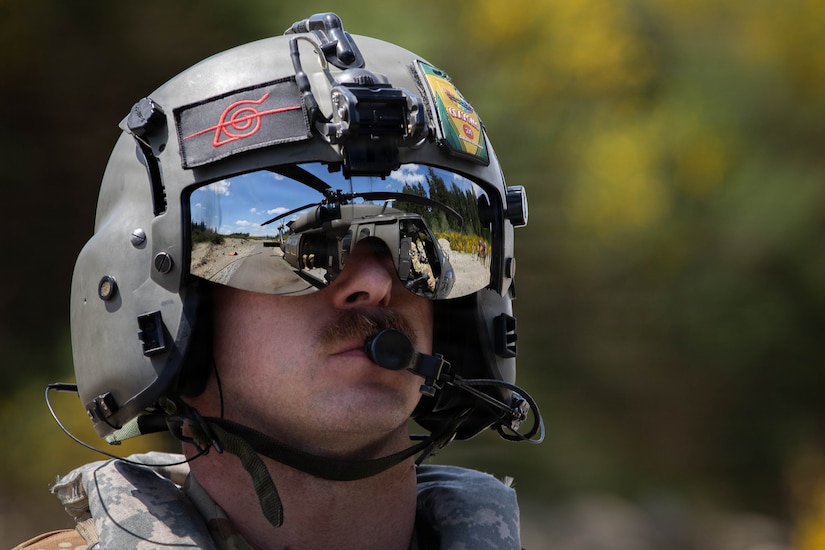
A close-up view of a man wearing an aviation helmet with a reflection in the visor of a military helicopter parked on the ground nearby.

Fire officials said helicopters and fixed-wing aircraft often provide firefighters additional access and suppression capabilities in areas that may be difficult or unsafe for crews operating on the ground.

Army Chief Warrant Officer 3 Jarin Trakel, 1st Battalion company standardization instructor pilot, emphasized the recurring partnership helps firefighters and aviation crews build familiarity and communication before responding to real-world emergencies.

"We kind of try to bridge that gap by putting a face to the radio before anything actually happens," Trakel said. "That way they know what to expect when they call the Washington [National] Guard."
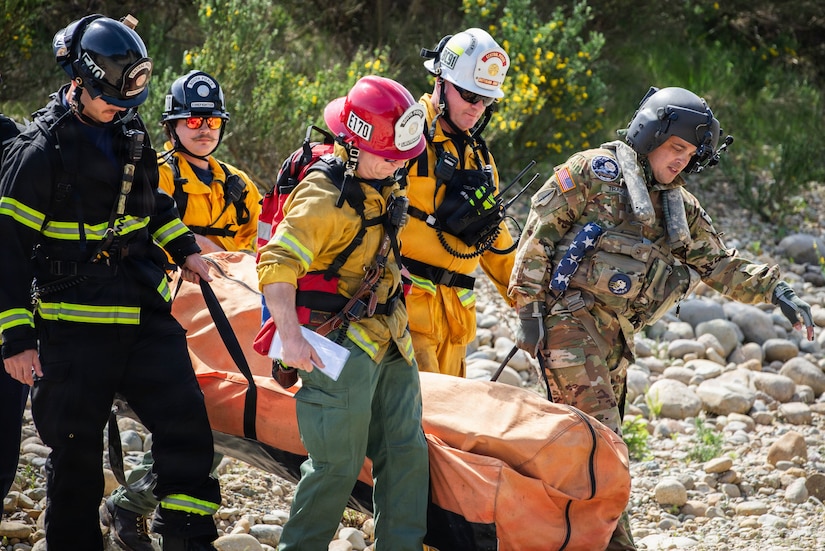
A man wearing a camouflage military uniform and aviation helmet and four other men in firefighter uniforms carry equipment outside.

The joint training also allows both organizations to better understand each other's capabilities, communication procedures and operational limitations before responding to wildfire incidents together, he said.

For Washington Army National Guard aviation crews, water bucket operations require annual certification and recurring proficiency training to ensure pilots and crew members remain prepared to respond when activated in support of wildfire suppression missions across the state.

Trakel described these operations as one of the more demanding aviation mission sets conducted during domestic training.
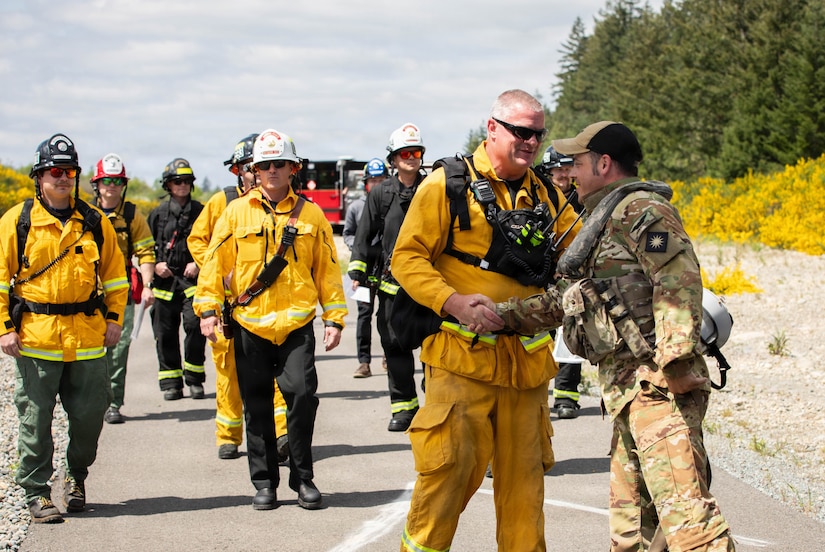
A man wearing a camouflage military uniform shakes hands with another man in a firefighter uniform at a training location outside; there are several other men wearing firefighter uniforms and helmets standing in the background.

"This is kind of the varsity league of training," he said. "The aircraft, we put it pretty close to its limitations when we're picking water up, moving the aircraft around in tight spaces, at low airspeed with a high-power setting."

He added that the mission requires experienced crews, constant communication and coordination between pilots, crew chiefs and firefighters on the ground. During real wildfire responses, military aviation crews often integrate with multiple civilian rotary-wing aircraft operating from the same water sources and flight paths.

"It takes a lot of coordination," said Army Chief Warrant Officer 3 Martin Hays, battalion aviation mission survivability officer. "You're dealing with firefighters on the ground and additional weight with the water bucket."
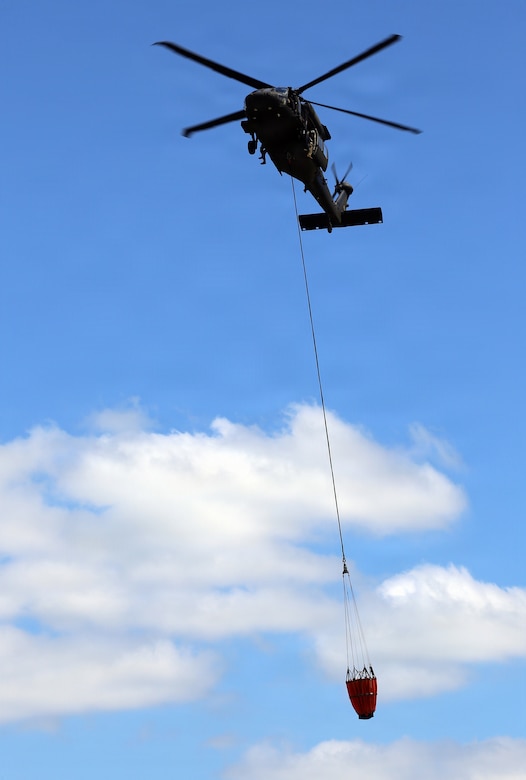
A military helicopter carries a large bucket of water that is hanging from a cable attached to the bottom of the aircraft.

Hays said wildfire response operations remain one of the more demanding domestic missions conducted by guard aviation crews, due to terrain, smoke, wind conditions and the coordination required between ground personnel and aircraft.

During the exercise, firefighters and aircrews practiced identifying targets, coordinating water-drop locations and maintaining positive communication throughout the operation.

"The first thing that we do is try to identify our ground contact to make sure we have positive communication with the crews," said the Central Pierce Fire and Rescue battalion commander. "Obviously, the priority is actually stopping any forward progress toward residential structures or life hazards."

Fire officials said the partnership has continued to grow through recurring joint training opportunities between firefighters and guard aviation crews.

"It's extremely rare to find helicopters that are willing to train with us," a firefighter said. "We decided this was a great opportunity for us to get some training out of this, too."

Since 2012, the Washington National Guard has supported wildfire suppression efforts throughout the state alongside the Washington Department of Natural Resources. In 2024 alone, aviation crews flew more than 75 firefighting hours and dropped nearly 300,000 gallons of water in support of multiple wildfire responses. According to the Washington Department of Natural Resources, 1.2 million gallons of water were delivered by aviation assets, with an average response time of 16 minutes, in 2025.
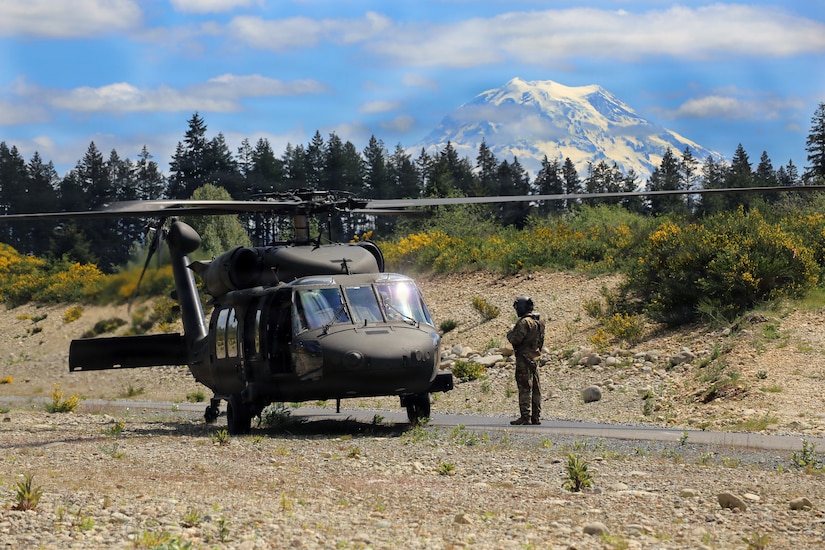
A person wearing a camouflage military uniform stands next to a military helicopter preparing to take off from a training location outside; there are trees and mountains in the background.

In recent years, Washington Army National Guard aviation crews have been activated to support wildfire response operations across the state.

"The more we get to go out and do this, the better," Trakel said. "It just makes us safer, more capable to give back to the state when called upon."

As wildfire season approaches, guard aviators and firefighters continue strengthening partnerships and operational readiness to protect communities statewide.
U.S., Multinational Allies Launch Exercise Salaknib's Second Phase in the Philippines

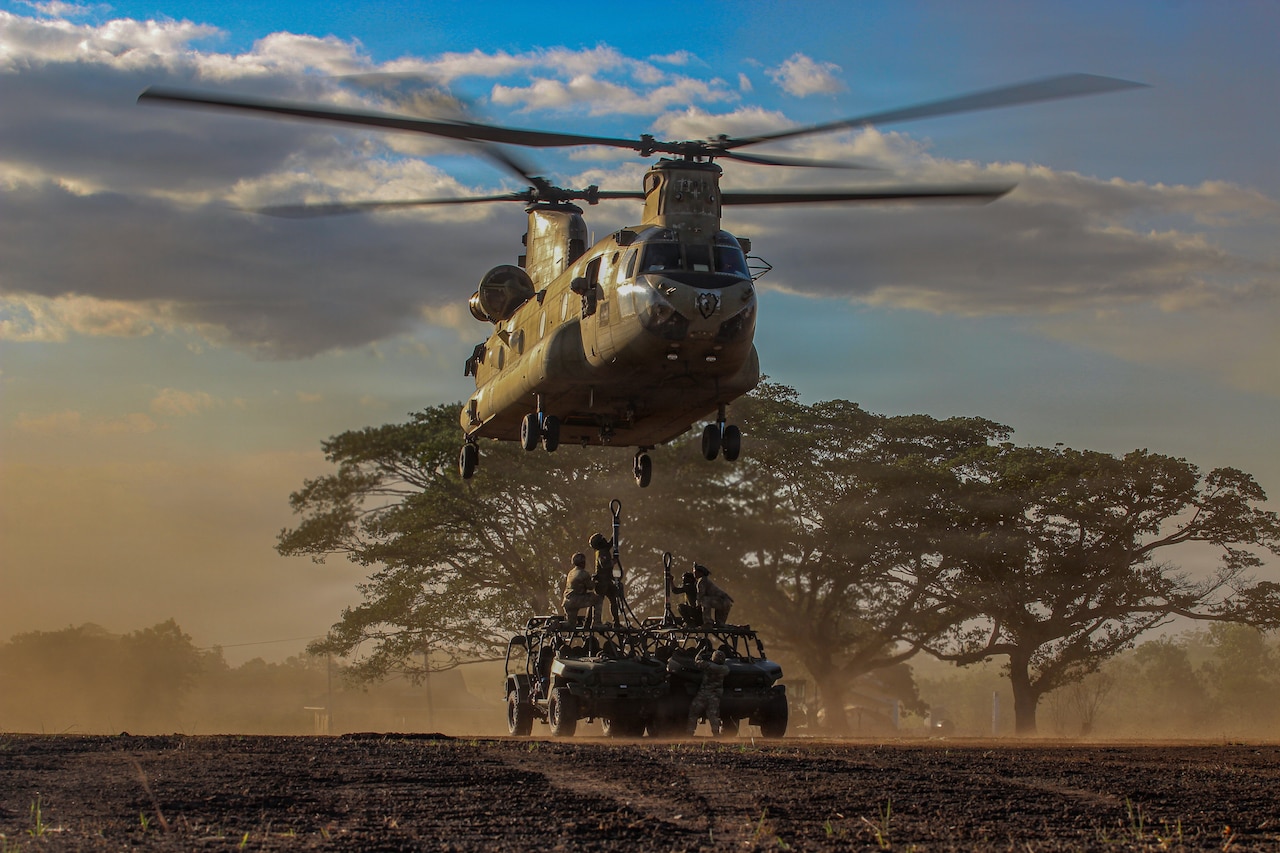
Four service members wearing camouflage military uniforms work to attach hooks tethered to two military vehicles to the bottom of a military helicopter that hovers above them.

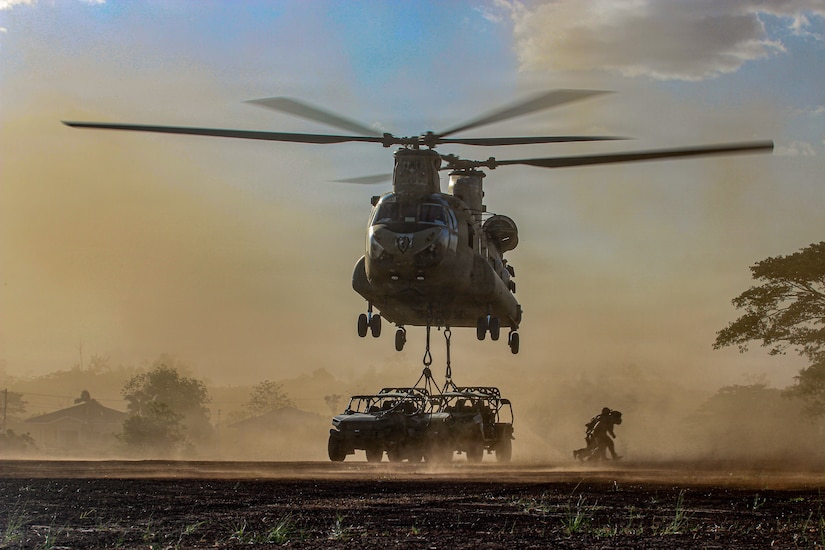
The Army's 25th Infantry Division, in close partnership with the Armed Forces of the Philippines and multinational allies, officially launched the Joint Pacific Multinational Readiness Center-Exportable Exercise, May 8. 

Operating as Part II of the bilateral Exercise Salaknib, JPMRC-X continues through May 20. This rotation brings an immersive combat training center experience directly into the Indo-Pacific theater, allowing forces to train in the complex, archipelagic environments where they operate. 

A group of service members wearing camouflage military uniforms run away from a military helicopter that is attached to two military vehicles as red dust surrounds them.

"Our alliance with the Philippines is steeped in history for over 75 years as the oldest treaty ally," said New Zealand Army Col. Aidan Shattock, deputy commanding general for interoperability of the 25th Infantry Division. "This is playing out with deep trust and understanding as we rehearse together during Operation Pathways."

During JPMRC-X, the 25th Infantry Division will execute complex, multidomain operations. The exercise is designed to strengthen the division's tactical proficiency and partner interoperability through rigorous, realistic training across diverse, challenging terrain. 

The training rotation features the 25th Infantry Division's role as the spearhead of Army modernization. Participating units will leverage human-centered technology, including the integration of unmanned aircraft systems to enhance situational awareness and the fielding of the Army's next-generation squad weapons, the M7 rifle and M250 automatic rifle, to advance squad-level modernization and mission effectiveness. 

"Exercises like JPMRC-X demonstrate our enduring commitment as the land partner of choice, strengthen our allies and deter aggression together," Shattock said. 

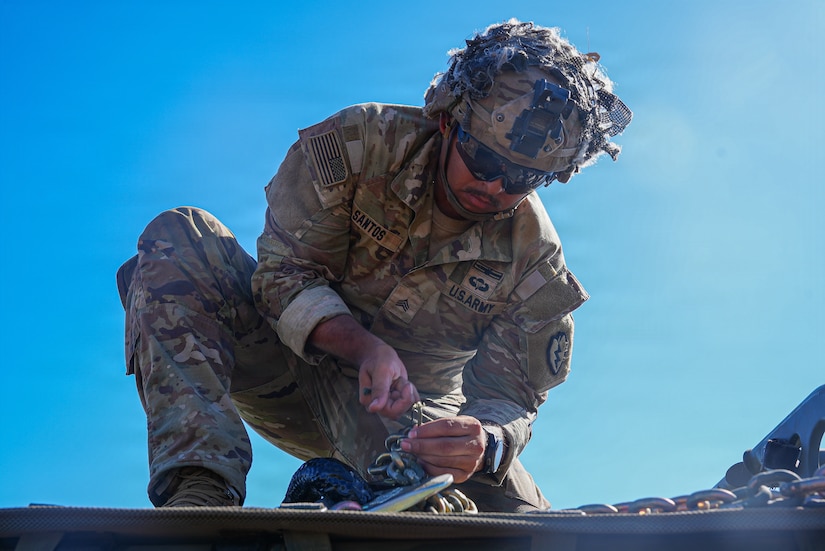
A service member wearing a camouflage military uniform connects a metal hook to a military vehicle.
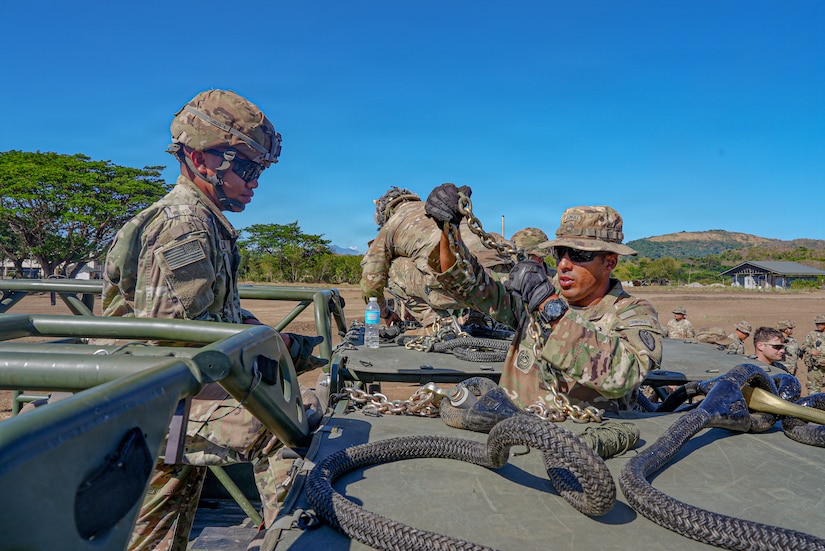
A service member wearing a camouflage military uniform holds a large chain as another service member in similar attire stands on a military vehicle and looks on.
In addition to bilateral operations with the Philippine Army's 7th Infantry Division, JPMRC-X includes the integration of multinational partners from Australia, New Zealand and Japan. This international coalition demonstrates a united, enduring commitment to maintaining a free and open Indo-Pacific region. 

All operations during JPMRC-X are conducted in close coordination with the Philippine government and local officials to ensure the safety of the civilian population and promote the strong, enduring U.S.-Philippine partnership. 

Exercise Salaknib highlights the enduring U.S.-Philippine alliance, enhancing interoperability and readiness through combined arms operations, multidomain integration and humanitarian assistance efforts to support regional stability. 

Department of War Enhances Lethal Strike Capacity Through Partnership With New Entrants

The Department of War has reached new framework agreements with a slate of disruptive new entrants and commercial innovators to aggressively expand the United States military's strike capabilities. Agreements with Anduril, CoAspire, Leidos, and Zone 5 will launch the Low-Cost Containerized Missles (LCCM) program, while a parallel agreement with Castelion advances an initiative to scale low-cost hypersonic solutions. These agreements will rapidly field effective and affordable kinetic mass for the Joint Force at scale, acting directly on the mandate from President Trump and Secretary Hegseth to strengthen America's military with an unequivocally lethal Arsenal of Freedom.

The new frameworks for LCCM will drive a fast-paced experimentation and assessment campaign that will culminate in a Military Utility Assessment by the sponsoring Service Components. Designed to move at the speed of commercial industry, the agreements establish the terms for future firm-fixed-price production contracts. This effort positions the Department to procure over 10,000 low-cost cruise missiles across these portfolios in just three years, starting in 2027. The Department is creating a pathway for rapid and repeatable production of high-volume, lethal strike capabilities. The agreements include firm fixed material-unit costs for production lots in 2027 through 2029.

Concurrently, once Castelion achieves testing and validation, the Department will award a two-year multi-year procurement contract for a minimum of 500 Blackbeard missiles annually, with options to extend for up to five years. To further encourage Castelion's self-funded facility expansion, the Department is actively seeking the necessary authorizations and appropriations to purchase over 12,000 Blackbeard missiles over five years.

Across these framework agreements, several of these new vendors will reach production scale without direct Department investment, reflecting a new model of commercial partnership that rewards speed, innovation, and private sector capital investment.

The experimentation and assessment campaign for LCCM will be led by the Office of the Under Secretary of War for Research and Engineering, with the Army Program Acquisition Executive Fires serving as the transition partner and acquisition lead for procurement. To kickstart this initiative, the Department will procure test missiles from all four LCCM companies starting in June 2026, laying the groundwork for the assessment phase of the program. These agreements were developed in close coordination with the United States Air Force Program Acquisition Executive Weapons, the Test Resource Management Center and multiple components across the War Department, including the Office of the Under Secretary of War for Acquisition and Sustainment.

"We will deliver affordable mass for our warfighters at unprecedented speed," said Under Secretary of War for Research and Engineering Emil Michael. "In concert with establishing a clear demand signal, these Framework Agreements commit American industry to on-time, on-cost delivery and investment in R&D and facilities. This commercial style of partnership is fully aligned with Secretary Hegseth's Acquisition Transformation Strategy."

This approach reflects a deliberate effort to expand the munitions industrial base, working with industry partners capable of delivering lethal capability at the speed required by the Joint Force. It reinforces the Department's staunch commitment to scalable production pathways that can surge when needed.

"Today's announcement is the latest sign that our Acquisition Transformation Strategy is delivering on its promise to rebuild the Arsenal of Freedom," said Michael Duffey, Under Secretary of War for Acquisition and Sustainment. "We are moving beyond the traditional prime contractors to expand our industrial base, accelerating testing timelines, and sending a clear, long-term demand signal to innovative new entrants."

Acting Pentagon Press Secretary Joel Valdez released the following statement:

The U.S. Department of War today is announcing three important personnel decisions that strengthen its leadership team with experienced and dedicated professionals. These elevations reflect the Department's commitment to placing highly qualified individuals in critical roles to advance national security priorities and support the Secretary of War's mission.

Patrick Weaver has been appointed Deputy Chief of Staff for the Department of War.
Matt Dobson has been appointed Senior Advisor to the Secretary of War.
Tami Radabaugh has been appointed Senior Advisor to the Secretary of War.

Each individual brings a proven track record of excellence, strategic insight, and unwavering dedication to public service. Their appointments will enhance operational effectiveness, provide expert counsel on key policy matters, and help drive the Department's efforts to maintain a ready and capable force.